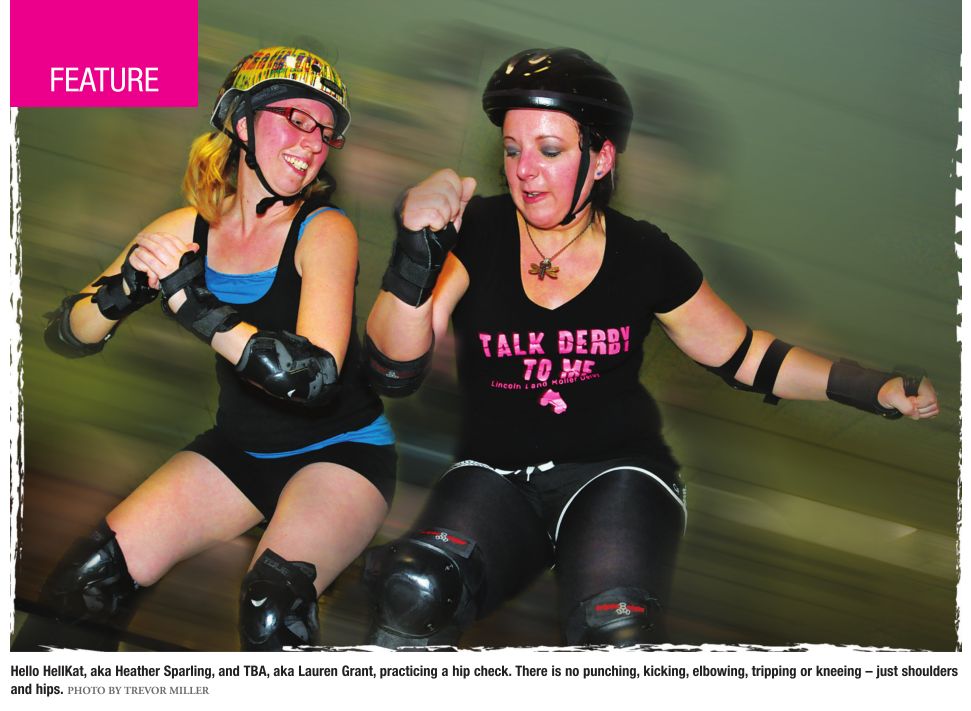
That’s all changed. Today’s roller derby was reborn in 2001, in Austin, Texas, with female competitors bringing legitimacy back to the sport. Its emergence was portrayed in the 2009 film, Whip It.
“Bank track roller derby was an entertainment venture, controlled by an elite few business individuals on both coasts, who took advantage of the players,” said Moore. “They owned the teams, they owned the venue, they owned the concessions. Now, with the Women’s Flat Track Derby Association, they mandate that a team must be majority-owned by women and a two-thirds majority run by women, so they can’t be taken advantage of.”
In its infancy, LLRDL is beginning the process of applying to the WFTDA apprenticeship program. “You don’t just join,” Moore said. New teams must have a mentor team to help them learn the ropes of the WFTDA. “It is quite a process.”
Moore said the league boasts 70 skaters.
Thirty-six of them are skilled enough to earn team member status. As more women improve, more teams will form, allowing for an all-star traveling team. There is a private intramural bout for friends and family set for Dec. 4, with six to 12 charity bouts for 2012 in the planning stages, including several out-of-town bouts. The league practices on Sunday and Thursday in Springfield, and travels to Decatur to practice with that city’s league on Wednesdays.
“The team members have all reached a level where they are proficient enough to actually participate in a bout, which includes the WFTDA basic skills profile. Confidence-wise they are way ahead of the curve,” said Moore.
“Decatur just split into two teams, and Champaign has teams. Chicago has multiple teams, St. Louis, Fort Wayne, Indianapolis, Rockford, Kansas City, Mo., and Kansas City, Kan. Even Berlin, Germany, has a team. Roller derby’s blowin’ up all over, going worldwide.”
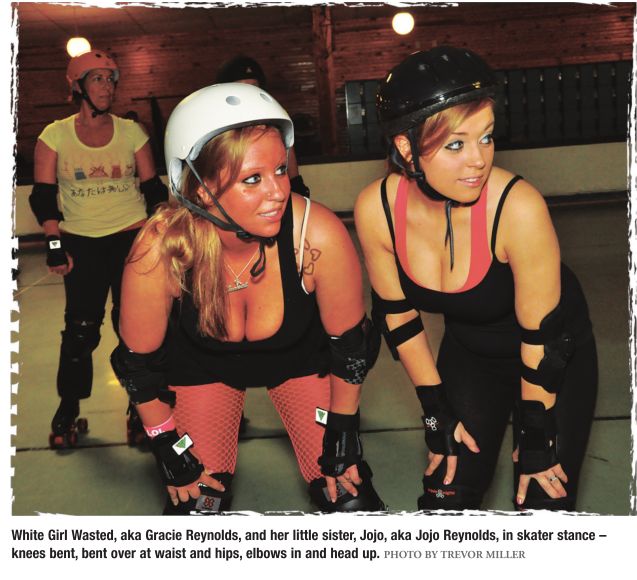
The game itself is relatively simple. Bouts are divided into two 30-minute periods, which are further divided into two-minute jams. A whistle blows to start a jam, and two teams of four blockers each start skating counterclockwise together around a track. When the last blocker crosses the pivot line, another whistle blows and the jammers skate, trying to work their way through the pack from behind. The blockers of each team try to help their jammer while attempting to hinder their opponent’s jammer. Points are scored after jammers work their way through the pack and then lap opponents.