John Patterson, a spokesperson for Cullerton’s office, says the Senate president would vote against SB 512, “but he wouldn’t stop a vote.” Cullerton has also floated the idea of pushing future costs of the teachers’ pensions back onto local school districts, but Patterson says no legislation has been drafted. “It was more of just an idea,” he says.
Problem or crisis?
The directors of the pension systems say the air of panic surrounding the pension problem is an exaggeration of the actual situation.
“I think it’s sensationalist to say there’s an $87 billion hole,” says Timothy Blair, director of the State Employees’ Retirement System, General Assembly Retirement System and the Judges’ Retirement System.
Blair and Teachers’ Retirement System director Richard Ingram emphasize the fact that the unfunded liability never comes due all at once – the more important numbers to look at are the assets and the long-term return rate.
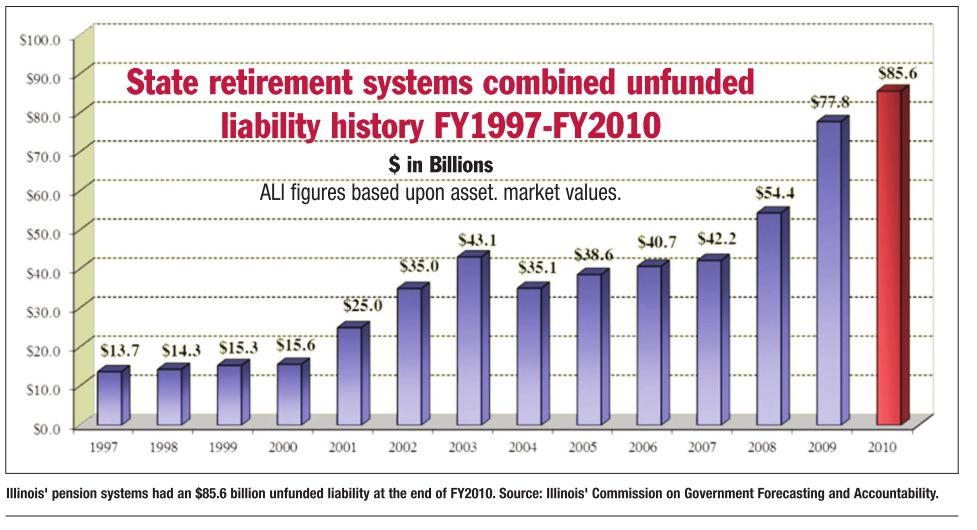
The State Employees’ Retirement System had an unfunded liability of $20.1 billion in FY10 and held $9.2 billion in assets, for a funded ratio of 31.4 percent. SERS that year saw $2.14 billion in revenues through state and employee contributions and investment income, and it paid out $1.39 billion in benefits.
Though the unfunded liability for all five systems at the end of June 30, 2010, was about $85.6 billion, Blair says that number is likely to go down by as much as $10 billion, after a year of more than 20 percent returns on investments. He adds that neither doubledigit gains nor losses (like those seen in FY2009 – a 20.1 percent loss for SERS) in one single year should be viewed in a vacuum.
“Our long-term return has been roughly 8.5 percent. If you do the math on that, even if the state were to completely decide they weren’t going to be in the business of contributing to pensions, our assets would last for decades,” Blair says. “We just need stable funding over the long term.”
TRS’ Ingram issues a similar sentiment.
“Frankly, all of the conversation, every element of SB 512 is focused on benefit reform.
There is nothing in that about funding reform, that guarantees that payments will not be skipped,” Ingram says. “That is what the outside world is looking at Illinois to address. How do you meet your commitments? You’ve made a promise to 370,000 people [in TRS]. How are you going to keep that promise?” Fahner says the idea that Illinois’ pension systems aren’t an absolutely urgent crisis is “nonsense.” “They’re crossing their fingers and hoping to die,” Fahner says. “Their ability to pay is counting on a healthy national economy and a healthy state economy. I don’t know how you see it, but I don’t think we’re at either one of those places today.”
He says that, unless the state pays off its unfunded liability, pension members might as well invest in a Ponzi scheme, in which “investors” are paid back only with new investors’ money. “That’s exactly what is going on here is a Ponzi scheme. … They can deny it all they want, but it’s only a very
short matter of time before some people will not get their benefits.”
House Speaker Michael Madigan’s spokesperson, Steve Brown, couldn’t say if a vote this fall on SB 512 had been planned. “While there’s a desire to move sooner rather than later, there’s no timetable.”
Springfield Republican Rep. Raymond Poe did not vote for SB 512 when it passed out of a House committee last spring. He says he believes the measure is unconstitutional and that “it looks to me like the whole motive of that bill is to push people into a different [tier] than they’re in. … The employees are not the ones who got us into this mess. The state didn’t pay its part.”
Poe adds that he thinks the civic committee’s prediction that, without pension restructuring, the state will end up using 50 percent of its main revenues to pay for pensions is “painting a worst-case scenario.”
“Evidently, they’re down on the U.S.
They’re down on the economy. They’re telling you we’re never going to come back,” Poe says. “I guess I’m a little bit more optimistic than that.”
Poe says he doesn’t expect a floor vote until after the 2012 elections, by which time lawmakers will know more about their newlymapped districts’ constituency, but Fahner says that’s likely not the case. “The Speaker and the leader of his [Poe’s Republican] party are the sponsors of the bill, so if they want to have it called for a vote in veto session, it will be called,” Fahner says.
Still, the measure needs more support in order to pass, he says. “I cannot promise you that we have the votes as we speak, and we don’t, but I believe we will by veto session,” Fahner says. If not, he adds, “The public will be informed. … It’s time for accountability of our legislative members and leaders.”
Contact Rachel Wells at [email protected].