
FOOD | Julianne Glatz
It’s a little gem of a museum, one worth visiting even if it weren’t just a short drive away.
And it’s currently featuring an exhibit that explores the evolution of foods, cooking methods, and eating habits in central Illinois over a period of 180 years.
“Come and Get It! The Way We Ate 1830–2008” will be on display at the McLean County Museum of History (www.mchistory.org) until Jan. 28, 2012. The museum is in the historic McLean County Courthouse at the center of Bloomington’s town square. The private, not-for-profit museum acquired the courthouse in 1987 and utilizes the entire building. It’s a beautiful facility, made with superb craftsmanship of intricate mosaics, mahogany, bronze and marble. And the quality of the exhibits is such that any museum anywhere would proudly display them.
“There’s nothing equivalent to it in central Illinois,” says curator Susan Hartzold. “Because the museum is private, it’s true to the community. It’s more about people than it is about the stuff.”
That’s certainly true about “Come and Get It!” While it’s the “stuff” that’s on display, the exhibit successfully provides visitors a sensual time-trip through Midwestern foodways. As with the museum’s other exhibits, it focuses on McLean County, but of course much is applicable to central Illinois in general.
Central to the exhibit are four kitchens.
The first is a typical Midwestern kitchen of the 1840s. Cooking was done in the fireplace. By the 1880s wood was still the fuel, but cast iron stoves provided a flat surface for pans and better heat regulation. In the 1920s, stoves were fueled by gas, and even had temperaturecontrolled ovens – a huge step forward. There was running water, another vast improvement, as were ice boxes which kept foods cool by means of large blocks of ice.
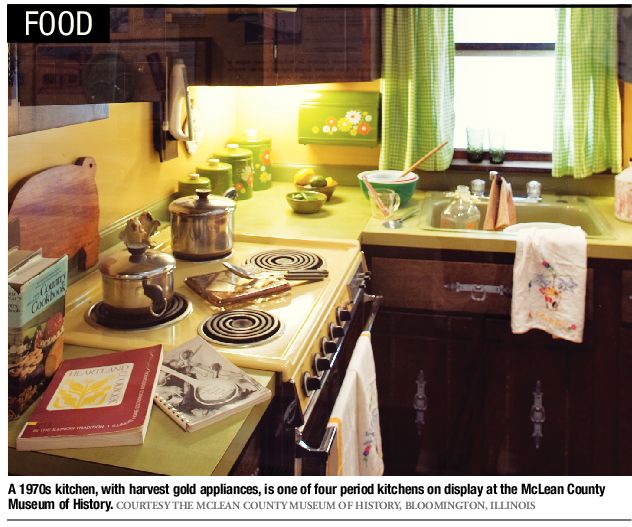
The 1970s kitchen – with harvest gold appliances, of course – has a dishwasher, electric stove and refrigerator with freezer. Other electric appliances have made their appearance: a crock pot, mixer and electric skillet.
Interspersed between the kitchens are displays of the evolution of what foods were eaten and how they were prepared and procured – from hunting and growing-yourown, to specialty markets (butchers, bakers, greengrocers), local food producers and processors, to the rise of supermarket chains. Dining out is explored, from nonexistent in the 1830s, to special occasion only in the late 1800s and early 1900s, to today’s fast food franchises.
For this special project, the McLean County Historical Museum appointed a guest curator, Robert Dirks. He is an emeritus professor at Illinois State University who specialized in the anthropology of food and nutrition for nearly 30 years. Dirks spent more than two years researching and conducting interviews for “Come and Get It!” The essence of the resultant manuscript was developed into a “script,” then Dirks collaborated with a set designer to create the exhibit.
Dirk’s full manuscript also resulted in a companion book that’s due out in print in a few weeks. “Loads and loads of what’s in the book didn’t make it on the walls,” he says.
On June 18, Dirks will lead an all-day tour featuring the “Come and Get It!” exhibit as well as other historic sites of culinary note, most of which are in the book. “I’ll have lots of two cents to throw in,” says Dirks with a
laugh. Sponsored by the Greater Midwest Foodways Alliance, the tour will begin at 10 a.m. at the exhibit (those who wish can arrive earlier for the Bloomington Farmers Market, which is located around the square). Other sites on the tour are:
Lucca Grill (lunch), cited by reviewers for the New York Times and Washington Post as one the best old-time bar rooms in America, was established in 1936. It was the first restaurant to serve pizza in central Illinois.
The 1872 David Davis mansion, with special attention to Sarah Davis’ kitchen and dining room.
Funk’s Prairie Home – in 1910 Funk’s Prairie Home became the first private farm in the United States to have electricity, even before much of Chicago was electrified. Not only did the kitchen have electric light, DeLoss Funk invented an electric washing machine and butter churn for his mother.
Funk’s Grove Maple Sirup: Glaida Funk will host the tour and talk about her family’s sugar camp, which was established in 1824.
RGW Candy Company – Founded in 1942, it was the subject of my 12/10/2008 IT column. Tour participants will not only learn about the company, but have a chance to taste and even help make some candy.
Hallie’s, Home of the Schnitzel. (Dinner.)
A descendant of The Mill’s, a Route 66 iconic roadhouse, Hallie’s is on the square in downtown Lincoln.
The cost for the tour is $30 and includes lunch and all admission. Dinner (which is cash only) and transportation are not included, although the folks at Greater Midwest Foodways will be glad to help pair people to share rides.
For more information or to make reservations by email, go to [email protected] or phone 847-432-8255. If making reservations, include name, address, phone number and number of reservations. Prompt payment confirms the registration. Mail check to: Greater Midwest Foodways, 280 Laurel Ave., Highland Park, Ill., 60035.