Illinois winemaking on the rise
Vines continue to spread across the state
WINE | Zach Baliva
More than 100 years ago, Illinois was the fourth largest wine-producing state in the nation. Now the Treasury Department holds Illinois responsible for just a fraction of the 40 million gallons bottled each month. Other states may have passed Illinois in production, but wineries and vineyards continue to sprout all across the Land of Lincoln. Thirteen years ago, there were 14 Illinois wineries and 150 growers. Now, there are 90 wineries and 450 growers. Several new and established vintners – whose grounds provide many opportunities for budding sommeliers – have set up shop in and around central Illinois.
Loren Shanle turned heads when he converted an old Rochester office into The Walnut Street Winery (309 S. Walnut, Rochester). Shanle’s passion for wine started in 2007 when he received a winemaking kit on his birthday. He made several batches before applying for a license and eventually convincing the dry town of Rochester to let him open shop. Walnut Street houses nine 300-litre tanks that each yield almost 30 cases of wine. Visitors to Rochester shouldn’t expect to witness a harvest, as the small property doesn’t have room for vines or crushing. Instead, Shanle imports concentrate, fills his tanks, adds yeast and makes his special recipes. Although Shanle’s 17 different varieties may overwhelm novice tasters, he offers three tastes for $3 every day. One of his most popular selections is Rosie Red, a black raspberry merlot named after Shanle’s mother.
Walnut Street has an inviting wine garden with a bocce court (summer leagues now forming), a stage for live music, and free Wi- Fi. Shanle serves Coz’s pizza and often grills out in the wine garden. Walnut Street’s wines are sold in Springfield at places like Robert’s Seafood, Party House Liquors, and Famous Wine & Spirits. More information at walnutstreetwinery.com.
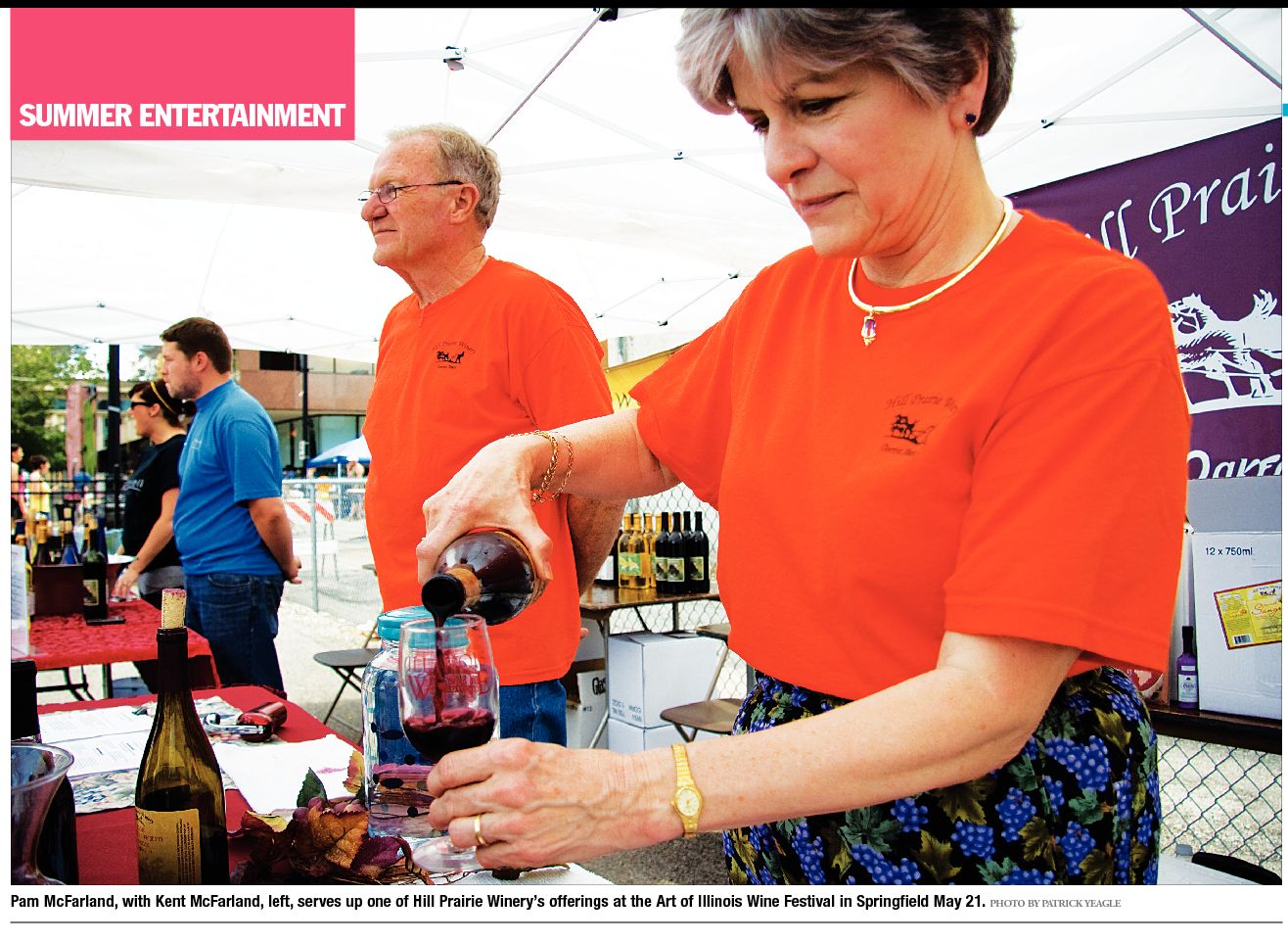
Menard County’s Oakford village boasts a population of 309. The rural setting is the perfect place for the Hill Prairie Winery (23753 Lounsberry Rd., Oakford), where Mark and Connie Lounsberry operate in a structure built by J.C. Lounsberry in 1911. (They’ll celebrate the 100-year anniversary this July with a BBQ fest.) The current owners are the fifth generation to farm the site; they offer family favorites like Prairie Dew, Autumn Spice, Prairie Barn Red and Crimson Moon.
Amid a flurry of new local wineries and vineyards, Hill Prairie stands out as an experienced operation. The nine-acre vineyard opened in October of 2004. A tasting room and several seating areas, including seating for 300 in a new pavilion, provide a welcome respite for guests. There, the family serves a lineup of 15 dry white, dry red and sweet wines (which Lounsberry says Midwesterners prefer the most). As a truly local label, HP wines are made mostly with fruit grown on site or purchased from local growers. This year, Hill Prairie partners with Howell-N- Good BBQ for a new catering menu. Starting in June, the BBQ team will serve food on first Sundays. Popular musicians fill the stage each Sunday afternoon, and Hill Prairie hosts a series of mystery theater shows year-round. Details online at hillprairiewinery.com.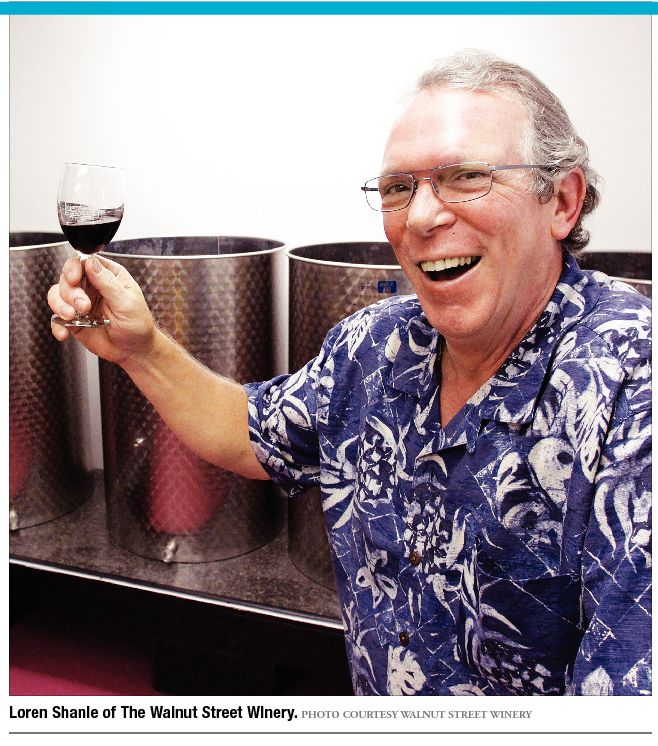
Wine enthusiasts need only travel 40 miles south of Springfield to discover another of Illinois’ most recently opened wineries in Crown Valley’s Wooden Nickel Winery & Saloon (3225 Honey Bend Ave., Litchfield), which celebrated its first anniversary this April. The site is an extension of the Crown Valley Winery in St. Genevieve, Mo., and sells 36 company wines, 5 sparkling wines, 12 beers, 3 ciders, grape juice, root beer and bison meat. While the Wooden Nickel is new to the area, Crown Valley is a well-established Midwestern label whose land is comprised of houses, inns, a restaurant, a brewery, vines and a herd of 350 bison.
Manager Jared Wirth says
his Litchfield facility, built in a 1960s-era barn, is the perfect
setting for a weekday jaunt or weekend getaway. “We’re not a bar, we’re a
destination. People are welcome to come out to the Wooden Nickel for
good live music, great drinks and beautiful scenery,” he says. Back and
side patios abut two ponds and hiking trails, and will provide excellent
views of vines once they mature. Wirth and his colleagues planted 250
vines that will produce in later summers. For now, he performs aging on
site with four vats, a label maker and a corking machine.
Crown
Valley and the Wooden Nickel are owned by Joe Scott of Scott
Properties, who also owns the adjacent Honey Bend Resort, which opened
for limited public use for the first time last year. The campground has
made its menu available to Wooden Nickel patrons. The Wooden Nickel is
open year round and is available for private events. Visit
woodennickelwinery.com for more details.
Long Creek Vineyards (7185
E. Firehouse Rd., Decatur) was launched in 2004 and winemakers Jody
Fisher and Brad Warnick continue to produce several wines with homegrown
grapes. Fisher and Warnick have planted Nebbiolo, Sangiovese, Syrah,
and Viognier grapes and are known for producing awardwinning
Chambourcin, Vidal Blanc, and La Crosse. Go to longcreekvineyards.com
for more information.
The
state of Illinois wine Although the industry’s state funding was cut in
recent years, Illinois stands to benefit financially if local
winemaking continues to flourish. Bill McCartney is the executive
director of the Illinois Grape Growers and Vintners Association
(illinoiswine.com), a nonprofit group formed to promote the wine and
grape industry in Illinois.
Significant
funding from the Illinois General Assembly was eliminated in 2010. In
the current legislative session, funding previously dedicated to the
viticulture and enology specialists and tourism marketing dollars were
included in the House budget, but not in the Senate’s budget. It remains
to be seen whether the Senate will adopt this portion of the House
budget. According to McCartney, the last economic impact study
(2007-2008) revealed that wineries contribute $319 million to the
state’s economy through construction costs, salaries, equipment
purchases and other expenses. Furthermore, McCartney says for every
gallon of wine sold, $1.50 of excise tax goes into the Illinois general
revenue fund. He estimates that every dollar once contributed by the
state was returned to the Illinois budget 10 times.
The
negative impact of budget cuts could be far-reaching; the IGGVA
sponsors seminars, workshops and other events for winemakers and grape
growers. Furthermore, the group retains specialists who assist newcomers interested in starting
small businesses. If funding remains low, fledgling vintners will
instead rely only on the kindness of peer mentors to get their new
companies off the ground.
continued on page 38


