
School turnaround
continued from page 13
Community partners like Eastside Pride and Grace Lutheran Church help the school meet those needs by providing food baskets when school is out and warm clothing when the weather turns cold. Those and other organizations and individuals are also vital to the school for providing mentoring and tutoring opportunities for students having trouble keeping up with their schoolwork.
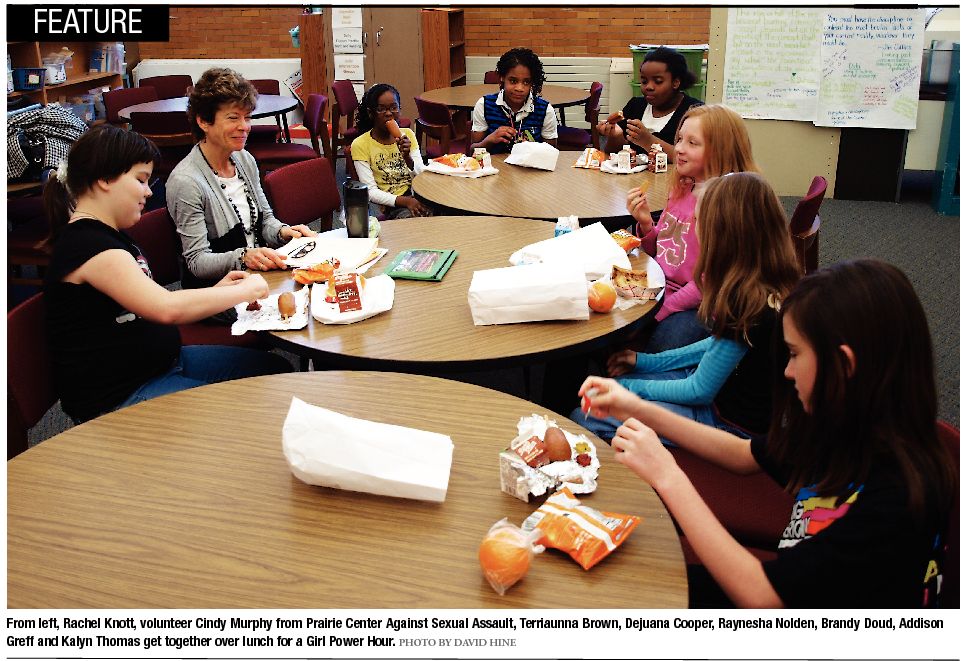
Since she came to the school three years ago, Lovingood has built community partnerships to bring to the school lunch-time programs like PAVE (Project Anti-Violence Education) and Girl Power Hour, which teach girls about self-esteem, and a life skills class for fourth- and fifth-grade boys through the Triangle Center.
In addition, the school sends 15 students to the district’s Saturday school program held five weekends each year at Harvard Park Elementary. For two and a half hours, students receive an education disguised as fun. One Saturday, for instance, they built a recipe. While it was fun, they were also learning critical thinking, math and reading skills. Another district-wide program that McClernand is taking full advantage of is F.A.C.E. (Family and Community Engagement), in which schools each build a team of parents who meet with school administrators to weigh in on school issues and organize programs designed to bring families and community members into the schools, thus paving the way for education to extend into students’ home lives. For McClernand, its F.A.C.E. team is the closest thing it has to a Parent Teacher Organization (P.T.O.).
Partnering with the Springfield Urban League and the Boys and Girls Club, the school also hosts 21st Century Learning, an after-school program funded by the federal government. About 80 students are enrolled in the program and receive an hour of tutoring every Monday, Tuesday, Wednesday and Thursday, before spending another hour gaining exposure to new activities, like volleyball or karate.
“It takes a lot of time to get all these things and it takes a lot of peoples’ time and energy and resources to get everything set up, but we’re dedicated and that’s the key – having that great staff,” Principal Jennifer Gill says, including volunteers and outside organizations in her definition of “staff.”
While community support is an essential element in McClernand’s recent academic success, the primary factor in a successful school is good classroom instruction provided by quality teachers, who are supported by quality leaders such as Gill.
“The teaching is done with great skill and fidelity,” says Kathy Crum, the district’s director of teaching and learning. “The big change that they’ve done is to have really focused intervention blocks in their school. It’s all hands on deck there when the kids are in intervention block.” Intervention blocks are set periods during the day in which academically struggling students break off from the rest of the class to receive individual instruction tailored to their needs.
Every six to eight weeks, McClernand sends substitute teachers into the classrooms to give regular teachers time to analyze data about each student’s academic performance. If they find that a student hasn’t improved in a subject, teachers look for new ways of teaching that topic and reaching that student. The process is generally referred to as intervention, or response to intervention (RTI), a method focused on early detection and correction.
“They (teachers) are just willing to try things and if that doesn’t work, they’ll try something different,” Crum says. The focus on intervention is so strong and students feel the benefits so much that they’re eager for that part of their day, she adds.
Marie Schroeder’s third-grade grandson transferred to McClernand as a second grader. When he first arrived, he could only read 16 words per minute. After a year of specialized intervention – 30 minutes of additional reading every day and a private tutor paid for by the school with federal funding – her grandson was reading 98 words per minute. “It was a partnership between the school, tutoring the school district offered and the work at home,” Shroeder says.
Schroeder appreciates the welcoming atmosphere the school exudes. About a decade ago, she transferred her own children out of McClernand, in part because she didn’t feel like her efforts to be more involved were welcome. That’s certainly not the case any more.
“Their policy is [for parents] to drop in at any time, and I do,” Schroeder says. “When you walk in the door, someone always greets you. The principal knows your name. All of the teachers are very responsive.”
She lists a number of programs – such as Muffins with Mom, in which mothers can eat breakfast with their child at school – that provide some parents with an opportunity to view school in a new light.
“I think in low-income schools, a lot of parents had a not-so-good experience at school themselves, so it’s hard to get them in the door. They’re afraid to come in,” Schroeder says about lack of parent involvement. “Once they get in and see how it is, they come back. The problem is we have to get them in the door first.”
With that in mind, Gill says one of the benefits of after-school programs that provide both academic and recreational activities, such as 21st Century Learning, is that parents have to come in to pick up their children. “So they’re getting a personal connection with our school every day when they are greeted by staff and have time to look at the things we have posted in the hallways,” Gill says.