
Overcoming the odds
Partnering with the Springfield Art Association is just another building block on top of several the school has already put into motion to provide its high population of mobile, lowincome students with a quality education.
Along with a high low-income rate, McClernand hosts the highest “mobility” rate of any District 186 elementary school. A student is designated as mobile if he or she transfers in or out of a school during the school year. Every year since at least 1999, McClernand has had a mobility rate ranging anywhere from 36 percent to nearly 55 percent. Often, highly mobile students move because their parents miss a few months’ rent, forcing them to move across town. Sometimes the cycle repeats itself and a student changes schools over and over again.
All of that change is hard on both teachers and students, who have to build new relationships and make sure incoming students are on the same track as the rest of the classroom.
For years the district has tried to align curriculum across the schools so that students transferring from one school to another midyear will only be a day or two behind their peers. Still, change is hard.
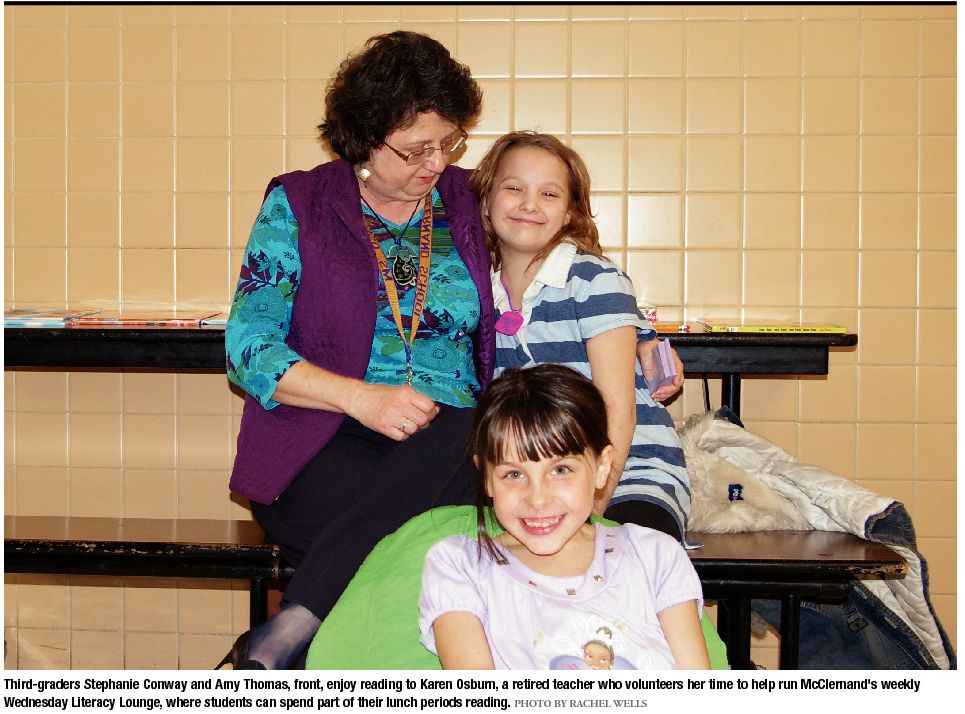
Amy Thomas, a third-grader who came to McClernand last year, seems to have adjusted well and she likes her new school – “They have real cool food, you get to read a lot and they have cool teachers,” she says, as she takes a quick break from reading Eloise and the Big Parade during her lunch period. But she adds that she misses her friends from Ridgely Elementary.
For teachers, it’s a matter of having enough materials on hand to accommodate new students and of managing a classroom that’s always in flux. “You just start from scratch and get to know that kid pretty quick,” says Wendy Flach, a fourth-grade teacher, who this year has seen two students leave her class. The school as a whole from October to February is showing a mobility rate of about 18 percent, with two students who since the beginning of the school year have left and returned and three new students who had been to McClernand in previous years.
“I think sometimes they get used to it,” says Flach, adding that returning students are common and sometimes easier to accommodate than brand new students. “We already know them, we already know their families and we don’t have to rebuild those relationships.”
To help combat the problem of mobility, Congress in 1987 passed the McKinney-Vento Homeless Assistance Act, which requires all schools to bus to their home school all children who become homeless. This year, McClernand is providing that service to between five and 10 students. As an extension of that, District 186 is allowing students who are forced to move out of McClernand’s residence boundaries to remain at McClernand if their parents can provide transportation for them. This year, of about 30 transfers into the school, 21 of them are students who were attending McClernand already but whose families moved outside of McClernand’s regular boundaries.
On top of mobility problems, McClernand is dealing with an extremely high low-income rate, which can manifest as poor student behavior and a lack of parental involvement. Supported by the district, McClernand understands that parents aren’t always able to overcome on their own the obstacles presented by their economic status, so the school is working on multiple fronts to help students as well as their parents.
Parent educator Nicolette Lovingood, who splits her time between McClernand and Wanless Elementary School, works to keep parents involved by checking in with them either by phone or a home visit. If parents need a ride to a parent-teacher conference, she makes sure they have one. If a child shows up to school sleepy and hungry, she finds out why and figures out a way to help parents make the situation better.
“If you provide a good support system for the parent, especially if they really want it, the child tends to do better,” Lovingood says. “The parent tends to focus more on what the child needs because their own needs are also being met, and then the child does better in school.”