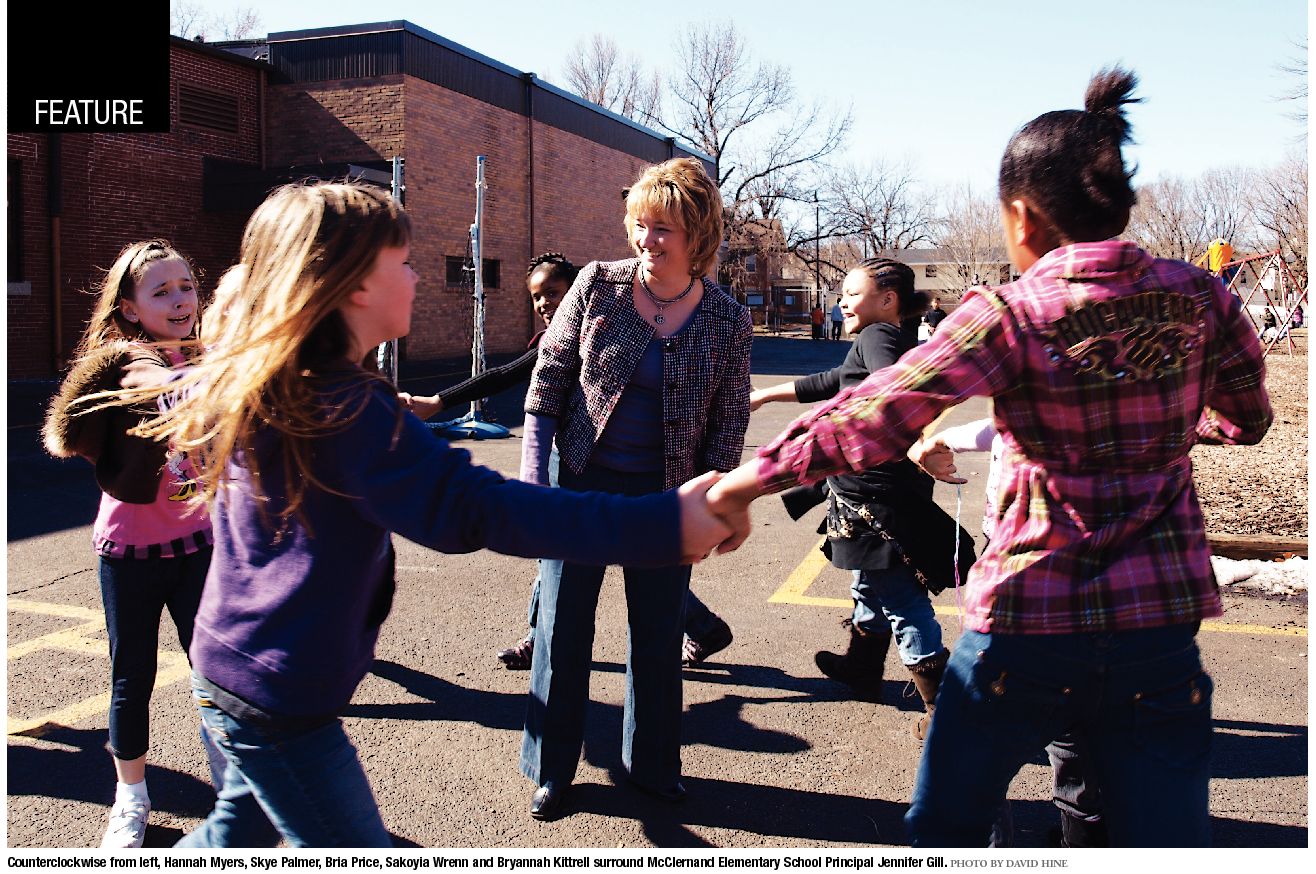
School turnaround
Partnerships make the difference at McClernand Elementary
EDUCATION | Rachel Wells
When Springfield Art Association director Betsy Dollar moved to town a little over a year ago, she learned early on of the poor reputation of McClernand Elementary School, the building at North Sixth Street and Enos Avenue directly across the street from her organization’s headquarters. Ninety-four percent of the school’s students are considered low-income, about 47 percent of its students transferred in or out during the 2010 school year and the school consistently scored low on standardized tests.
“I was just told that it was this absolutely struggling school that had a pretty poor reputation, partially because of the incredibly high transient rate of the neighborhood and how kids are in and out of there.” Appealing to Dollar was the idea of turning the school into an arts-focused magnet school to breathe new life into both the school and the neighborhood. But she soon learned that the school was already on an upward path and that the snapshot statistics weren’t really telling the whole story.
Indeed, the school’s reputation is a remnant of problems that the school, which hosts about 280 students in pre-kindergarten through fifth grade, is now successfully overcoming. In the spring of 2008, only 43 percent of McClernand students met and exceeded Illinois Standards Achievement Test (ISAT) standards in reading, compared to 64 percent district-wide. Also in 2008, only 53 percent of McClernand students were meeting and exceeding standards in math, compared to 69 percent district-wide. Last year, McClernand’s numbers were up dramatically, to about 61 percent in reading, an 18-percentage point difference from 2008, and to about 76 percent in math, a 23-percentage point difference from 2008. District-wide, 64 percent of students in reading and 69 percent in math met and exceeded standards during 2010 testing.
As a result of its increased scores, McClernand has earned an Illinois 2010 Academic Improvement Award. The upward trends should be credited to increased community and family involvement, a team of dedicated teachers and a commitment from the school to use student data to help individual students, says Principal Jennifer Gill, who took the helm at McClernand in fall of 2008.
“I think maybe three or four years ago, what I was told was true,” Dollar says about McClernand’s reputation. “But they really have gotten in there and made huge changes. Now they just have to have more support in terms of implementing what they’ve already got going.” With that in mind, Dollar has ditched the magnet school idea. “I’m much more inspired to support what they have in place and elaborate on that than try to impose anything from the outside,” she says.
Instead, the Art Association is working with Gill and a handful of McClernand teachers to build a strong partnership that can compliment the many other community relationships that have become integral to the culture at McClernand Elementary.
While still in the early stages of building programs, a team of teachers is working with Dollar to develop ways McClernand can benefit from the resources of the Art Association – from more space in which to create, to new types of materials, to resident artists’ expertise. Dollar wants to help students create community art installations that instill pride in both students and the surrounding community, to help host Saturday Academies that are both fun and educational for students and their families and to help teachers think of ways to integrate the arts into daily instruction.
“Art is very hands on,” says Sarah Bentson, one of two teachers who provide each McClernand class with one hour of art every week. “I think it motivates kids when they’re not just sitting and doing work on paper.”
“Art
takes such a bad rap as being frivolous when in fact it teaches
incredible critical thinking and hierarchical thinking skills,” Dollar
says. “Creating a picture doesn’t just happen. Every single movement of
the crayon or the pencil or the material across the page is a decision
toward achieving a final goal.”
Integrating
art with core subjects, Bentson and Dollar add, can also make reading,
writing and arithmetic more accessible to students who find those
subjects difficult. “It’s another way to reach those testing goals.”


