
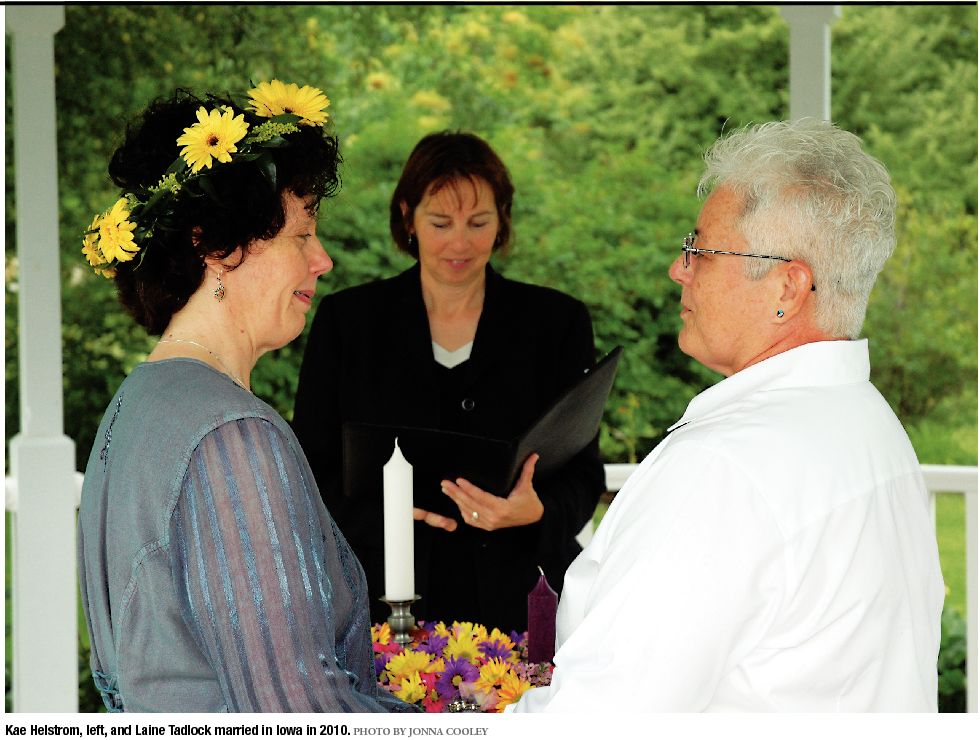
All but married
continued from page 11
Even at the state level, Illinois’ civil union law creates a separate, however equal, institution for same-sex couples.
“We’re making available civil unions to gay and heterosexual couples, which we think is great,” says John Knight, director of American Civil Liberties Union of Illinois’ Lesbian and Gay Rights/AIDS Project. “But only different-sex couples are given access to the more esteemed recognition, the relationship of marriage. Ultimately, we think that is something Illinois should make the same.” Illinois has a law defining marriage as a relationship only between one man and one woman. In all other state-level aspects, a marriage and a civil union in Illinois are exactly the same. As of June 1, same-sex couples in a civil union will be subject to all 648 laws and regulations in Illinois that now only apply to married couples.
Those legal protections have been at the heart of LGBT activists’ push for civil unions in Illinois, Knight says. But also important is the social legitimacy the government institution can bring to same-sex relationships – those relationships are the main fuel for the discrimination and bigotry that gays and lesbians experience.
For Doug Gamble, a 57-year-old Springfield resident who spent decades repressing his gay sexual orientation, the passage of civil union legislation in Illinois has reinforced his decision to “come out.” He only began telling people he was gay about one year ago. “It was a very important thing to me, being relatively new to the gay and lesbian community, to realize that society was finally coming around to accept all people. It’s not there yet – we’d like to see gay marriage – but it’s a wonderful start,” Gamble says. Now, he’s serving as the civil unions coordinator for Heartland.
Metropolitan Community Church, which already has had five same-sex couples asking about having a civil union ceremony after the legislation becomes effective this summer.
“To have that recognition is a sign for many of us in the community that we are worthwhile in the eyes of the law too,” says Gamble’s pastor, Tony Thieman-Somora, who married his partner, Tony, in Iowa more than a year ago.
Prior to civil unions becoming an option for gay and lesbian couples, in order to have the same rights and protections as married couples LGBT couples had to spend hundreds or thousands of dollars for a lawyer to create documents ranging from a will to powers of attorney. Married couples only have to pay for a single marriage license for automatic protections such as hospital visitation and inheritance rights.
Besides the cost, putting two lives in legal order takes time and energy, the very things that have kept Buff Carmichael from obtaining all of the recommended legal documents.
Carmichael is a Springfield resident and publisher of the now-shuttered monthly LGBT newspaper the Prairie Flame. “It’s too costly, too much trouble, procrastination, all sorts of things,” he says about the fact that he and Jerry Bowman, his partner of nearly 20 years, have only gone so far as to write wills and put property in both their names.
The 63-year-old Carmichael says end-oflife issues are a major reason why he and Bowman are planning on entering into a civil union this summer. “None of us plans on being in a hospital or dying in the next week or two, but you never know.”
Laine Tadlock of Springfield married her same-sex partner, Brenda Thompson, in Massachusetts in 2004. The following year, Thompson fell ill and entered the hospital, where later her heart stopped beating and she no longer could breathe on her own. “She never came out from that,” Tadlock says. “It totally fried her brain.” Thompson could have lived, but she would have been in a vegetative state. Because Tadlock and Thompson had already gone to the effort of drawing up medical powers of attorney, Tadlock was able to participate in the decision to remove life support. “I wouldn’t have been involved in it if we had not had power of attorney,” she says.

Illinois’ new civil union law will mean couples won’t have to have powers of attorney to visit their partner in the hospital or make medical decisions for them, as long as they remain in Illinois. Though not exactly a weakness in Illinois’ law, it is a problem that Illinois’ law lacks portability – a valid civil union license in Illinois isn’t valid in other states, unlike a marriage certificate. “If you have a civil union in Illinois, it’s not going to be recognized in most other states in the country,” Knight says. Because other states don’t recognize Illinois’ civil unions, gay and lesbian couples must still go to extra legal trouble to ensure they have the same spousal rights while traveling out of state.
Knight also recommends that gay and lesbian couples who’ve been granted a civil union and who have children go through second-parent adoptions to ensure both parental relationships, including that of the non-biological parent, are recognized outside of Illinois. Prior to civil unions, even for such power within the state, second-parent adoptions were necessary for gay and lesbian couples. Now, however, a civil union spouse will be treated as a married spouse in terms of adoption, though Rhonda Jenkins, a Springfield lawyer and member of the LGBT community, says she’s curious to see how the law will be implemented.
Unlike Faupel and Frain, who adopted their daughter from Guatemala, most of the same-sex couples Jenkins has helped through adoptions have been two females with one woman carrying the child through pregnancy. Although the decision to conceive was a joint decision, the non-biological mother still had to go through an adoption process, even if she signed the birth certificate, Jenkins says. She explains that any child born to a couple during its marriage is presumed to be a product of the marriage, whether the mother conceived with someone who was not her husband or the couple conceived through artificial insemination. Only by positively establishing that the husband is not the father by identifying the real biological father is that presumption denied.
“If a child is born during the course of a same-sex civil union, are you going to have the presumption that that child is the biological child of both parties? Well, the biology isn’t there. Essentially, we know that is anatomically impossible, so it’s going to be real interesting to see how that shakes out. It’s still an open question,” Jenkins says.
For Tadlock, she’s wondering what will happen to her pension. Having retired as a public school educator prior to Illinois’ civil union law, Tadlock withdrew her survivor benefit years ago so that, if she died, her partner could benefit from her years of contributions. “When I retired early, I took out my survivor benefit because I was never thinking in my lifetime that it would be possible for my partner to get my benefit, my retirement, when I am deceased,” Tadlock says. “Now that’s changed.”
When Tadlock’s first wife, Brenda Thompson, a well-known Springfield police officer, died, the city of Springfield did what Tadlock believes was a precedent. “They didn’t give me her monthly retirement, but they gave me pretty much most of what she had paid into retirement. … She was so wellliked, I’m guessing that was one of the things that swayed the decision.”
Others across the state in situations similar to Tadlock’s haven’t been so lucky, say civil union supporters. Now, however, anyone joined through a civil union will have automatic access to a spouse’s state pension and health insurance. All Illinois employers will have to extend any benefits provided to a married person – from leave of absence to health insurance benefits – to anyone in a civil union.