
FILM | Chuck Koplinski
A poll I read some years back showed that the number one fear of most people was having to speak in front of a crowd. This is a completely justified response. Now imagine having to do so though you suffer with a nearly debilitating stammer and that your words would be broadcast to thousands via a new form of media technology.
Thus was the case with King George VI, a man who was never meant to be England’s monarch but found himself thrust into that position with his nation on the brink of war. The second son of King George V, the crown rested briefly on the head of his elder brother, King Edward VIII, who took the unprecedented step of abdicating the throne in order to marry an American divorcee, though an argument could be made that he foresaw the trouble Hitler was creating and he wanted to get out of the royal kitchen before things got too hot.
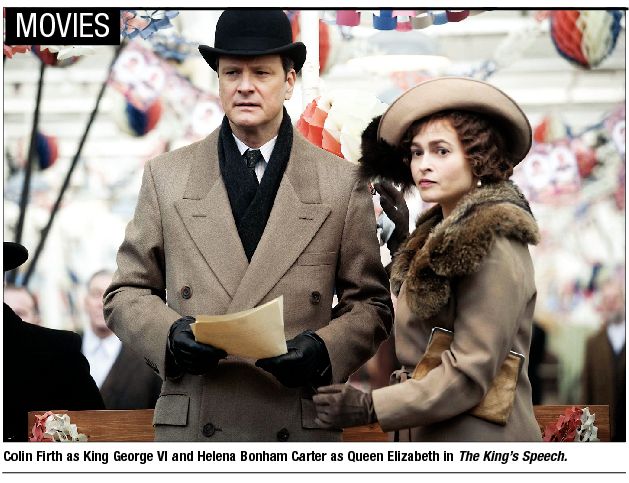
While this is the setup of Tom Hooper’s compelling and poignant The King’s Speech, it’s the extraordinary efforts the king goes through to tame his stammer and the unusual friendship that develops from it that gives it its heart. At the urging of his wife, the Duchess of York who becomes Queen Eliabeth (Helena Bonham Carter), her husband, Prince Albert (Colin Firth) – later King George VI – reluctantly falls under the tutelage of speech therapist Lionel Logue (Geoffrey Rush). Unorthodox in his methods and his manner – he insists on being treated as an equal when they are in session – these two enter into an arrangement that proves beneficial for both in unexpected ways.
There is wonderful interplay between the two leads as well as a moving narrative. Firth’s Albert is withdrawn, self-conscious and angry, while Rush’s Logue is outgoing, a bit of a ham and hopeful. These two play off each other masterfully, one never trying to top the other but sharing the screen in a way that allows them both to shine. They both know the story is compelling, full of quietly moving moments that cannot be obscured. Firth is heartbreaking as he brings Albert’s struggle to life, paralyzed by his own fears. Rush is equally good, steady and assured throughout, delivering a performance that brims with confidence and good cheer.
Perhaps the most fascinating moments in the film are the quiet ones between the king and the Australian commoner who would ultimately help him communicate with the masses. Their time together comes to resemble therapy sessions in which Albert reveals his true self. Social stations are ignored, cultural differences are put aside and two men confide in each other in a way that reflects the trust that’s grown between them. While The King’s Speech is ostensibly about Albert’s efforts to overcome his stammer, thematically it addresses the relief that comes in finding someone with whom we can speak to freely and honestly, a rare gift indeed.
Contact Chuck Koplinski at [email protected].