
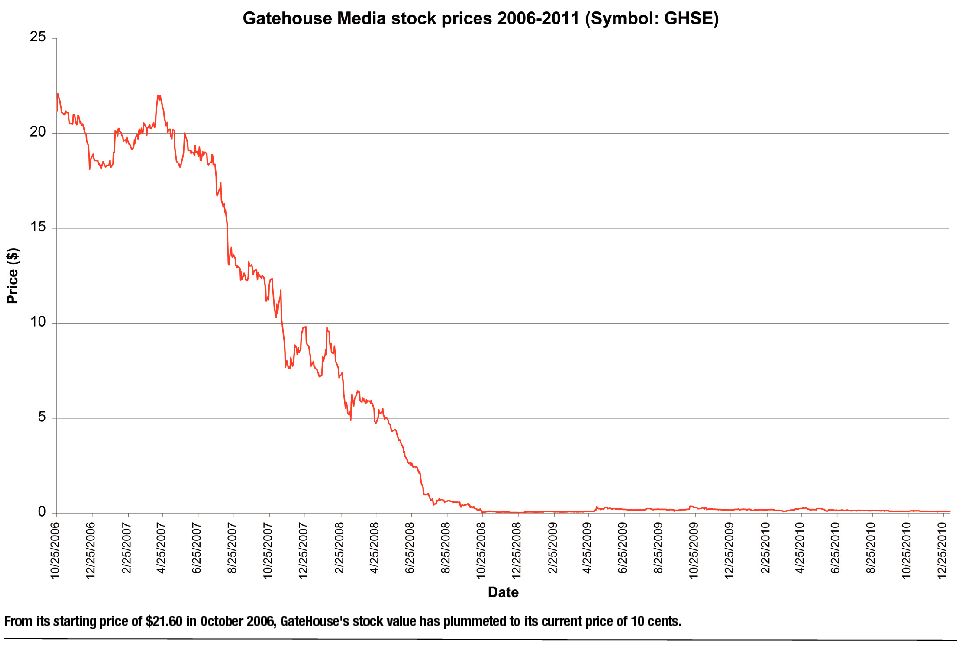
Since becoming a publicly-traded company in 2006, GateHouse has seen its stock plummet from about $21.60 in October 2006 to its current price of only 10 cents. The company’s revenues have also fallen drastically. According to filings with the SEC, GateHouse’s revenues fell by 13.8 percent in 2009 compared to 2008, putting their total revenue for 2009 at $585 million. The company’s reported net loss for 2009 was $530.6 million, according to a press release from GateHouse. The company’s most recent quarterly filing with the SEC shows revenues of $137.9 million in the third quarter of 2010, down 4.8 percent from the same quarter in 2009. The 2010 fourth quarter and annual report has yet to be filed.
“The newspaper industry and the company have experienced declining same store revenue over the past few years,” says GateHouse’s third quarter SEC filing. “This has led to increased losses, reduced cash flow from operations and the need to record impairment charges for certain long-term assets. It has also made it more difficult for us to meet certain debt covenants and has eliminated the availability to us of additional borrowings....”
Indeed, GateHouse’s credit rating was downgraded to “below-investment grade” by both Standard & Poor’s and Moody’s Investors Service in 2008 and was further downgraded in 2009 and 2010. The company also reports carrying $1.2 billion in long-term debt – more than twice the value of the company’s total reported assets.
Despite GateHouse’s heavy debt and extended season of losses, the company paid large bonuses to its top executives in 2009. GateHouse CEO Michael Reed received a $500,000 bonus, which was equal to his salary that year. Altogether, the company’s top five executives received $1.1 million in bonuses, atop their collective $1.7 million in salary payments. Bonuses for 2010 will likely be announced in March 2011.
GateHouse’s financial trouble has burdened the State Journal-Register with reorganizations and vacant positions, say current and former employees. The size of the paper’s newsroom staff has decreased in recent years, due mostly to workers who left not being replaced. In 2007, before GateHouse bought the paper, there were 68 newsroom employees, including newsroom editors, clerks, photographers, graphic designers, columnists and reporters, according to interviews and employee lists reviewed by a former employee at Illinois Times’ request. A count by the same former employee this month showed 52 newsroom employees at the paper. In the state capital, where important political litigation is regularly filed in state and federal courts, the only daily paper doesn’t have a dedicated courts reporter. One former SJ-R employee, who requested anonymity, says the real effect of the attrition is a loss of specialized coverage.
“Clerks are writing ‘news stories’ for the web; classified people take obits,” the former employee says. “There isn’t really a permanent courts reporter or a solely dedicated police reporter. Positions are now split between several things. This leads to a loss in coverage of meaningful issues and an increase in pre-planned fluff. The front page ‘centerpiece’ story is planned out days in advance. Rarely is it scrapped for real news. It’s disheartening.”
Meanwhile, the paper is working to move its printing operations to Peoria, to the in-house presses used by the GateHouse-owned Peoria Journal Star. That consolidation is expected to eliminate 32 full-time and 32 part-time positions, according to an SJ-R announcement.
GateHouse has come under investigation by the U.S. Department of Labor for failure to contribute to the company’s employee Retirement Savings Plan in a timely manner. A Department of Labor spokesman would not comment on or even confirm or deny the investigation, but documents obtained by Illinois Times show contributions to employee 401k plans were not deposited on time for about two years, from 2007 to 2009. It is unclear whether any deposits at all were made during this time, but the documents show GateHouse made a corrective deposit to employee accounts in July 2010 after working with the Department of Labor to determine how much was owed.
A telephone message seeking comment from SJ-R publisher Walt Lafferty was not returned. SJ-R executive editor Jon Broadbooks refused via telephone to discuss any issues regarding the SJ-R.
“Due to the fact that we have had problems with accuracy with Illinois Times in the past, I’m not going to comment,” Broadbooks said. “If we have something to say, we would say it in our pages.”
While several current and former SJ-R employees declined to speak to Illinois Times on the record – some out of fear for their jobs and others out of respect for a publication they hold dear – one former GateHouse employee who now competes with his former paper in Missouri had little hope that GateHouse’s fortunes would change.