“It was built in 1926 and had always been a community market, although the quality had gone down – it was just a convenience store,” Lipton says. “It would probably turn into a bank or shoe store. And I really believed it needed to stay a community market. Lipton and her husband Randy purchased the building and first finished the second floor, from where Randy helps with accounting and bookkeeping and runs his real estate business.
Lipton had formed the idea of a general store, but not kitschy-nostalgic. “It was about what I needed from a community store, about kids, and about food that’s local, healthy and joyful.” Lipton’s initial vision of WH continues to evolve: “We’ve been very fluid in allowing it to emerge,” she says. “Initially there wasn’t supposed to be inside seating, but people just liked hanging out here, so we added tables.”
A visit to Winslow’s Home is worthwhile for shopping, eating, or simply reveling in its ambience. (It’s at 7211 Delmar Blvd., St. Louis. 314- 283-3964, www.winslowshome.com) Unlike Winslow’s Home, Salume Beddu’s intriguing name doesn’t match its exterior in a small Hampton strip mall. Inside, though, visitors find a small, well-appointed shop that local food periodical, Sauce, calls “St. Louis’ premier artisanal salumeria.”
What’s a salumeria? Basically, a place making Italian-style salume, a category of cured meats and sausages that goes far beyond (though including) American “salami”. Methods and recipes for salume (and French charcuterie, German wurst, and other preserved meats worldwide) developed in prerefrigeration times as a way to preserve meat.
The word derives from the Latin sal (salt), one of the most common and ancient ingredients used. Though they began through necessity, cured and preserved meats endured because of their deliciousness.
A decade ago, small salume/charcuterie makers, along with local butchers, seemed on the verge of extinction. These days, however, top chefs and a new generation of artisans are sparking a renaissance of the old art.
Salume Beddu (Sicilian translation: Beautiful Salume) co-owners Mark Sanfilippo and Ben Poremba are part of that renaissance. St. Louis native Sanfilippo graduated from college with a philosophy degree emphasizing German literature. But his Sicilian family background had giving him an interest in cooking and salume; in 2002 he moved to Los Angeles to work in Osteria Mozzo, a restaurant making its own salume. “I started making my own stuff, turning a closet in my small apartment into a curing chamber, which didn’t make my wife too happy.”
In 2007, he returned to St. Louis. “All the good pork in LA comes from the Midwest,” he says. “I wanted to get closer to that pork… and my family was here, too.”
The week he moved back, he built a curing chamber in his basement. Shortly after, a former professor introduced him to Ben Poremba.
Poremba had emigrated to St. Louis from Israel as a teen, been a student in Slow Food’s Italian University of Gastronomical Sciences 2004 inaugural class, and, incidentally, Winslow’s Home’s first chef.
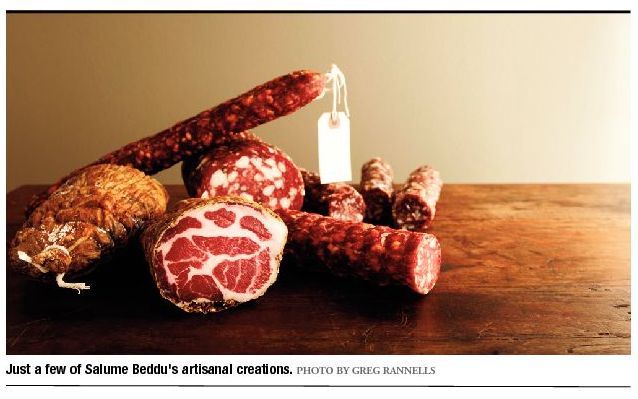
Initially they sold their products at area farmers markets, opening Salume Beddu last May. It’s worth noting that the kitchen and curing facilites are larger than the retail area. Sanfilippo is in charge of the cured meats, a rotating, expanding list including three kinds of coppa, soppressata, pancetta and two kinds of fresh salsiccia. Some seasonal sausages have waiting lists, such as unctuously delectable cotechino, traditionally poached with lentils (I ordered two). Poremba makes occasional pâtés and confits, accompaniments such as eggplant caponata, cannellini bean spread, mostarda (a traditional mustard/fruit “chutney”) and is responsible for décor and the small, thoughtful selection of cheeses, dried pastas and beans, tableware and cookware. Gift boxes, salume platters, and pasta bowls (a pottery bowl, dried pasta, cooking utensils, and appropriate salume and cheese for the included recipe) are available.
Sanfilippo and Poremba will happily explain, recommend, offer cooking suggestions and advice – and lots of free samples of their uniquely traditional products. 3467 Hampton Ave., 314-353-3100, www.salumebeddu.com.
Contact Julianne Glatz at [email protected].


