An exercise in empathy
Getting ready to take the Food Stamp Challenge
REALCUISINE | Julianne Glatz
Hello, Ms. Glatz: I recently got a letter from the Central Illinois Foodbank, inviting us to participate in a statewide hunger challenge to simulate the assistance food stamp users receive. The challenge is to eat on $4.50 a day for one week starting Sept. 19. I thought you might have some insights on how to make this challenge easier. There’s even a section to submit recipes that cost no more than $1.50. I plan to participate in and blog about the challenge each day, and I would welcome your advice. (If nothing else, at least I’ll save some money!) Patrick Yeagle
Hi, Patrick –Yes, I do have ideas, and I would REALLY like to talk to you about this. BTW – please call me Julianne.
Some of the ideas Yeagle, IT staff reporter, and I talked about were mine. Others came from a book I’d coincidentally just read, and a 1970s cookbook a friend had recently left me.
On A Dollar A Day was written by Christopher Greenslate and Kerri Leonard. The California high school teachers decided to embark on a month-long experiment: spending no more than one dollar apiece on food per day, which is all that “a large portion of the world” has to spend.
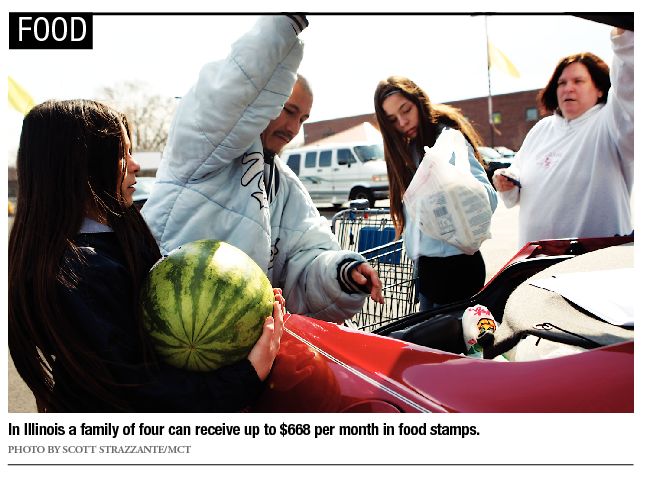
Next they challenged themselves to a month of spending only the average amount someone on food stamps has to spend on food and beverages. For Greenslate and Leonard, that was $4.13 – a huge step up from a dollar a day, but as they found, still far from adequate. Food stamp programs are now known as SNAP, Supplemental Nurition Assistance Programs. As the name indicates, the program assumes that participants will have some of their own money to spend on food, which is included in the $4.13 and $4.50 figures. But many of America’s poorest citizens lack any additional money to spend towards food beyond food stamps.
Using the insights they gained from those two months, the couple formulated an eating plan. They’d be mindful of their spending, but not have a strict dollar amount. They’d eat as healthfully as possible, and buy as much food as possible that was fair trade and organic. They’d also strive to eat reasonable-sized portions.
On A Dollar A Day is both a journal, with alternating chapters written by Greenslate and Leonard, and a primer on hunger and related food issues in the world, and especially in America. Outright starvation is relatively rare here, although certainly not unknown. Far greater is “food insecurity” – the uncertainty that some days and for some meals, there won’t be adequate food.
During their month on the food stamp budget, Greenslate and Leonard also decided to follow the USDA Thrifty Food Plan (TFP) as closely as possible. The Thrifty Food Plan’s goal is admirable: to help low-income households to get the most nutrition from, and most effective use of, food stamp benefits. It’s intended as a guideline, and includes two weeks of menus, 40 recipes and a shopping list.