
Who says there’s nothing to do in Springfield? Not anyone who reads the weekly IT calendar section, for sure. And if that weren’t enough, the IT special edition guides – fall, summer, holiday, etc. – offer even more possibilities and insights.
But just in case there are any doubters among local food/culinary enthusiasts, a trifecta of intriguing food events will take place on Saturday, Sept. 11: a class on home cheesemaking, an oyster and beer festival, and the annual Hope School Celebrity Chef Benefit featuring four-star Chicago chef Curtis Duffy.
It’s especially nice to have so many things to look forward to on Sept. 11, which happens to be my birthday. It’s not been fun having a birthday on a day of national mourning. I don’t mean to whine about it – nothing I’ve experienced could even remotely be compared to the suffering and trauma experienced by the 9/11 victims, their families, New York City and the entire nation. Still, too many times I’ve heard “Your birthday is 9/11? That’s a bummer!” from folks perusing some form I’ve filled out or looking at my driver’s license (sadly, not to check if I’m over 21).
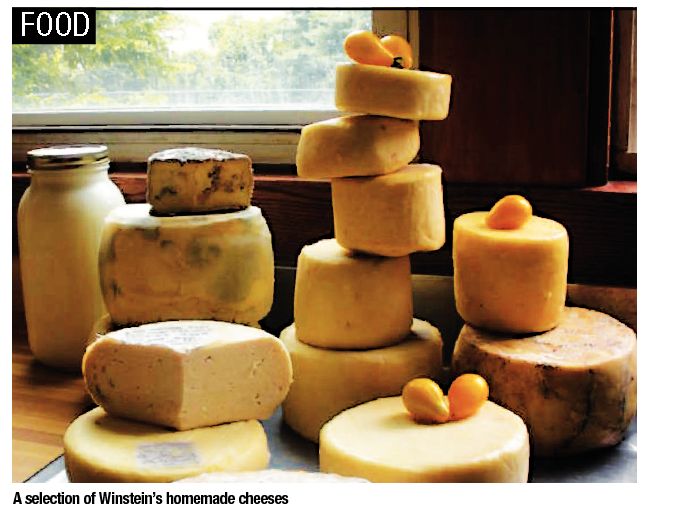
Event #1: Merryl Winstein will teach an all-day, hands-on cheesemaking class in Springfield. Winstein lives in Webster Groves, a leafy St. Louis suburb. She’s been raising goats in her backyard for 17 years and making cheeses from their milk, and eventually cow’s milk, for almost as long.
“But at first they didn’t turn out very well,” she says. She read as many books on cheesemaking as she could find: some specifically about home cheesemaking, as well as agricultural college textbooks – at least those published before the 1970s. In the seventies, college courses began focusing on large-scale commercial production. Earlier textbooks were geared to small-batch production on family farms.
Despite all her reading and experimentation, Winstein continued to be frustrated with the cheeses she was producing. Eventually she concluded that some of the information was just wrong – especially in books geared to home cheesemaking – and virtually all of it was inadequate.
“The books weren’t cutting it,” she says.
“Then one day I realized that those textbooks were meant as an accompaniment to a professor demonstrating the methods and techniques. And I decided that I needed to watch cheese being made in a class instead of just reading about it.”
Winstein traveled to Massachusetts to take an advanced class at the New England Cheesemaking Supply Company. Six months later she enrolled at the Vermont Institute for Artisan Cheesemaking in Burlington. “They teach a three-week series, and you could take all three weeks at once, or do one week, then come back for the second and third weeks at different times,” Winstein laughs. “I was going to do it that way, but as soon as I got home after the first week, I turned around, went back, and took the whole series at once.”
She had found the missing link:
“Watching master cheesemakers and dairy science professors, it was very clear what I needed to do differently. How much to stir.
Making judgments about moisture level and curd texture. Recognizing subtle changes – things a teacher can demonstrate that you don’t get in the books.”
For the last seven years, Winstein has been sharing that knowledge with others. At first she gave classes only occasionally, but interest has grown in home cheesemaking. “Homemade craft cheese is where craft beer was 20 years ago,” says Steve Shapson, founder of TheCheeseMaker.com, one of many websites offering cheesemaking supplies and information. “Home cheesemaking is where all the creativity and inspiration is happening.” Winstein now offers classes “every few weeks” in the St. Louis area and elsewhere – she’s even given cheesemaking classes in Wisconsin!
I sampled three of Winstein’s cheeses: a mild, creamy blue, a Lorraine-type Swiss, and a Swiss Gruyère. All were delicious, although the Gruyère was substantially milder than the original, because it hadn’t aged as long. “Oh, it’ll get more intense,” Winstein laughed. “If it lasts that long!” Participants in Winstein’s Springfield class will learn to make Chèvre, Feta, Cheddar, Yoghurt, and Mozzarella/Scamorza. That’s a lot of cheeses in a single day, but Winstein strongly feels that students can learn the essential techniques of cheesemaking in a day. “I try to cover as many methods as possible,” she says. “Why should they keep coming back day after day, when they can learn it all in a day? They can use the methods I teach and apply them to recipes in books. And they can always call me and ask questions as they begin making cheeses on their own.”
The Springfield class will start at 9 a.m.
and last until approximately 4 p.m. The cost is $135 per person; $260 for two.
Winstein provides all supplies for the class, but participants should bring a bag lunch to be eaten during a lull in the cheesemaking process. Visit her website, www.cheesemakingclass.com for more information. E-mail Winstein at [email protected] or call 314-968-2596 for details about the Springfield class or to register.
Next week: 9/11/10, part II: Springfield’s first Oyster and Beer Fest and the annual Hope School Celebrity Chef Benefit.
Contact Julianne Glatz at [email protected].