Will the capital city take another hit?
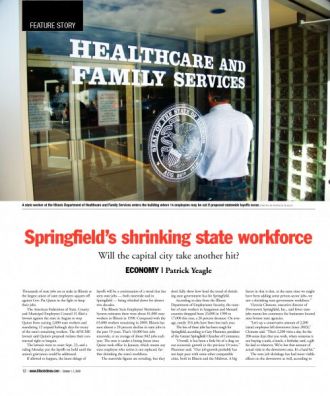
Thousands of state jobs are at stake in Illinois as the largest union of state employees squares off against Gov. Pat Quinn in the fight to keep their jobs.
The American Federation of State, County and Municipal Employees Council 31 filed a lawsuit against the state in August to stop Quinn from cutting 2,600 state workers and mandating 12 unpaid furlough days for many of the state’s remaining workers. The AFSCME lawsuit said Quinn’s proposal violates their contractual right to bargain.
The lawsuit went to court Sept. 23, and a ruling Monday put the layoffs on hold until the union’s grievances could be addressed.
If allowed to happen, the latest deluge of layoffs will be a continuation of a trend that has seen state jobs — both statewide and in Springfield — being whittled down for almost two decades.
The Illinois State Employees’ Retirement System estimates there were about 81,000 state workers in Illinois in 1990. Compared with the 65,000 workers remaining in 2009, Illinois has seen almost a 20 percent decline in state jobs in the past 19 years. That’s 16,000 lost jobs statewide, at an average of about 842 jobs each year. The state is under a hiring freeze since Quinn took office in January, which means any state employee who retires is not replaced, further shrinking the state’s workforce.
The statewide figures are revealing, but they don’t fully show how hard the trend of shrinking state government has hit Springfield.
According to data from the Illinois Department of Employment Security, the number of state workers in Sangamon and Menard counties dropped from 23,000 in 1990 to 17,000 this year, a 26 percent decrease. On average, nearly 316 jobs have been lost each year.
The loss of those jobs has been tough for Springfield, according to Gary Plummer, president of the Greater Springfield Chamber of Commerce.
“Overall, it has been a little bit of a drag on our economic growth in the previous 10 years,” Plummer said. “Our job growth probably has not kept pace with some other comparable cities, both in Illinois and the Midwest. A big factor in that is that, at the same time we might have been adding some private-sector jobs, we saw a shrinking state government workforce.”
Victoria Clemons, executive director of Downtown Springfield, Inc., said fewer state jobs means less commerce for businesses located near former state agencies.
“Let’s say a conservative amount of 2,200 (state) employees left downtown (since 2003),” Clemons said. “That’s 2,200 visits a day, for the 200-some days that you work, where someone is not buying a soda, a lunch, a birthday card, a gift for dad or whatever. We’ve lost that amount of actual visits to the downtown area. It’s a hard hit.”
The state job shrinkage has had more visible effects on the downtown as well, according to