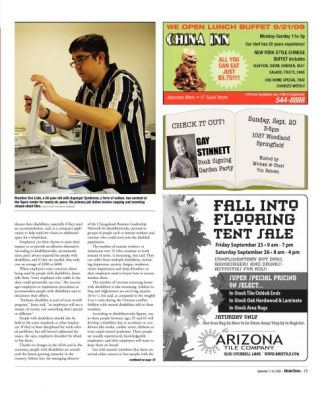
Hiring workers with disabilities is good for the bottom line
Finding a job has never been an easy feat for Kerry Jennings.
Nine years ago, while living in southern Illinois, Jennings sent out nearly 150 resumes. Even though he touted a bachelor’s degree in social work from Southern Illinois University Carbondale and an extra dose of confidence, he was still turned down.
Jennings, who was born with cerebral palsy, wasn’t surprised that most employers considered his wheelchair instead of his skills. He’s since moved to Springfield, hearing several other times that his disability would impede his success in the workplace.
“I went into an interview and knew I nailed the interview, but could just tell I wasn’t going to get the job,” Jennings says. “They didn’t think I could handle it based on my wheelchair, even though I was clearly qualified on paper.”
Jennings has two children who are 12 and 15, and has accepted underpaid temporary or contract jobs throughout the years to support them. He continues to push himself and other people with disabilities to be persistent and determined when seeking employment.
“You have to talk to employers, you have to educate people,” Jennings says. “Just because you’re disabled doesn’t mean you can’t be a productive member of the workforce.”
Last week Jennings and nearly 80 people from central Illinois businesses, social service organizations and community groups attended a special Springfield summit hosted by disabilityworks, a statewide initiative primarily funded by the Illinois Department of Commerce and Economic Opportunity to increase employment opportunities for people with disabilities.
Disabilityworks staff briefed the audience on the Americans with Disabilities Amendments Act, which went into effect on Jan. 1, 2009, and its expansion of the “disability” definition. Under the changes, one out of five Americans has a disability — including those with chronic health conditions like cancer or asthma. More employers need to tap this growing group of diverse workers, the organization says, and benefit from the economic and social supports that accompany them.
Dr. Allan Woodson, the director of workforce development with the Greater Springfield Chamber of Commerce, a summit partner, agrees that hiring more people with disabilities will diversify Springfield’s workforce and help the capital city compete with other communities.
“If we can increase our effectiveness with the disabled community, to put individuals like this to work, that helps out everybody,” Woodson says. “Not only does it help us out from an employer standpoint, because you’re trying to get the very best
people, but it also makes a statement to our broader community that
we’re reaching out to everybody.”
“Just because you’re disabled doesn’t mean you can’t be a productive member of the workforce.”
Robin Jones, the project director for the Disability Business Technical Access Great Lakes ADA Center at the University of Illinois at Chicago, spends a lot of time answering employers’ questions about the ADA and whether the law covers their employees.
The ADAA, the first amendment to the ADA since its enactment in 1990, passed in September 2008 in response to a series of U.S. Supreme Court decisions that too tightly narrowed the definition of disability. It became clear, Jones told summit members, that changes were needed to broaden the law to protect more employees.
The new legislation maintains the prior definition of disability as “one involving a physical or mental impairment that substantially limits one or more major life activities,” but it now expands the meaning of “major life activities.” These include performing manual tasks, concentrating and working, as well as the operation of major bodily functions such as normal cell growth (for example, cancer is now included within the definition of disability).
The legislation also now includes people who have an impairment that limits only one major life activity and who suffer from episodic or intermittent conditions like migraines, asthma or irritable bowel syndrome.
“The message of the act is that you should assume that people are covered under the law,” Jones said, “and focus on the skills and abilities of the person in front of you.”
While it’s the employer’s responsibility to understand ADA rules and regulations, Jones believes it’s the job applicant’s responsibility to