

In this cover feature, The Forum highlights three recent stories that tout success in our community. Willis-Knighton gains a cancer treatment device called ProteusONE™ that hospital officials say signify the certain future of cancer treatment. The Shreveport Chamber of Commerce receives a 5-Star Accreditation for the second year. Grammy-winning drummer and producer Brady Blade cultivates the music scene in Shreveport with the development of Blade Studios. These newsworthy stories are just a selection of many that give this community “something to crow about.”
The Willis-Knighton Cancer Center has installed a spectacular, stateof-the-art cancer treatment device in the expansion to their existing location on Kings Highway, making the center the first in the world to soon offer Intensity Modulated Proton Therapy and Pencil Beam Scanning via the compact, technologically advanced system called ProteusONE™ that hospital officials say signify the certain future of many cancer treatments.
The $25 million ProteusONE™ and its 220-ton particle accelerator cyclotron was delivered from Belgium manufacturer Ion Beam Applications and arrived from Houston on an 80-wheel flatbed in mid-July. The 95-foot-by-49-foot installation, which will include 10-foot-thick concrete shielding walls, was placed beside the original cancer center into a section of the 53,000-square-foot, three-story expansion scheduled for completion at the end of the year. That will segue into patients receiving the first proton therapy treatments in the region by fall 2014.
The $40 million overall expansion is part of the hospital’s plans to increase space for the radiation oncology, hematology and oncology departments at the center, along with new areas for conference rooms, registration, chemotherapy and physician offices, while also adding the ProteusONE™ vault and therapy space.
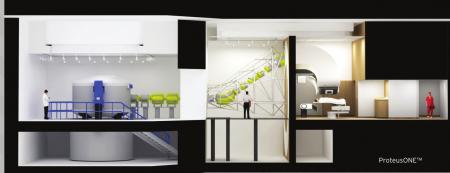
With treatment rooms, ProteusONE™ will use about 3,700 square feet, or one-fifth of the expansion space and dramatically less than the massive, football-sized areas that have been used for older proton therapy systems at other major cancer centers around the world for the past few years.
Also called proton-beam therapy or particle therapy, proton therapy is a fairly new form of cancer treatment that has only been available since 1991 and in mainstream use since 2008 at other big-name locations such as MD Anderson Cancer Center in Houston and the Roberts Proton Therapy Center at the University of Pennsylvania.
Today, there are about 40 proton therapy facilities in the world and only 11 of them in the United States.
According to a study last year published in the Oxford Journal of the National Cancer Institute, the median Medicare reimbursement for a full course of available current proton therapy treatments was $32,428, and $18,575 for the more conventional intensity-modulated radiotherapy.
Dr. Lane Rosen, medical director of radiation oncology for the Willis- Knighton Cancer Center, has been with the hospital since 1997 and is an outspoken proponent of proton therapy. His efforts are a primary reason why Willis-Knighton was chosen to be the first to use the ProteusONE™.
Rosen says what weighs in favor of proton therapy are not just the immediate and long-term benefits to the patient – and those include strikingly lower rates of side effects, sometimes up to 80 percent, according to a study by Harvard-Massachusetts General Hospital – but society overall, and how healthier patients and especially children will eventually contribute to a stronger community.
Despite that, he said, he finds himself often defending the economics of proton therapy versus other types.
 “The most common question I get about proton therapy is, is it worth the cost?” he said. “Someone has decided to do an article on proton therapy, and they do a quick Google search and see something about an ‘arms race,’ and that proton therapy costs more than conventional therapies. They don’t look at
the significant long-term benefits or the fact that this is the first
device of its kind in the world, and you can be darn sure that this will
change radiation therapy, and there will be people all over the world
buying it soon ... it’s compact and inexpensive compared to the other
proton machines, and it does what they couldn’t do.
“The most common question I get about proton therapy is, is it worth the cost?” he said. “Someone has decided to do an article on proton therapy, and they do a quick Google search and see something about an ‘arms race,’ and that proton therapy costs more than conventional therapies. They don’t look at
the significant long-term benefits or the fact that this is the first
device of its kind in the world, and you can be darn sure that this will
change radiation therapy, and there will be people all over the world
buying it soon ... it’s compact and inexpensive compared to the other
proton machines, and it does what they couldn’t do.
–Dr. Lane Rosen
“The question should be, ‘Why is this not expensive?’ Look at the patient benefits. This is a huge deal for Shreveport and this community. There’s no arms race here. That’s ridiculous ... Willis-Knighton invests in the community and believes in cancer care, and we were convinced this was important.”
Greg Sonnenfeld, operations manager for the cancer center since 2009, said entering the proton therapy arena with ProteusONE™ was a choice that keeps them on par with other major medical cancer treatment centers around the country.
“Other than proton therapy, there’s really nothing MD Anderson does in radiation oncology that we don’t do,” he said. “We’re widely recognized as the TomoTherapy world leaders. We’re one of a half-dozen national training sites for brachytherapy. We were among the first to start Intensity Modulation Radiation Therapy in 1998. This was the next logical step to keep our radiation oncology department on the cutting edge and to continue to offer patients the best services without traveling outside the region. This keeps us on the same level as world-class centers.”
For his part, Rosen is passionate about the benefits of proton therapy and has the data to back it up, but he recognizes all too well that the medical field is always looking at the bottom line. Nevertheless, he said the remaining arguments in proton therapy have to be taken in context with the costs for other therapies.
“If you have metastatic prostate cancer in the bones, an incurable illness, you could be given an immunotherapy drug that costs $85,000 and gives a median survival advantage of four months,” he said. “Or you might have chemotherapy that costs $35,000 and gives you two additional months. But then you have providers who want to argue that a $45,000 course of proton therapy that is curative for prostate cancer in the majority of patients is too expensive when compared to hormone therapy alone.”
 The
point is not that you would be given proton therapy for metastatic
prostate cancer – you wouldn’t – but that the cost argument just doesn’t
add up.
The
point is not that you would be given proton therapy for metastatic
prostate cancer – you wouldn’t – but that the cost argument just doesn’t
add up.
“Government and insurance providers are willing to pay massive costs for typical types of cancer treatments to add a few months of life over whatever existing treatment is doing, versus paying less than twice the cost for proton therapy and potentially curing the cancer with less downstream costs and patient side effects,” Sonnenfeld said. “Considering that, it doesn’t make sense for providers to claim proton therapy is too expensive.”
“People are throwing out the baby with the bathwater and being short-sighted when they look at proton therapy,” Rosen said. “Economically, the use of radiation therapy spoiled everybody. It’s the most cost-effective therapy and always has been. It’s less than surgery and drugs, and now the technological advantage costs money, and that’s all people see.”
In fact, despite the cost differences, both proton-beam therapy and traditional X-rays are equally effective at killing cancerous tumor cells, but proton beam therapy, and particularly the Pencil Beam Scanning used by ProteusONE™, is vastly more efficient in terms of patient health, reducing or entirely eliminating side effects because of the manner in which the protons are delivered via a small, tightly-controlled beam.
Conventional X-ray therapy, which is most common, uses a series of photon beams which enter the body in a high dose and then decrease as they move forward, hitting the tumor but also exposing the healthy tissue on both sides of a patient to radiation.
Proton therapy is widely recognized as overwhelmingly advantageous for certain types of cancers because protons can be directed using magnets, exploding all their energy directly on the tumor and stopping there, avoiding the exit dose and damage to other tissue.
Part of this is due to Braggs Peak, a scientific phenomenon that describes the way in which a proton enters the body in a lower dose, then increases its energy to a peak at which it bursts.
From 1991 to 1996, proton therapy was implemented via a cumbersome technique called passive scatter, which essentially meant the beam was less controlled and affected more healthy tissue. The solution was PBS, which has been around since the late 90s and more widely used at a very few major cancer centers since 2008.
The use of PBS offers greater control over extremely precise doses of protons in a thin beam, so doctors are able to essentially paint a tumor with spots of protons and stop there, effectively eliminating the damaging side effects to healthy organs and tissues that can come from conventional radiation therapy.
For a patient, that can mean the difference between conventional therapy side effects such as infertility, joint problems, lymphedema, mouth problems and secondary cancers – or almost none at all.
Rosen said the center will treat about an additional 200 to 250 patients per year with ProteusONE™ but will still use standard photon therapy, as well.
“This is not for everybody,” he said.
“We have no intention of giving up X-ray photon therapy, and 8-out-of-10 people we treat will still get that ... proton therapy would not be advantageous for a bone metastases, for example because you aren’t hitting any healthy organs.”
The cost for the technology versus the benefits is something that will ultimately have to be weighed by patients and the medical industry, but as far as Rosen is concerned, it’s an open-and-shut case.
“The difference between the therapies is dramatic, but there’s still a debate over costs,” he said. “There’s data from Harvard from over a decade ago that shows when you radiate the brain and spine of a child through conventional cancer therapy, it lowers their IQ, but if you use proton therapy, it goes from a 29 percent decrease to less than 2 percent and there’s no lung or heart damage.
“So it costs $20,000 more for this treatment, but do you think that kid is going to grow up to earn and contribute more? Yes. The long-term effects on society mean the treatment pays for itself instantly. That’s the key about proton therapy that no one has debated ... what’s it worth to society to have someone never get secondary lung or heart disease because of radiation treatment he or she had as a child?” For more information about the ProteusONE™ at Willis-Knighton, go to www.wkhs.com.
– Eric Lincoln

After a comprehensive filing and structured review, the U.S. Chamber of Commerce has awarded the Shreveport Chamber of Commerce again with 5-Star Accreditation. The chamber’s first 5-Star Accreditation was achieved in 2008 and this second 5-Star rating is among the high standards that the chamber seeks to maintain. Recently, the editor of The Forum sat down with chamber President Richard Bremer, Executive Vice President Lindy Broderick and Board Chairman Murray Viser at the Shreveport Chamber to discuss their second 5-Star Accreditation.
WHAT DOES IT MEAN TO BE A PART OF THE 5-STAR ACCREDITATION?
BREMER:
Overall it was a team effort and a success of the chamber. It took the staff three months to get the information together and covered nine areas of the chamber’s operation. We are pleased with the 5-Star outcome that we have now achieved twice in a row.
BRODERICK:
It’s really an affirmation from the U.S. Chamber that we are among the best. Of course, we always look for ways to improve, but we’re not just your grandfather’s old chamber of commerce.
VISER:
We are trying to piggy back on this success and make sure that we are beneficial to our members.
HOW HAS THE BOARD BEEN PROACTIVE IN PROMOTING THE WORK OF THE SHREVEPORT CHAMBER?
VISER:
The board has been behind the staff throughout the 5-Star Accreditation process. We are active and want to be involved with staff. The board is engaged and has symbiotic relationship with chamber staff. We want the members to feel like the money that chamber members put in is working for them.
BRODERICK:
The board of directors are decision-makers. It is formed with business leaders from members of the chamber. They chart the course, set the direction, decide on policy and the staff pays attention to the detail and makes it happen.
BREMER:
Each year, we have six to seven new board members. The new members bring fresh ideas and new goals to accomplish. Our board is a collection of diversity. We have representation from big companies, small companies and representation from different industries – from nonprofits to manufacturing. We are a strong advocate for local businesses.
AS THE SHREVEPORT CHAMBER, WHAT IS THE BEST OFFER THAT YOU CAN MAKE A NEW BUSINESS COMING INTO THE SHREVEPORT AREA?
HOW DO YOU PLAN ON MAINTAINING THE CHAMBER’S 5-STAR ACCREDITATION?
BREMER:
I hope that our members will see that they are investing wisely in us and for the overall benefit of the community. We tackle a variety of projects. We want to be looked at as a valuable partner to businesses in the community. We want to make sure that we are doing everything we can to achieve success.
BRODERICK:
We stay in touch with other chambers around the country so that we can learn of their successes and see if there are better ways to achieve our goals.
VISER:
It’s a dynamic process. We are not just around to fill in the blank. We want to see changes and be apart of the innovative process within the community.
WHERE DO YOU THINK SHREVEPORT HAS THE MOST POTENTIAL?
BREMER:
Members tell us that jobs, education and health care are the most important things in Shreveport. Education has been a key in the development of our area. We have been working on improving and assisting in K-12 and higher education.
VISER:
By working on education, we hope to produce a higher example of capability. Having a solid education system will only grow the local economy and bring new industries and companies to Northwest Louisiana. Our main goal is to grow and help companies to be more productive in the community.
BREMER:
We want to make Shreveport as attractive as possible. We want to look sharp. We want people to visit and say ‘I could live here.’ We want to attract families and businesses and let them know what this community has to offer them. We are fortunate to have a local exceptional health care industry. We look for any opportunity to sell the community and solve business issues.
BRODERICK:
Depending on their needs, we offer help to businesses. We cover public policy and learn what the needs are for our business community. We have the Young Professionals Initiative that is a good opportunity for young professionals interested in growing the community. We work with businesses and offer them networking opportunities for their sales force, including but not limited to Business After Hours, Breakfast of Champions, Chamber 101 and offering procurement technology assistance counseling for those who want to get contracts with government agencies.
VISER:
The Government Procurement Center is a huge opportunity for small businesses to have professional staff at the Chamber assist in steering businesses in the right direction and securing government contracts.
HOW DO YOU PLAN ON STRENGTHENING THE SHREVEPORT CHAMBER IN THE FUTURE?
BREMER:
We are good at legislative advocacy. If you want to see something done in government, you really have to be in Baton Rouge during the legislative session. The Shreveport Chamber is there. We obtain insight from our community and then go to Baton Rouge to be an advocate. You have a huge advantage if you are in Baton Rouge.
We just got out of a board meeting with hopes that we will help increase chamber membership. Our market penetration rate isn’t as high as it should be and we hope to use our 5-Star Accreditation to convince more organizations to join. Overall the Accreditation process was a lot of work, but it points to areas where you have opportunities to improve and we are continuously improving.
– Staff report