
The living history of East and West Germany
“I was a soldier in the East German army,” Danilo said, describing what he did in Dresden before the fall of Communism.
This hard, worn-looking fellow was the evening’s tour guide and owner of Nightwalk Dresden. Since our 24-yearold daughter had joined us for this part of our German adventure, we agreed that a late night, walking pub tour of the Neustadt (New Town) would ensure interactions with the locals, what we see as the path to travel’s greatest rewards.
As we sat on the patio of our first pub stop, Café Eckstein on Louisenstrasse, I asked, “So … you went to sleep one night an East German soldier and woke up the next day as … what?” … thinking to myself how incredible it was to be talking to a soldier who had been our “Communist enemy.” Danilo said, “Then nothing. I lost everything.”
The personal discussion, which ensued was not a planned part of the evening’s tour, but that night’s group was small, just the three of us and an older German executive and his wife from Dusseldorf, who had lived the reunification from the free, West side.
They
kept quiet through most of the discussion, though visibly uncomfortable
at times, as they clearly disagreed with Danilo’s account of much of
what had happened as reunification took place. It was evident the
transition had been hard for Danilo and his family, and to us, he still
seemed haunted by his past. Thankfully, Danilo and the other couple
agreed that what mattered most was that they were all still Germans,
even after 40 years of separation.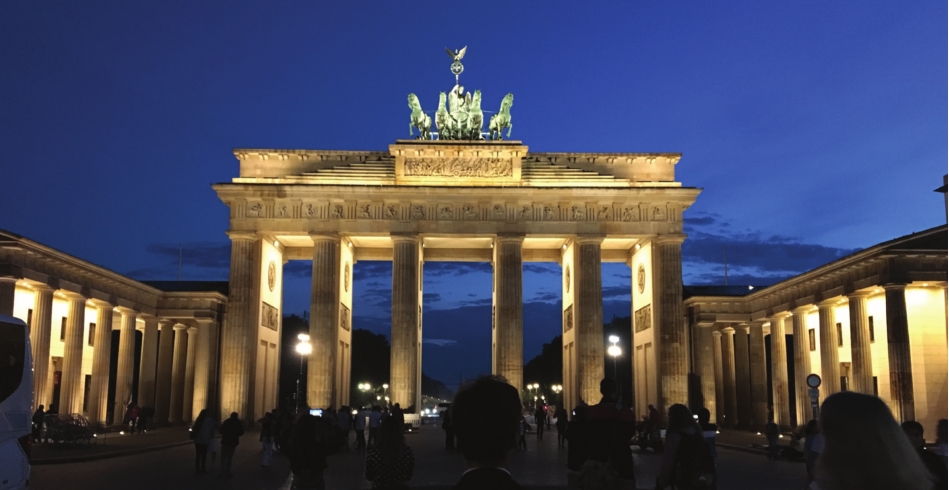
We
had just one night in Dresden, but this three-hour tour, booked at the
last minute, certainly felt like the real reward of travel, connecting
personally with someone across the globe and understanding, just for a
moment, an experience so foreign to our own.
Experiencing
a slice of life under Communism was the theme of another fascinating
tour we took while in Prague. After a Google search for “the best things
to do in Prague with young adults,” we chose the Communism and Nuclear
Bunker Tour. Our guide was an intelligent, young man who described
himself as “born free.” He told a brief yet poignant account of the
history of Prague from the start of Soviet rule in 1945 through the
peaceful “Velvet Revolution” for freedom 44 years later. A walk and tram
ride took us to the i kova neighborhood, a real concrete jungle, with
grey block buildings constructed under Communism.
As
we entered a locked, wooden gate into what was a small beer garden only
open at night, he led us to a padlocked door, which he pointed out had
just recently been “decorated’ with graffiti. He unlocked the door, then
easily pushed open the two-foot-thick steel entry to the nuclear
shelter. We were led five stories underground into a cramped network of
tunnels holding Communist era memorabilia, gas masks, weapons, uniforms
and propaganda. We stepped back in time to the Cold War and lived a
piece of history.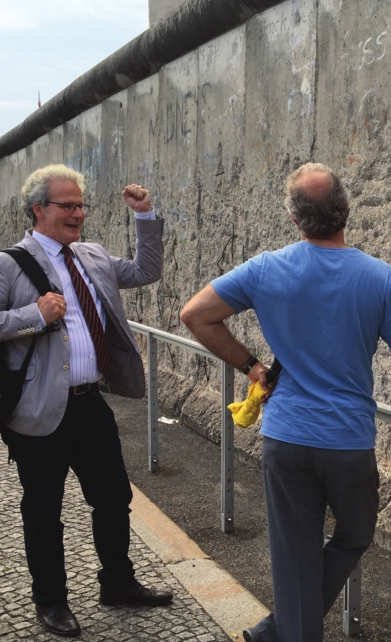
Our
journey continued to Berlin, where we reunited with Shreveport friend
and Jesuit alumnus Michael Burda, a professor at Humboldt University,
who took us on walking adventures. In Berlin, we experienced a favorite
hotel, the Adlon Kimpinski at the Brandenburg Gate. This luxurious hotel
sits within steps of the location of historic political speeches and
rallies and now is surrounded by the United States, French and UK
embassies, just to name a few. The most surprising fact about Berlin was
that only in the last 10 years since reunification has it been growing
economically and culturally. This is a city not to be missed with the
Reichstag Dome, the cathedral Gedächniskirche (left bombed out as a
memorial to WWII), sprawling museums (we visited the Neues and the
Pergamon) and several bohemian, former East Berlin neighborhoods like
Prenzlaur. A walk along the East Bank Gallery to view the street art on
the remains of the Berlin Wall is an experience unlike any other. And
finally, just a 20-minute train north of the city is the sobering
Sachsenhausen Concentration Camp, which imprisoned, tortured and killed
political dissidents, alleged criminals, Jews, Communists, Jehovah’s
Witnesses and homosexuals.
Eight
days earlier, we had started our journey in Dusseldorf, made a quick
stop in Bonn to visit another college professor and Jesuit classmate of
my husband. John and his family cooked us a traditional German meal of
sausages and white stalks of spargel (asparagus) locally grown. We then
took a train to Lindau in the south central part of the country and
meandered by car for two days through the small byways of the German
Alps (with a little time at 160 km/ hour on the autobahn). Bavarian
favorite experiences included the Neuschwanstein Castle and the view at
Zugspitze (The Top of Germany).
With
10 days in Germany and three in Prague, Czech Republic, we covered over
1,600 miles by train and car. The Deutsche Bahn (DB) train system is
excellent, with a fantastic smartphone app where you can buy and track
your travel. The trains are clean, safe and on time. There are no
security lines, and you can arrive just 15-20 minutes before your
departure and not feel rushed to board your train. Don’t be afraid to
ask for help as almost everyone speaks English and is friendly,
especially if you make an effort to say a few words in German. I
recommend purchasing a data plan for your smartphone, as having access
for train information, quick translations and maps can make life easier.
Our
top hotel for the trip was the Goldenwell Hotel in Prague. This small,
luxury hotel was like a private home located up a secluded, cobblestone
walk, just below the walls of Prague Castle. It was a splurge but also a
great value with unsurpassed service, unique art, luxurious and quiet
quarters and special touches like “goodnight cakes” under glass next to
our bedside each night.
There
were many delicious culinary adventures to be had in Germany and Prague
from the best schnitzel at Swiss in Lindau to goulasch at Ferdinand’s
in Prague, and homemade Ethiopian at okra in Dusseldorf. However, the
yummy theme wherever we landed was fresh, locally made bread and beer.
The rewards of this travel for us were time with friends and a few
strangers who took us back in time, shared their spirit and stories and
left us wanting to spend even more time in the area.
Auf wiedersehen, friends – until we meet again.
– Katy Merriman


