
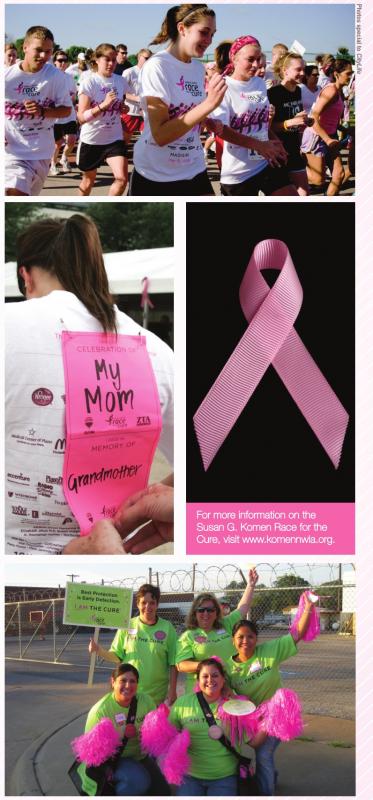
Since the first pink ribbons were pinned to breast cancer survivors during the 1991 New York Race for the Cure, it has come to symbolize a woman’s strength of spirit in her battle against breast cancer. An icon in the American collective consciousness, the rosy ribbon raises awareness for women’s breast health and recognizes the bravery of breast cancer survivors.
The Northwest Affiliate of Susan G. Komen will bring the 19th annual Race for the Cure on Nov. 2 back to Shreveport, after a several year hiatus in Bossier City. A projected 10,000 participants will do their part to help achieve this years’ $350,000 goal.
According to a 2013 American Cancer Society stats, Louisiana had the second highest breast cancer mortality rate in the country, behind the District of Columbia. It’s that startling statistic that drives the commitment of local Komen volunteers and race participants, who know that 75 percent of all proceeds raised stay in Northwest Louisiana.
"You think this could never happen to you, but it does and your whole life changes. Everything is different and now being a part of the race means a lot. ”
– Karin Oathout
“Not only does it stay in our region, but it’s strictly spent on breast health and care,” Karin Oathout, a breast cancer survivor, Race for Cure participant and Komen board member, said. “It goes to grants, mammographies and education.”
Oathout knows all too well the importance of the Komen mission and breast health after being diagnosed with breast cancer in April 2011.
“I found it myself,” Oathout, a Shreveport resident and elementary school teacher, said. “I wasn’t checking intentionally. I just felt something funny and went to the doctor the next day.”
Things moved quickly and within two or three days, soon visiting a surgeon who performed the necessary breast tissue scans and subsequent biopsy. Having had routine breast exams, annual health checkups and no family history of breast cancer, Oathout was stunned by her diagnosis and later opted for a bilateral mastectomy.
“After being diagnosed, it’s a whole different world,” Oathout, who participates in the Race for the Cure with her friends and teammates called “Karin’s Krewe,” said. “You think this could never happen to you, but it does and your whole life changes. Everything is different and now being a part of the race means a lot. [I like] being around others who have been through or are going through what I was.”
Being insured made all the difference in Oathout’s treatment, and she is grateful to her doctors care and that she had good insurance coverage at the time of the diagnosis.
For many of the millions of uninsured mothers, daughters, wives and sisters, an annual mammography is unaffordable.
Helping to aid the uninsured and providing quality care for women, Komen offers grants to local health care providers in order to administer free breast cancer screening, mammographies, breast care education and support for those living with or having been affected by breast cancer.
For the second year, Race for the Cure will host a pre-race event, which Oathout chairs. The night’s festivities is a celebration with pink beer, an assortment of restaurant fare, and live music from the Keith Horton Band, all of which is donated with entire proceeds going to Komen.
The next day, race day activities kick off at dawn with registration and a survivors parade followed by a one-mile fun run and walk. The main event is the 5K race, driving which thousands on hand to share in a celebration of stamina for the millions of women who have been diagnosed with the disease. Lining the parade route, the Tribute Tulip Garden is a somber reminder of those who are fighting or have lost their fight with the deadly disease.
“Now I’m much more passionate about the race because I don’t want anybody to go through what I went through,” Oathout said, presently healthy and cancer-free. “I want to share my story and do my best for others. Just be there to support someone. I don’t think I was ever a bad person, but today I am a better person having survived.”
–Elizabeth Branca