“Bean pie, my brother?” was
originally published in the issue of November 18, 2013. Since I first
went in search of the sweet, custardy navy bean pie, made in accordance
with the dietary regimen prescribed by the late Elijah Muhammad, it
hasn’t quite gone mainstream, but it might be easier to eat one. Plenty
of online recipe churners can show you a method, as well as more august
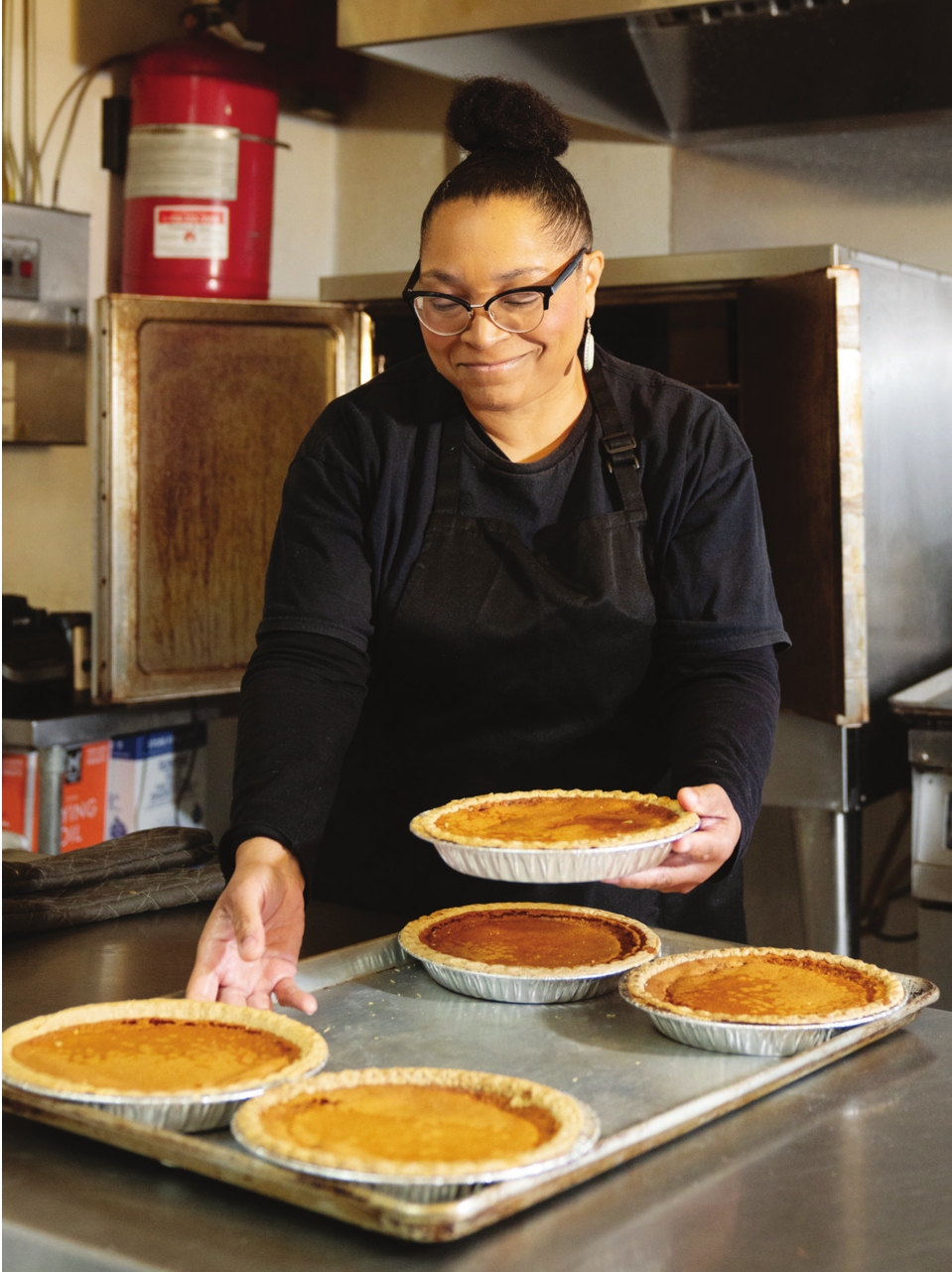
outlets like Saveur and Southern Living. Imani Muhammad is still making them and shipping them nationwide—and also hosting her own podcast, Conversations Over Pie. The
Nation’s Supreme Bean Pie, relatively revitalized, is still baking at
Mosque Maryam in South Shore and distributing whole pies at a handful of
south-side locations. You can get one shipped, order one on Uber Eats,
or just pick one up in Bronzeville or Olympia Fields at Shawn Michelle’s
Homemade Ice Cream, which still makes its original chunky bean pie
flavor, as well as a newer, smoother variant made with the pie custard
recipe.
—Mike Sula, senior staff writer
The Nation of Islam’s iconic dessert is still around, if you know where to look.
By MIKE SULA
The young man who met us at the front doors of Muhammad University of Islam wouldn’t let us in. He was polite yet firm when he told us they weren’t making bean pies that day. But my friends Peter Engler (eminent investigator of south-side culinary oddities) and Rob Lopata (occasional Reader contributor) had just toured the Nation of Islam’s neighboring Mosque Maryam a few days earlier, as part of the Chicago Architecture Foundation’s [now the Chicago Architecture Center’s] Open House Chicago. When they had asked about bean pies, their guide told them to come back during the week, when the university’s bakery would be in production.
We stood in the vestibule flummoxed, and it wasn’t until the same guy who had conducted the tour passed by and spotted us that we were let in. Sure, we could buy a pie, he told us—but not before some security measures. We took turns standing behind a screen while the guard patted us down, and then grabbed a seat in a row of chairs by the door while a perfect formation of white-shirted young boys filed past. Eventually, a blue-bedecked woman who introduced herself as Sister Medea came out with two official Nation of Islam Supreme Bean Pies. We forked over $18, and before we could ask too many questions, we were gently sent on our way. The university parking lot’s automatic metal gate— wide open when we turned off Stony Island—closed behind us when we pulled out.
Made from cooked, mashed, small navy beans, the bean pie is the iconic food of Black Muslims everywhere, but locating one in Chicago in recent years has been a hit-or-miss proposition. That’s surprising given the zeal Elijah Muhammad, the Nation’s leader for 41 years, had for navy beans. “Eat food that Allah (God) has prescribed for us,” he wrote in How to Eat to Live, a
two-volume dietary guide for followers of the Nation, whose main points
are repeated with the circularity of an industrialsized mixer: “Even
take little things such as beans. Allah (God) says that the little navy
bean will make you live, just eat them. He said to me that even milk and
bread would make us live. Just eat bread and milk—it is the best food.
He said that a diet of navy beans would give us a life span of one
hundred and forty years. Yet we cannot live ½ that length of time eating
everything that the Christian table has set for us.”
Made from cooked, mashed, small navy beans, the bean pie is the iconic food of Black Muslims everywhere.
In
some ways Muhammad’s Nation of Islam diet was ahead of its time. He
advocated eating unprocessed foods and mostly vegetables (definitely not
pork) in moderation. On the other hand, it’s an extreme form of
moderation. He advised eating just one meal per day, or every other day
if you were strong, or—for those who could work up to it—once every 72
hours. “The European white race,” he wrote, “blessed
with the privilege of eating the best food the earth provides, has
taught us to eat the worst (divinely prohibited) foods. We eat all the
time, three and four times a day. This is enough to wear out the
intestines of a brass monkey.”
Though in How to Eat to Live he
never precisely says why, Muhammad lists most legumes—lima beans, field
peas, black-eyed peas, speckled peas, red peas, and brown peas—as among
the divinely prohibited.
The navy bean was the sole exception.
These
rules, he wrote, came directly from the mouth of Wallace Fard Muhammad,
who the protege asserted came to Detroit from Mecca to found the Nation
of Islam (and then mysteriously disappeared en route to Chicago in
1934). And with him came the recipe for bean pie, according to
Lance Shabazz, an archivist and historian of the Nation who says that
the theory of the bean pie emerging as a substitute for sweet potato pie
might have some validity. Elijah Muhammad doesn’t mention bean pie, but
he’s pretty clear about sweet potatoes: “Sweet potatoes were never good
for any human to eat. They are good for hogs, but not for you.” (That
might have been a tough sell for African Americans new to the Nation.
Sweet potato pie, which originated in the south, was likely the mingling
of the cooking of enslaved Africans, who knew yams, and their European
enslavers, who knew pie crust. It is enshrined in the soul food canon.)
In
any case, Lance Shabazz says Fard Muhammad bestowed the first recipe
for bean pie upon Elijah Muhammad and his wife, Clara, in the 30s in
Detroit, though none of this is precisely stated in How to Eat to Live either.
But
bean pie is in fact a convincing substitute for sweet potato pie. Built
on a whole wheat crust, with a filling of strained and mashed beans,
butter, raw sugar, evaporated milk, eggs, cinnamon, and other baking
spices, it develops a mildly sweet, dense, custardy understory, with a
browned layer on top that one bean pie maker told me is the result of
the butter rising and browning in the heat of the oven. If nobody tipped
you off to the fact that you were eating pie made from mashed navy
beans, you could be forgiven for thinking it was sweet potato or pumpkin
pie.
Bean pie wasn’t
the only Nation of Islam dish made with the miraculous navy bean— there
was bean soup and bean bread—but it was certainly the most iconic, not
just in Chicago but in any other city with a Nation of Islam presence.
In Chicago it used to be that you could reliably pick up a bean pie on the street—along with the latest issue of the Final Call—from a
fastidiously dressed male member of the Nation of Islam, who might
proffer, “Bean pie, my brother?” Lance Shabazz bemoans this sales
tactic. “One of my pet peeves is that when Elijah Muhammad was present,
we had bakeries all across this country. They baked the bean pie on the
premises. We didn’t go on the street, on the corner selling pies,
stopping traffic. I find it embarrassing because if you want a pie you
should go to the bakery and get it. I’m talking about in New York City,
where on
major streets you may see brothers stopping cars at the light trying to
sell a pie. We had the tractor trailers bringing pies and bringing
newspapers up and down the east coast. It seemed to be more
professional.”
The
late Lana Shabazz, operator of a renowned bakery in New York City, was
probably the Nation’s most famous bean pie maker. She cooked for Elijah
Muhammad and Muhammad Ali—and in 1979 she authored the cookbook Cooking for the Champ. In
Chicago there were at least three Nation of Islam bakeries on the south
side at one time, most notably the Shabazz Bakery on 71st near Saint
Lawrence. Khalilah Camacho Ali worked in all three before she married
Muhammad Ali, becoming his second wife. Camacho Ali is emphatic when she
says that, counter to most popular accounts, she wasn’t in any of those
bakeries on the day she first met the Champ, but that’s where she was
working at the time. And he was a customer.

Camacho
Ali, who grew up in the Nation of Islam, says she learned to make pies
from Elijah Muhammad himself. “That came about because I grew up in his
house with his grandchildren,” she says. “When my mother was working or
my dad was working, I was with him and his family. They had us all
working in the house, working in the kitchen. We served. We were taught
proper ways of cleaning and cooking our food, and this was part of our
lifestyle. That’s when we learned how to make the bean soup and the bean
pie.”
The bakeries
where she worked are gone now, but independent bean pie makers still
come and go. “Things change really fast in the bean pie world, it
seems,” says Peter Engler, who has made a study of bean pies over the
years. When he first came across one in the early 70s it was at the Hyde
Park Co-op. “I saw these stacks of pies. I’m pretty sure these were the
Shabazz pies. I bought one and I think I was surprised that it was
sweet. It was just like a pumpkin pie. I’d buy one every now and then.”
Later, in the 90s, Engler bought pies from the now-defunct Original Bean
Pie Bakery for his coworkers in the molecular immunology lab at the
University of Chicago. “Almost everybody in the lab liked them,
especially the Chinese guys,” he says, which he chalks up to the Chinese
appreciation for sweet bean desserts.
Such
observations give credence to the idea that the bean pie deserves a fan
base larger than just members of the Nation of Islam. And perhaps it
once had one. There’s a recipe for bean pie in Imogene Wolcott’s 1939 The Yankee Cookbook, submitted
by Mrs. Mae Bangs of Oak Bluffs, Massachusetts, and it could pass for
any of the Muslim recipes I’ve seen—if she only called for raw sugar.
In
2008, as Engler was preparing to give a talk about the bean pie at a
Greater Midwest Foodways Alliance symposium, he realized how hard it had
become to find one. A number of independent bakeries had gone out of
business, and Muhammad University’s Supreme Bean Pie had just gone back
into production after a mysterious absence. With some difficulty he
managed to get a half dozen pies delivered to the conference through a
semi official bean pie courier.
It
still isn’t easy to find them. Last month I spotted a stack of business
cards at the register of the Nation’s [now closed] Respect for Life
Bookstore, across 79th Street from the headquarters of the Final Call. It
advertised a distributor of the Nation’s Supreme Bean Pies. The
bookstore has a refrigerator case that used to stock pies, but it was
empty at the time, and repeated messages left at the number on the card
went unreturned. The same was the case with the many calls I placed to
Muhammad University after our visit.
So where does one get a bean pie these days?
Of
course, you can always make your own; recipes and YouTube tutorials
abound on the Internet. The Nation’s Salaam Restaurant & Bakery
[currently temporarily closed], across the street from the bookstore,
has them on the menu—$3 a slice and $10 for a whole pie. And there are
still a few independent operators around the city. You can even find
house-made “Taste of Heaven” bean pie ice cream at Flippin & Dippin
Shawn Michelle’s Homemade Ice Cream on 87th Street in Burnside (it’s
really good). [It’s now Shawn Michelle’s Homemade Ice Cream, with
locations in Bronzeville and Olympia Fields.]
Then
there’s Imani Muhammad, who may be the reigning bean pie queen of
Chicago. Like many Black Muslims, she grew up eating the pies, made by
the grandmother of a friend. But about eight years ago, while she was
conducting a project on the navy bean for her daycare/home-school
group, Imani’s Original Bean Pies and Fine Foods was born.
She
says that in the course of the navy bean project, “we were just
experimenting with it and talking about how it got its name, and the
properties of the navy bean—being a staple food with the vitamins, the
protein, that type of thing.” She moved on to recipes: a bean pie, a
bean salad, and a bean soup. “The soup and the pie was good. The salad,
not so good.”
From there, she began to consider the merits of the bean pie as a potential moneymaker.
She
started production at the shared-use facility Kitchen Chicago but now
operates out of a space in the Grand Boulevard neighborhood. She
eventually started to diversify, making a vegan pie and a cream cheese–
frosted pie appropriate for birthdays. She has also experimented with
blueberry and banana bean pies—all made with natural ingredients.
Along
with her husband and another baker, Muhammad puts out about 200 large
pies and 350 six-inch pies per week, which are distributed to some 18
groceries and health food stores all over the south side (and one on the
north side). She also ships them to customers in New York, Indiana, New
Jersey, Michigan, Wisconsin, Missouri, and Pennsylvania. For about a
year, when its own production was down, she made them for the Nation of
Islam itself. “That was a great honor,” she says.
Right
now she’s in her busiest season, pulling all-nighters three nights a
week. In the days leading up to Thanksgiving, it seems, everyone wants a
bean pie. “We couldn’t even keep the stores stocked last year,” she
says. “I had a lady tell me that not only did she tell her husband that
she made it, but she told him it was sweet potato pie.”
[email protected]