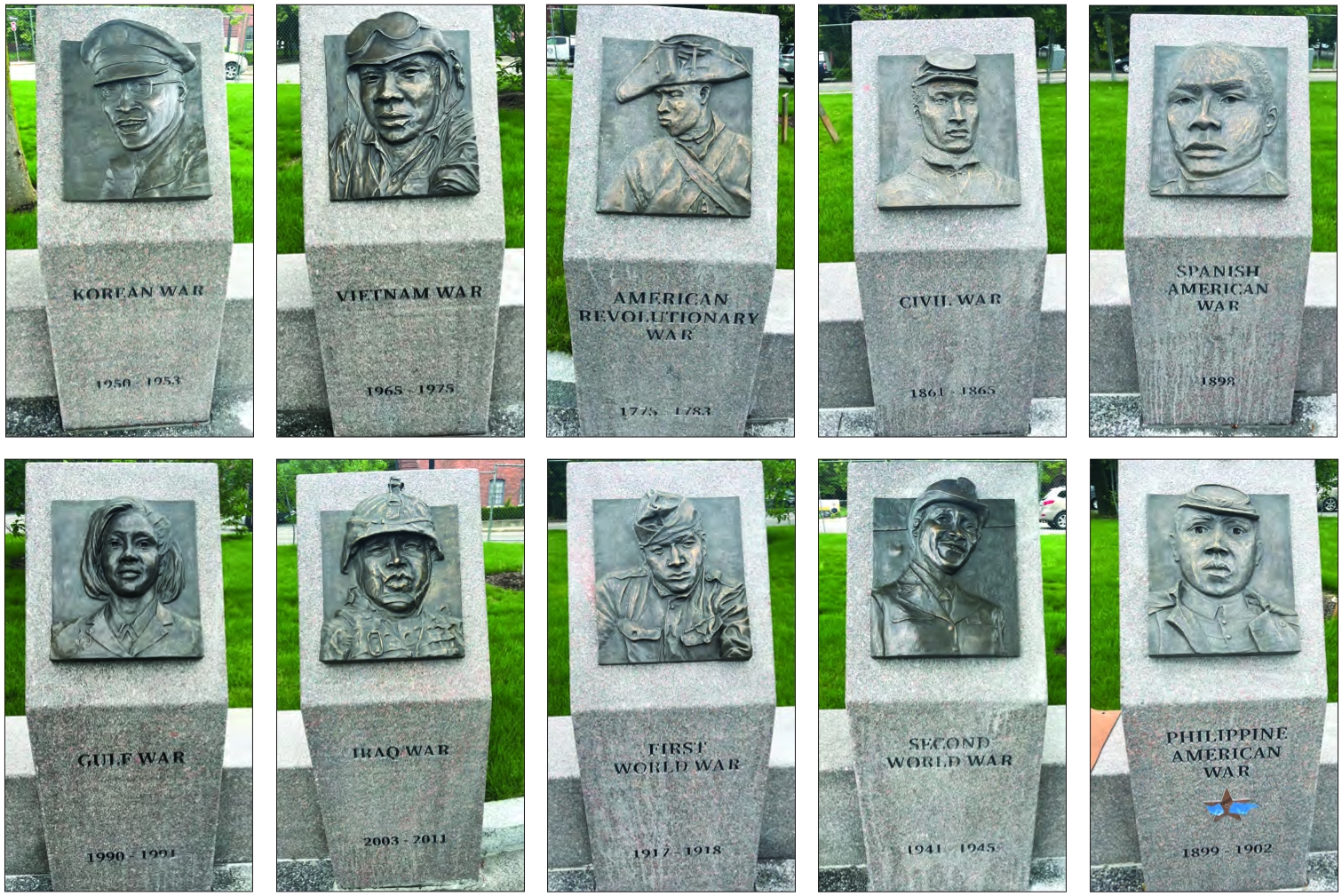
Alongside
the statue of General Gourdinare 10 bas-reliefs sculpted by Karen
Eutemey representing Black military contributions from the American
Revolutionto the Iraq war. 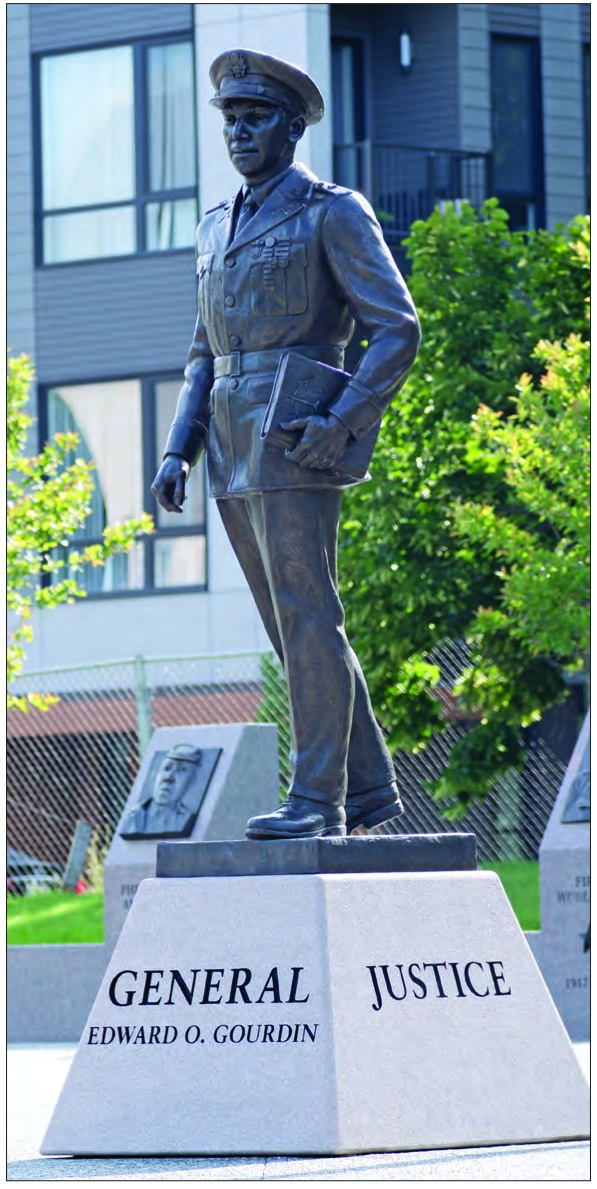
Statue of General Edward Gourdin at the General Gourdin and African American Veterans Memorial and Park in Roxbury.
As we celebrate Veterans Day and America celebrates 250 years of independence, Michael Curry asks us to remember: some Black Americans fought for independence; others fought against the patriots to secure freedom.
Curry, president and CEO of the Massachusetts League of Community Health Centers
and an NAACP National Board member, advocated for the group to adopt a
resolution “Truth Catching Up to History: Black Veterans of the American
Revolution.” The October vote was unanimous, he said.
The resolution asks for protection of monuments, memorials and museums addressing slavery and the nation’s
founding contradictions, and for NAACP units to teach the totality of
Black military history. It builds on the NAACP’s 1999 curriculum
resolution, reaffirming its 1966 “Negro History” and 1968 “Negro History
and Teacher Training” positions.
“The
resolution calls for the 2,200 NAACP units across the country to become
familiar with this history and to share it with their communities,”
Curry said. “It should inspire a national debate on patriotism, since so
many people today have co-opted the word, distorted it and weaponized
it to justify violence against those they view as unpatriotic and to
stifle dissent.”
Curry
continued: “I hope it inspires deeper exploration and discovery of the
contributions of Black Americans that remain to be unearthed. Our story
is the greatest testament — or indictment — of whether this experiment
of 1776 really worked for everyone.”
Who signed a document and who built a nation are different questions.
Consider
the familiar paintings of the Declaration’s presentation and the
Constitution’s signing. In artist John Trumbull’s 1817 scene and Howard
Chandler Christy’s 1939 commissioned reconstruction, the figures
exercising political authority are white men.
Images of the Mayflower Compact, the First Federal Congress and the American peace commissioners reinforce that pattern.
These
pictures show who occupied governing rooms, but cannot encompass the
labor, knowledge, military service and challenges to exclusion that
shaped America. When they become the entire founding story, political
exclusion becomes historical invisibility.
Curry’s
resolution widens that narrative. Asked what inspired him, Curry
pointed to historical study, a documentary and an unexpected encounter
in Boston.
“I was
inspired by studying this history and watching Ken Burns’s documentary
‘The American Revolution,’ a six-part, 12-hour PBS documentary series
that explores the founding of the United States as a sprawling, complex
civil war,” Curry
said. “He includes an account of Black involvement but only scratched
the surface. Ironically, there was also a little-known exhibit in Boston
on Black participation in the American Revolution that I stumbled
upon.”
His experience
raises a question: Why should a history so central to the nation’s
founding still feel like a discovery? A 1777 Massachusetts petition
associated with Prince Hall and other Black residents claimed the same
natural, unalienable liberty as other people, exposing the contradiction
of resisting British domination while enslaving neighbors.
These political thinkers addressed the Revolution’s central question: whose freedom?
In
1781, Elizabeth Freeman and Brom successfully sued for freedom in
Massachusetts. Alongside the Quock Walker cases, their case helped make
slavery legally indefensible under the state constitution.
Betsy
Ross was a craftswoman and flag maker, but the familiar claim that she
made the first American flag at Washington’s request lacks credible
contemporary substantiation. Why is that story better remembered than
Freeman’s documented challenge to enslavement?
The
comparison reveals unequal standards of recognition: an unverified
story about a national symbol has overshadowed a Black woman’s
successful test of constitutional promises.
Military
history requires similar honesty. Black men fought before Washington
took command; he initially restricted further Black enlistment. In
November 1775, Virginia’s royal governor, Lord Dunmore, offered freedom
to enslaved people belonging to rebels who could and would bear arms for
Britain.
Dunmore
sought military advantage, not universal emancipation. Nevertheless, he
offered some enslaved people a path to freedom. In late December,
Washington reopened enlistment to free Black soldiers, concerned
excluded veterans might join Britain.
Enslaved
people weighed opportunities for themselves and their families. Patriot
independence and Black freedom did not always coincide. For many Black
participants, the outcome brought betrayal: military service did not
guarantee emancipation, and freedom did not
guarantee equality. Some faced reenslavement, while slavery persisted
and later expanded within the independent United States. Haiti widens
the frame. Under Toussaint Louverture, Saint- Domingue’s 1801
constitution retained a formal French connection while permanently
abolishing slavery, rejecting employment color barriers and affirming
legal equality. It also restricted agricultural workers’ movement and
made Louverture governor for life. Independent Haiti’s May 20, 1805
constitution, sanctioned by Jean-Jacques Dessalines, linked sovereignty
and emancipation. Article 1 asserted independence; Article 2 declared,
“Slavery is forever abolished.” Articles 3–4 affirmed legal equality.
Article
14 designated all Haitians as Black — an assertion of shared belonging
against colonial color hierarchies. Black founders wrote emancipation
into nationhood.
Who
we recognize as a founder shapes who we recognize as belonging today.
Presenting whites as America’s creators and everyone else as later
additions can serve white supremacy by making unequal belonging seem
natural. This reality is part of why the NAACP’s resolution and advocacy
for better historical education could be transformational for young
people.
Encountering
Black people chiefly as enslaved, excluded or recipients of generosity
obscures their agency. In the spirit of this resolution, the public
would commit to teaching about ancestors who thought about liberty, made
difficult choices and acted to change the conditions of their lives.
The fuller account aims to change how children understand their own
possibilities.
Despite
differences over religion, integration, nationalism and strategy, Black
and revolutionary organizations, such as SNCC and Mississippi Freedom
Schools, the Black Panther Party, the National Council for Black
Studies, Revolutionary Action Movement and Young Lords, have long
treated historical education as necessary to freedom, community power
and repair.
Their
commitments historically included numbered demands, curricula,
resolutions and institutional missions. Boston TenPoint places Black and
Latino history alongside mentoring, violence prevention and community
development. Historical knowledge prepares people to act.
Curry’s
initiative builds on the NAACP’s 1999 curriculum resolution,
reaffirming its 1966 “Negro History” and 1968 “Negro History and Teacher
Training” positions. His hopes extend beyond adding names to textbooks.
Dissent, the resolution affirms, belongs within the story of American freedom. And success, history tells, requires action.
NAACP
branches can partner with schools, churches, libraries and museums.
Teachers can pair the Declaration with Black freedom petitions and
Haiti’s abolition. Museums can place Black military records and
Indigenous political life alongside leaders’ portraits. Communities can
protect historic sites and support the research that brings overlooked
lives into public view.
The
resolution affirms, as do many of its predecessors, that children
deserve to know their ancestors were always here — working, thinking,
fighting and demanding that freedom meant what the nation said it meant.
THEREFORE, BE IT
RESOLVED, The NAACP calls for all units to promote a more inclusive and
accurate account of the American Revolution, including the service and
bravery of Black colonists, free and enslaved, who fought either with
the colonists against British rule or with the British to gain their
freedom from chattel slavery;
THEREFORE,
BE IT FINALLY RESOLVED, The NAACP opposes the continued erasure of
Black patriotism, resistance and service to America, and calls for all
monuments, memorials and museums that include exhibits on the
enslavement of Black people, as well as the contradictions of the
American Revolution, to be protected and preserved.