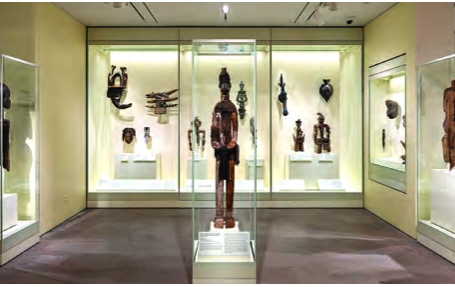
Installation view of the Arts of Africa Galleries.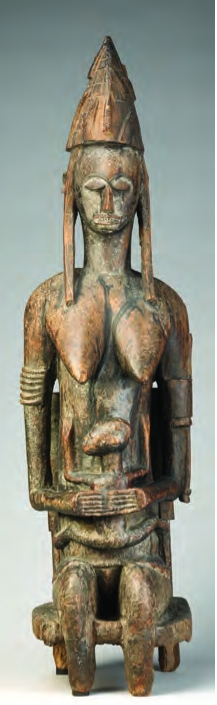
“Gwandusu,”
by Bamana numuw (blacksmith), The Metropolitan Museum of Art, New York,
The Michael C. Rockefeller Memorial Collection. Bequest of Nelson A.
Rockefeller, 1979
The arts of Africa, Oceania and the Ancient Americas are on dazzling display in the recently renovated Michael C. Rockefeller Wing of The Metropolitan Museum of Art in New York City.
Closed for renovation in 2021 and reopened in May 2025, the 40,000-square-foot wing is named in memory of Michael C. Rockefeller, the son of former New York Governor and U.S. Vice President Nelson A. Rockefeller.
More than 1,700 objects — a fourth on view at The Met for the first time — are presented as art and as objects essential to the spiritual, social and political lives of people spread over five continents and eight millennia.
Many are designed for movement, adding splendor and gravitas to ceremonial events and bearing a community’s collective memories, culture, ancestry and identity. Handmade from local resources such as wood, stone, feathers, clay, shells and native fibers, these objects incorporate motifs that encode lineage and power within a community and evoke shared stories rather than a single artist’s experience. Their primal power and beauty speak to us today.
Organized by Alisa LaGamma, curator of African art, the reimagined Arts of Africa galleries present about 500 works from The Met’s collection in groupings that represent diverse cultural traditions across the subcontinent, from Mali to Madagascar.
Immersive displays draw the visitor into Africa. At the threshold of the Arts of Africa galleries is a cluster of stunning Bamana sculptures from Mali. Behind these serpentine carved works, barely visible, is a shimmering contemporary tapestry by Ghanian El Anatsui and rising in the background are the tips of soaring Bisj ancestor poles from New Guinea. Overhead, a high, vaulted ceiling evokes the Great Mosque of Djenné in Mali.
Works large and small are presented in installations that tell stories of Africa’s distinct cultures. These objects were fashioned by clans of artisans revered for their power to transform raw materials into works that embody their community’s identity and history. Sculptures, masks, weavings, metalwork, basketry and other media are not displayed as anthropological specimens but as art. A further antidote to anonymity extends to the labeling, which credits the artist by location if not by name.
On view in the gallery and online, a series of brief videos, “Africa’s Cultural Landmarks,” highlights these diverse cultural landscapes and community-led projects to preserve these unique ancestral legacies.
Perhaps the oldest work on
display is the 13th-century “Mali Seated Figure,” a small, fluidly
shaped terracotta sculpture. Fashioned during a time of suffering, its
subject, bent over in a yoga-like posture, finds repose.
Stories
emerge across cultures; among them, how geography shapes a community
and its art and the power of women as both makers and subjects of
venerated works.
Coastal
regions engaged in trade with Europeans who admired their handmade
artisanry. On view are exquisitely carved ivory pieces made for
Portuguese export in the early 1600s as well as wooden figures
portraying European traders.
Some
regions adopted Christian iconography and religious practices, none
more deeply than Ethiopia. Highland villages in Ethiopia carved churches
out of mountain cliffs and their artists painted liturgical images to
adorn them. On display are late 14th-century images on parchment that
illustrated Gospel books. Works by 17th-century Kongolese master carvers
include strong, unadorned wooden crucifixes.
Carved
by a Gabonese sculptor in lustrous black wood, a female guardian figure
with long breasts and bulging muscles stands poised to fight as she
protects an altar holding her ancestors’ relics. Another sculpture
portrays an early Angolan
leader, Cibinda Ilunga, as a muscular hunter and warrior and as a man of
culture. Playing a thumb piano, he is a keeper of oral history.
Living
cultural traditions also animate contemporary African works on view.
Sculptor El Anatsui, 82, fashions glittering tapestries out of discarded
bottle caps from Nigerian distilleries that echo the handwoven Kente
textiles of Asante and Ewe weavers in his native Ghana.
A
wall hanging by Joël Andrianomearisoa, 49, who in 2019 became the first
artist to represent Madagascar at the Venice Biennale, takes its title
from a poetry collection by Madagascan diplomat Maurice Ramarozaka. His
“Les Herbes Folles du Vieux Logis” (2022) is a tribute to Madagascar’s
natural beauty. Tinted with hues of stones, earth and sky, its rippling
fibrous surface evokes the island’s long grasses. A work of devotion as
well as art, “The Cross, the Church, and the Butterfly” (1980s) is a
parchment healing scroll by Skunder Boghossian (1937-2003) of Addis
Ababa and Washington, D.C.
More
works of astonishing beauty and power await a visitor in the Arts of
Oceania and Ancient Americas galleries. Handcarved by Asmat artists of
New Guinea, nine towering spirit poles stand in a semicircle adjacent to
an Oceania gallery where, suspended overhead, a stunning 80-foot
construction of painted palm panels replicates the ceiling of a Papuan
ceremonial house. Nearby is an Asmat canoe hollowed from a single
48-foot-long tree trunk along with ornately carved canoe prows and
ancestor figures as well as elegant, patterned textiles.
In
the Ancient Americas galleries are still more works that, like those of
Africa and Oceania, further the identity and belonging of communities
and serve as their conduits to the divine.
ON THE WEB
Learn more at metmuseum.org/exhibitions/arts-of-africa