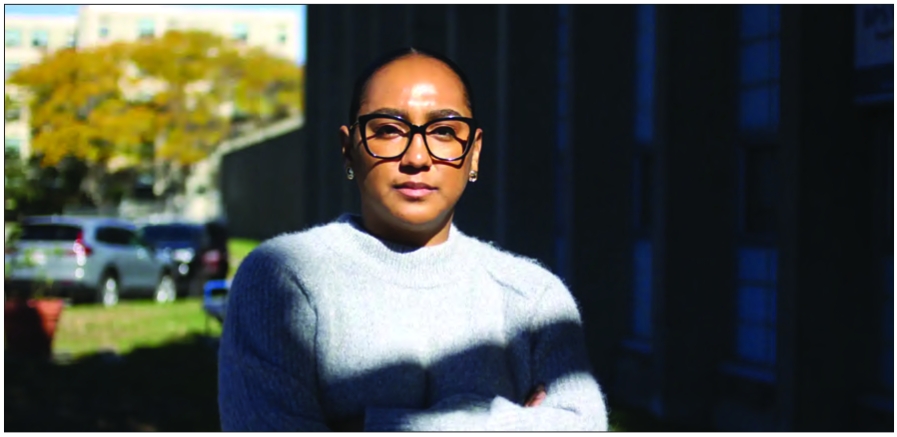
Cesarina
Barros, 39, works as a registration specialist at Boston Public Schools
in Dorchester. She dropped out of Newbury College in Brookline, and now
faces a debt collector seeking more than $28,000 in past-due tuition.GBH NEWS
Cesarina Barros dropped out of Newbury College in Brookline in 2009, unable to afford to finish her degree in early childhood education.
She says she left with a $10,000 tuition debt she slowly attempted to pay off. But when the college shuttered its doors in 2019, struggling under its own financial and enrollment issues, Barros thought she had a reprieve.
That didn’t happen. Instead, last summer Barros was sued by the college — claiming she owed $28,000 in back tuition and interest. In October, she went to court to defend herself and fight the new bill.
“Newbury College is no longer a college,” she pointed out to a judge during a hearing in Boston Municipal Court downtown.
“Yes, I understand that,” responded Judge Steven Kim from the bench. “I know they’re not offering classes anymore, but I think as an entity they still exist — or they’re collecting debts still.”
“When they collect this debt, where is it going?” Barros asked the judge.
The judge didn’t have a definitive answer. Nor did the lawyer representing the college. The case is postponed until January. But the question about whether a shuttered university can still seek recompense from past debts is concerning to consumer law advocates and former students as an increasing number of colleges across the country close down.
“It’s a newer issue, I think, that’s becoming a bigger problem,” said Anna Anderson, a senior attorney at the Boston-based National Consumer Law Center that advocates for people fighting debt collection cases in the courts.
Newbury closed seven years ago, citing financial and
enrollment challenges. Three years later, it dissolved as a nonprofit.
Today, the former campus is a retirement community on a hilltop in
Brookline. But the college’s closure has not erased the tuition debts of
its former students.
A
Quincy-based lawyer claiming to represent Newbury is suing Barros and
at least 20 other former students, seeking payment and threatening to
garnish their wages, according to documents filed in Boston Municipal
Court.
The lawyer,
Carl Brugnoli, did not respond to GBH’s several requests for an
interview. National consumer advocates, however, question whether he has
the legal standing to sue. Some states, including Maryland and
Washington, have moved to prohibit the collection of debt from students
at colleges that close abruptly.
Students
may still owe tuition directly to a college that closed, Anderson
explained, even though federal and private student loans have separate
discharge options.
“It
really depends on what happens with the wind-down process of the
college and where those debts go to essentially after the school is
officially shut down,” she said.
In
2022, the Massachusetts Supreme Judicial Court and the attorney
general’s office named Wheaton College in Norton, about 40 miles from
Newbury, as the legal successor to Newbury’s funds and assets.
Wheaton
has used those funds to “help continue Newbury’s legacy of expanding
access to higher education, including through the Newbury Scholarship,
which provides generous scholarships to eligible Boston-area students,”
said college spokesperson Suzi Robinson in an email. Since 2022, the
fund has grown to $4 million and has benefited seven students, according
to Wheaton.
But
Robinson said Wheaton did not acquire any student accounts or
outstanding balances from Newbury when the college closed. Still, court
filings by the debt collector alternatively list both Newbury’s former
address in Brookline and Wheaton’s address in Norton.
Wherever the money ends up, Anderson said, students should not be left paying for promises a college can no longer keep.
“Part
of the promise when someone goes to college is that after they graduate
or they complete school, their college will still be there to support
them,” she said. “They will still have connections with alumni — still
have opportunities to get help from their college for future employment.
That all goes away when a college shuts down.”
Adam
Minsky, an attorney representing student loan borrowers and their
families, says it’s not uncommon for a nonprofit to transfer financial
interests or obligations to a different institution. But he says it is
rare for students to still owe money to a closed school.
“It’s
not something that I tend to see in my practice, and it’s not a
situation that has come up, and I’ve been doing this work for 15 years,”
he said.
Minsky also believes it’s unfair for students to pay tuition to a school that closed before they finished their program.
“They
didn’t really get anything out of it, and the school no longer exists,”
he said. “I would think that those folks should not have to pay.”
In
a “worst-case scenario,” Anna Anderson said, debt collectors can buy
portfolios of debt cheaply and then seek to profit through fees, wage
garnishments and liens, often counting on people not knowing their
rights.
Her advice? Don’t ignore a lawsuit. Consult a lawyer immediately to explore potential defenses.
Barros said the case is taking a toll on her mental and physical health.
“I
go to bed, I’m thinking, ‘Oh my God, I have to go to court on a certain
day. Now I’m not OK with my kids, my significant other,’ or I’m losing
sleep over this,” she said. “I’m getting headaches, and so it’s very
stressful.”
Barros
said when she was enrolled at Newbury, she struggled to pay her tuition,
working retail and other jobs in Dorchester. But after three years, she
dropped out.
“It was
too much for me to keep up,” she said during her lunch break outside a
Boston Public Schools welcome center, where she works as a registration
specialist. “It was just a lot of money accumulating.”
Barros
hopes to have her debt cleared soon and return to college someday to
finish the early childhood education degree she started two decades ago.
The mother of two young children says she can’t realistically afford to pay back the money the documents say she owes.
“There’s
no way,” she said, shaking her head. “But I would love to know where
the money is going now since Newbury College is closed.”
This article first appeared on GBH News