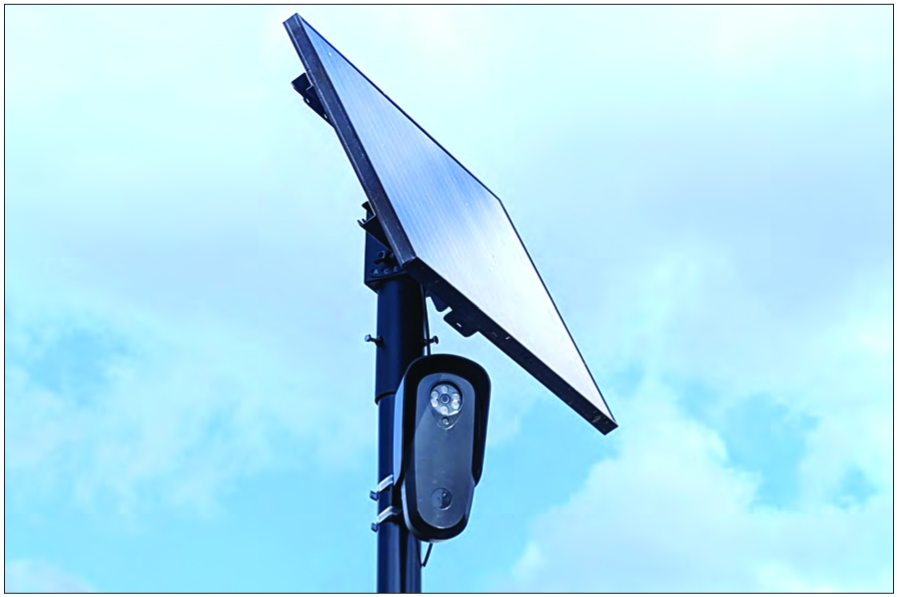
A
Flock Safety ALPR (automated license plate reader). These cameras face a
nationwide backlash over mass surveillance, privacy violations, police
misconduct and high error rates.
Boston put an end to its pilot with Flock, an automated license plate reader (ALPR) company, after the Boston Police Department found that a data-sharing function had been enabled, despite the contract prohibiting it.
But though the city dropped Flock, whose data has been misused by law enforcement to stalk former romantic partners and to aid immigration searches without warrants, Boston’s annual surveillance report revealed that the police department continued or launched pilots with alternative ALPR platforms, such as Motorola Solutions and Axon.
The city partnered with Motorola Solutions on a 45-camera ALPR pilot launched in February, and with Axon on a 30-camera pilot launched in June. There are no publicly available locations of these cameras posted, but crowdsourced websites like DeFlock.org let users map them by submitting coordinates.
City Councilor Ben Weber has proposed an amendment to Boston’s surveillance ordinance to increase transparency around automated license plate readers. The amendment would require the city to disclose when using a new vendor for surveillance technology except for emergencies.
Weber
said he filed the ordinance because he thought the decision to end the
city’s partnership with Flock led people to believe there were no more
automated license plate readers being used.
“I
thought maybe we needed to amend the ordinance to require disclosure
whenever we changed vendors or use a new vendor of a technology, even if
that technology had been approved,” Weber said in an interview.
Although
the general use of license plate readers had been approved by the City
Council in 2022, Weber said councilors were not notified before the
Motorola and Axon pilots began.
City
Councilor Miniard Culpepper said in an online statement to the Banner
that the City Council plays an important role in making sure
surveillance tools are used transparently.
“Involving
the City Council before new surveillance tools are deployed is an
important step toward ensuring meaningful oversight and accountability,” Culpepper said.
The
American Civil Liberties Union of Massachusetts, an outspoken opponent
of Flock, said switching vendors has not solved the issues around
automated license plate readers.
“It’s
not only about deployment of these companies’ license plate readers but
[we’re] also concerned that the police department will continue to
acquire more surveillance technologies from these exact same vendors,”
said Gideon Epstein, policy counsel for the ACLU of Massachusetts’
Technology for Liberty Program.
Both
Motorola Solutions and Axon pilot special orders state that detections
are retained in the system for 30 days and are then permanently deleted.
If the data is needed for an investigation, it must be downloaded
within those 30 days, and the Boston Police Department retains it
according to the department’s applicable retention schedule or rules.
Other law enforcement agencies may submit requests to search BPD’s data
through the Boston Regional Intelligence Center, but the policies do not
give those agencies direct access to the pilot systems.
Epstein
said he was concerned about how Motorola Solutions has previously
contracted with the Department of Homeland Security and U.S. Immigration
and Customs Enforcement.
Fatema
Ahmad, executive director of the Muslim Justice League, said there
needs to be a complete ban on automated license plate readers in
Massachusetts.
“A
number of police officers have already been caught using them to stalk
their partners or ex-partners,” Ahmad said. “It’s just so incredibly
dangerous and needs to be banned.”
Both pilot special orders state that it is a violation to use the cameras to “harass and/or intimidate any individual or group.”
Ahmad said the BRIC’s information-sharing practices have also raised concerns regarding deportations.
“BRIC
has been a concern in the Boston area and something we have campaigned
against for many years now, because of its mass surveillance efforts,
and the fact that it’s funded by the Department of Homeland Security,”
Ahmed said. “BRIC has already shared information with ICE that led to
deportations of young
people from Boston Public Schools.” Boston-based legal organization
Lawyers for Civil Rights obtained records showing how at least 135 BPS
student incident reports were made accessible to ICE through BRIC
between 2014 and 2019. The organization also reported that a student
from East Boston High School was deported in 2017 based in part on a
school incident report shared with ICE through BRIC.
Boston’s
use of automated license plate readers extends beyond the city’s own
police department. The Metro Boston Homeland Security Region’s, one of
five geographic homeland security planning regions in Massachusetts,
fiscal year 2025 funding plan includes a $250,000 Regional License Plate
Reader Program. The program is intended to sustain existing
participation by six municipalities, Boston, Chelsea, Everett, Quincy,
Revere and Winthrop, while expanding the program in Boston and Quincy.
The
City Council’s Public Safety and Criminal Justice and Government
Operations committees are scheduled to hold a joint hearing on Nov. 10
at 10 a.m. to review the annual surveillance report and discuss Weber’s
proposed amendment, Docket No. 1796. Members of the public may testify
in person or virtually and submit written comments.