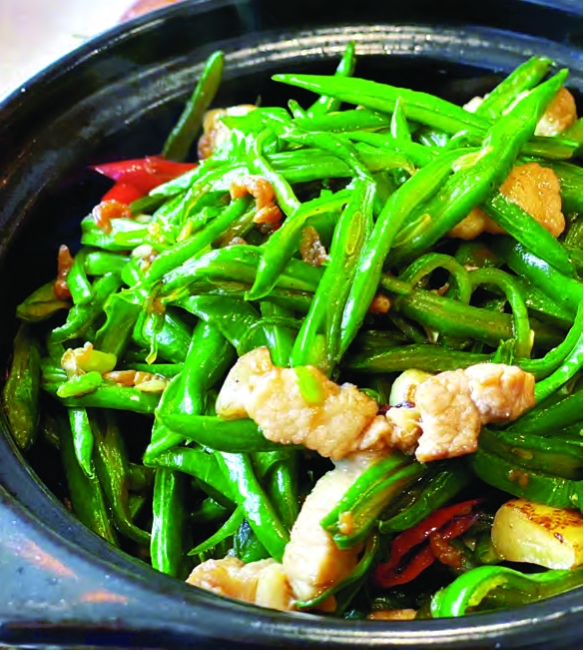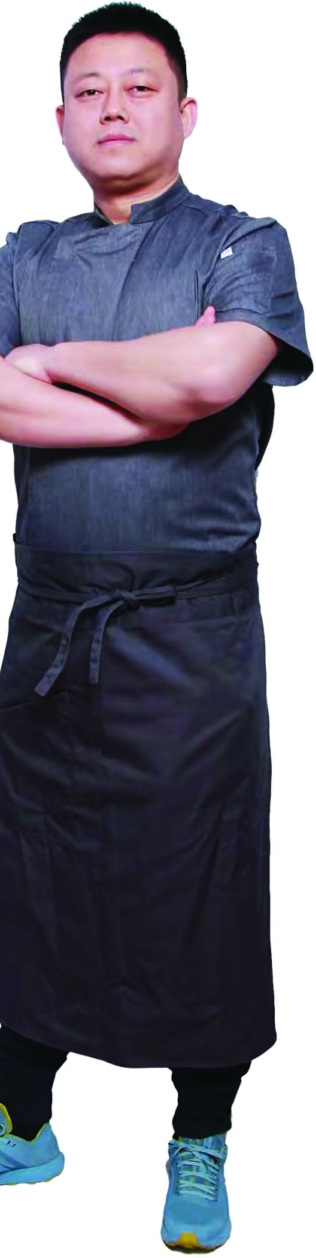
(Above) Stir-Fried Green Beans from Hao Shi Guang. (Right) Chef Liang HouChef Liang Hou has been the executive chef at Northern Chinese restaurant Hao Shi Guang in Allston for two years. Through his menus he hopes to educate American audiences about the nuances of Shandong cuisine, also known as Lu cuisine. Lu cuisine is less common in the American Chinese ecosystem and Hou’s mission is to give it the same gravitas with local audiences as Sichuan and Cantonese styles.
The Banner spoke with Hou about his culinary work and the food history he’s working to preserve. This interview has been edited and condensed for clarity.
Banner: How has your culinary approach evolved since you moved to the United States in 2024?
Hou: In China, most of my guests were locals who already knew Shandong cuisine well. In Boston, everyone’s tastes, eating habits and familiarity with Chinese food are very different. What I have learned is that the form of a dish can change, but the “roots” of its flavor cannot. For example, back in China I developed a barbecued chicken neck dish. I adjusted the seasoning blend many times before I was satisfied, and once it launched, it became a bestseller at our restaurants in China.
When I came to the U.S., I found that most American diners are not used to eating chicken necks, so I switched the main ingredient to chicken wings while keeping the flavor of the seasoning
exactly the same. That became the dish we now call Bu Yi Yang De Ji
Chi, “a different kind of chicken wing.” Chinese and American guests
alike love it.
What makes Shandong cuisine unique?
Shandong
cuisine is regarded as the foremost of China’s eight great cuisines and
it has a very long history. During the Ming and Qing dynasties, it
formed the foundation of imperial court
cuisine. Shandong cooking respects the natural flavor of each ingredient
and demands precise control of heat and balances the five flavors. It
is known for its mastery of broth, which is considered the soul of the
cuisine. As the saying goes, “No broth, no Shandong dish.”
What’s an example of a traditional dish you’re preserving?
Guo
Bao Rou (fried pork in a scoop). This is a time-honored classic of
northern Chinese cooking. The flavor should be sweet and sour with a
savory finish, followed by a lingering fragrance of spices.
Why is it important to you to preserve these culinary traditions?
It
is about lineage. These dishes may look homey, but behind them lies the
skill accumulated by generations of Shandong chefs. Being able to bring
them to Boston in their original form, so that guests here can taste
them too, means a great deal to me.
To
me, preserving tradition does not mean putting old dishes in a museum.
It means holding on to the essentials, giving classic dishes new life so
they keep living in a new place, and teaching these skills to young
chefs.
How do you hope people feel when they eat your food?
I
hope they feel the warmth of home. The name Hao Shi Guang is a play on
the Chinese words for “good times,” with the character for “food” in the
middle. It expresses the hope that people will gather around the table
with family and friends and share a good time together. For Chinese
people living in the United
States, I hope they can taste the flavors of home. For American
friends, I hope they discover how rich and varied Chinese food really is
and want to come back to try more.
ON THE WEB
Learn more at haoshiguangboston.com