MTK
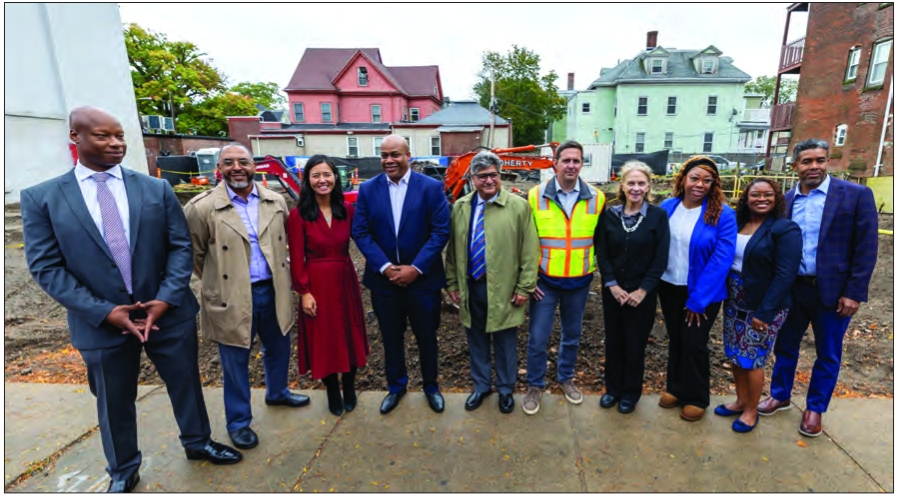
Development and community members join Mayor Michelle Wu to celebrate
the groundbreaking of Marzuq Muhammad Plaza II, located at 376-384 Blue
Hill Avenue in Grove Hall. 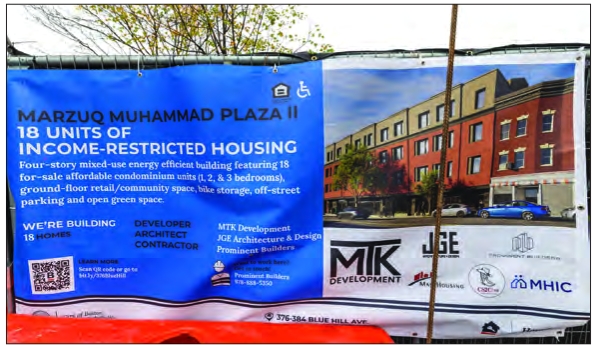
Marzuq Plaza II is named after developer Wadi Muhammad’s brother, who died tragically in 2018.
A Black development firm recently began construction on an affordable housing project in memory of their brother and dear friend. Marzuq Umar Robert Muhammad, died on May 20, 2018 in Atlanta. He was a community leader and developer.
The project, called Marzuq Plaza II at 376-384A Blue Hill Ave., will create 18 affordable homeownership opportunities, community and retail space and public green space, according to a press release issued by the city of Boston.
Wadi Muhammad, one of the leaders of MTK Development and brother of Marzuq, said that one of the lessons he learned from his sibling was to make sure that different projects in the community were about people and community centered.
“Equitable development was a big part of what he believed in as a developer. …Our motto [is] not just building, but building the capacity of people, understanding housing and the quality of housing, how it can change someone’s life and it can change their trajectory as well,” he said.
Being from the community and having seen the divestment over the years, the firm wanted to be part of the investment and building of the community by helping people to stay and not be priced out.
“That’s a big part of honoring his legacy and his work, and continuing that is this project by not just creating housing, but creating ownership opportunities for first-time homebuyers, creating ownership opportunities for our commercial tenant family movement as well,” he said.
Another MTK leader, Jared Harrell, said that there is a lot of benefit in doing a project like this.
“It
feels good to honor Marzuk in doing this, and I think that the benefit
that it’s going to provide the community is much needed with newer
units. If you drive around Boston and you see all of the housing stock, a
lot of the newer buildings stand out, and I think that for us to be
putting new housing in this area will be very beneficial,” she said.
Malik
Aziz, another leader at MTK, said that having worked in different
community development corporations in the city, it feels uniquely
important to be starting new development work for themselves and to
partner with the city on this project.
“It
feels like a different path to success that we are partners with the
city to create, which is [to] find another way to do affordable housing.
Boston is not
short of community development corporations, and the fact that they want
to work with us is exciting, and I think the timing is right. …There’s
another way to do housing development in a smaller kind of startup way,
based on the city having smaller plots of land to work with also. So, it
feels right,” he said.
Aziz
said historically, a lot of community development corporations do not
have people who look like them or reflect and represent the community
coming in for a project and determining and developing what goes in
those communities.
“It’s
particularly meaningful to our community to see two and a half of its
own producing something that’s producing a building on a block that we
used to play on as kids,” he said.
When
asked about the obstacles they faced with this project, Harrell said
that changing general contractors halfway through the predevelopement
phase and making sure that the project meets all the city’s requirements
were the major ones.
“When
you’re working with the city, you have a bit of a defined budget, so we
had to find the right team that could get the job done and then also
work with a lot of the requirements of the city, primarily the financial
kind of requirements. We had to fit inside a certain number and still
get the project done. So that was a big hurdle we overcame, and then
also just in general making the budget work,” he said.
Muhammad had advice for Black entrepreneurs and entrepreneurs of color who may want to open a business.
“Just remind yourself of the North Star. I think for us it was a little easier knowing what we were doing it for,” he said.