
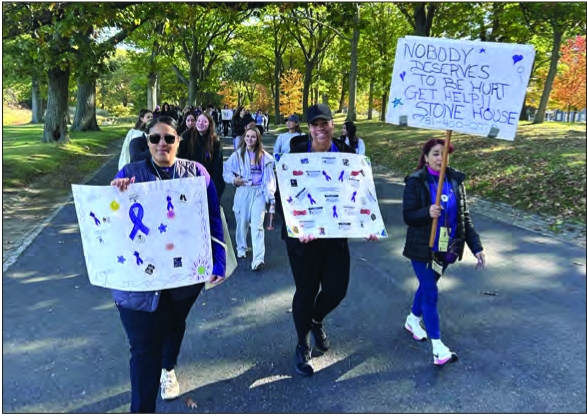
Stone House staff members, lead participants through Franklin Park in Boston on Oct. 24, during the organization’s domestic violence awareness walk. The signs were made by Stone House clients.
This Domestic Violence Awareness Month, prosecutors and shelters that serve survivors in Greater Boston describe growing demand, while a state victim-assistance official says funding is shrinking.
More than 100 people gathered at Franklin Park on Oct. 24, for a domestic violence awareness walk organized by Stone House, a Roxbury-based organization that serves survivors. The event was meant to build community and awareness, not to raise money, said Gina Varamo, the organization’s chief development officer.
Survivors, community supporters, Stone House staff, clients and leaders took part, along with members of sororities from Emerson College and Northeastern University, Varamo said. State Sen. Liz Miranda, whose brother was killed by gun violence in 2017, gave the opening statement.
“Nearly 40 relatives of Yoseliani Ann Marte Ocasio, 18, came to honor her,” Varamo said. Boston police said Marte was found dead July 18 at a home on Malta Road in Mattapan. The state medical examiner’s office ruled her death a homicide on July 30.
The walk came shortly after the Boston City Council adopted a resolution on Sept. 30. The resolution, sponsored by 12 councilors, expresses support for federal, state and local initiatives that provide resources and funding for programs that address domestic violence, according to the city. It also points to the connection between gun violence and domestic violence.
“Stone House shelters more than 400 clients a year,” Varamo said.
Nearly 95% are low or have no income, and most are single women with children. The organization offers emergency shelter, crisis intervention and safety planning, along with an early-learning center for children ages two months to seven years old. Many of those children have seen or experienced trauma at home, she said.
Funding has been a challenge.
Stone House relies on private donations, public funding and other support. Early this year, the organization could have lost nearly $60,000 if funding had not come through, and inflation has strained philanthropy.
During last year’s freeze of SNAP food benefits, she said, the organization gave clients Stop & Shop grocery coupons so they would not lose access to food. It also provides MBTA passes so clients can get to appointments, work and school, and accepts inkind donations so children have clothes that fit. People should keep their dignity wherever they are, she said.
Sometimes the shelter is full and staff must turn people away, Varamo said. They refer them to other programs, including Casa Myrna, DOVE and REACH Beyond Domestic Violence. Jane Doe Inc., the statewide coalition against sexual assault and domestic violence, maintains an active list so people can find the closest shelter, she said.
Prosecutors are seeing growth, too. Erin Murphy, chief of the Domestic Violence and Sexual Assault Unit at the Suffolk County District Attorney’s Office, said her unit handled about 500 to 550 cases a year in 2021 and now has handled more than 800 in 2026, counting domestic violence and sexual assault together.
“There has been a year-on-year increase in domestic violence and sexual assault,” she said, and many cases involve both. Her office prosecutes on behalf of the commonwealth and does not represent survivors as clients, Murphy said. It connects them to shelters and agencies such as Casa Myrna.
The goal is to reduce the impact on women and children, who are most often the victims, she said, while noting that sometimes men are victims too. Murphy said she wants to prevent children from growing up in homes where they see one parent hurt another, and that children who witness violence carry the trauma with them to school and elsewhere.
“We hope to prevent it from happening in the first place,” she said.
State figures show a rise in the most serious cases. The State Domestic Violence Fatality Review Team’s 2025 annual report counted 31 domestic violence-related murder and non-negligent manslaughter offenses reported to police in 2024, up from 26 in 2023. Reported aggravated and simple assaults declined slightly. Vilma Uribe, who chairs the team, wrote that its reviews found “recurring patterns in crisis, judicial response and funding.”
The report says a $7 million cut to a Department of Public Health line in the fiscal 2026 state budget threatened shelter beds, prevention efforts and direct services.
The Healey-Driscoll administration announced a plan in December 2025 to restore cuts to direct services, according to the report, and the team urged the Legislature to provide stable funding and increase annual appropriations for sexual and domestic violence programs.
Liam Lowney, executive director of the Massachusetts Office for Victim Assistance, said in an email statement to the Banner that he is grateful to the administration and the House for prioritizing victim services funding in their supplemental budget.
Domestic violence programs have reported more complex cases, he said, and LGBTQ+ and immigrant survivors have been “especially fearful about accessing help due to recent federal actions.”
“Funding is decreasing while the demand for victim services continues to grow,” he said. “The need for a long-term funding solution from the state has never been more urgent.”
At the State House, several domestic violence bills have been sent to study orders, a step that sends a bill for further study, according to the Legislature’s website. House bills H.1676 and H.2001 were sent to study orders in March, and H.2146, which would extend protections to all employees who are domestic violence victims, was sent to one in May. A Senate version, S.1312, was reported favorably by the Joint Committee on Labor and Workforce Development in August 2025 and referred to the Senate Committee on Ways and Means.
Varamo said domestic violence affects people of all races and income levels, and that it includes emotional and financial abuse as well as physical and sexual violence. All survivors deserve support, she said.