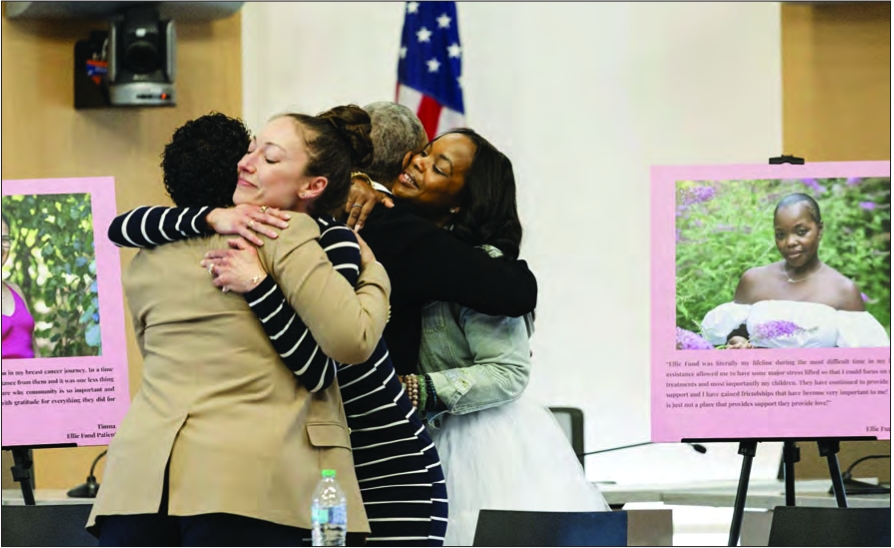
Panelists
embrace after speaking on a patient panel at the Boston Breast Cancer
Equity Coalition’s Breast Cancer Empowerment SummitThe Stoughton resident and mother usually drove herself to appointments. But after her mastectomy at Boston Medical, the 50-year-old cancer patient needed someone to take her home. She did not want to ask a family member, as she’d kept the diagnosis to herself.
The Ellie Fund stepped in.
The Needham-based nonprofit supports breast cancer patients across Massachusetts.
With a few hours before the surgery, staff arranged and paid for a medical escort so the patient could keep her date, said Nekia Clark, the fund’s director of community engagement and advocacy.
Gaps like that can matter more than they seem. Black women in the United States are about 38% more likely to die of breast cancer than white women even though they are diagnosed about 5% less often, according to the American Cancer Society’s 2024 report.
The disparity is not simply about getting screened. Before the pandemic, screening rates in Boston were high among both Black and white women, according to Boston Medical Center’s HealthCity, yet Black women diagnosed under 65 were still dying at higher rates.
A 2024 analysis led by Mass General Brigham researchers found worse survival for Black women across all breast cancer subtypes and suggested factors such as structural racism and the quality and timeliness of treatment play a role.
Clark
said the Boston Breast Cancer Equity Coalition formed in 2014 after
leaders saw Black and brown women dying despite being screened at the
same rates as others. At the time, a Boston Medical Center study found
gaps in education and navigation, and the coalition brought hospital and
community leaders together to address them. When its previous co-chairs
stepped down, the Ellie Fund took over leadership and the coalition is
now part of the fund, she said.
Clark
explained the two biggest reasons women delay or skip treatment as
practical: getting to appointments and finding child care. A breast
cancer survivor herself, Clark knew of the fund because she knew people
who used it.
“I had to ask for it,” Clark said.
“”f you don’t look like you’re in need or you don’t say that you’re in need, it’s not going to be offered to you.”
Money
is another obstacle, said Paula Campbell, a nurse practitioner at
Brigham and Women’s Hospital and breast cancer survivor. Campbell had 20
weeks of chemotherapy followed by surgery at Dana-Farber Cancer
Institute. She chose a women’s oncology team and never felt she received
unequal care.That experience was important and empowering.
“I
went into every appointment professionally, because my life depended on
the information I was getting,” she said. “I went with the agenda to
save my life.”
Still, she lost her health insurance during treatment and said she got no help from her insurer when she tried to sort it out.
Campbell
did not work during treatment, which she described as a privilege, and
she wonders how families with children manage. In her experience,
patients with middle incomes can fall into a gap, earning too much to
qualify for help but not enough to afford care. She believes outcomes
are better for people with more resources.
“The
stress from all these hurdles, other than the actual medical process,
is serious,” she said. “If you’re Black and middle class, you have to
make yourself poor to get help.”
The
Ellie Fund’s women of color support group, formerly called the BIPOC
support group, meets in eight-week cohorts, in person at Healthworks
Community Center in Codman Square in Dorchester and over Zoom, Clark
said. It gives patients a place to talk with peers who have been through
treatment.
Women in
the most recent cohort said they felt they were not being heard, Clark
said. Some told her they skipped meals or bills to pay for
prescriptions.
“It really bothers me that again, in 2026, these are the things that are still happening in our communities,” she said.
Both
women urged patients to speak up. Campbell said patients should ask
questions, such as what dense breast tissue means, and bring someone to
help them stay organized at appointments.
“People can’t help you if you don’t tell them things,” she said.
Clark
noted that screening guidelines now begin at 40, earlier for people
with a family history of breast cancer. She wants October to mean more
than awareness.
“I
want to change the narrative from awareness to action,” she said. That
means staying current on screenings, checking that friends and relatives
do the same and supporting someone in treatment.
For clinicians and social workers, she said, it means listening to patients “and not just providing a service.”