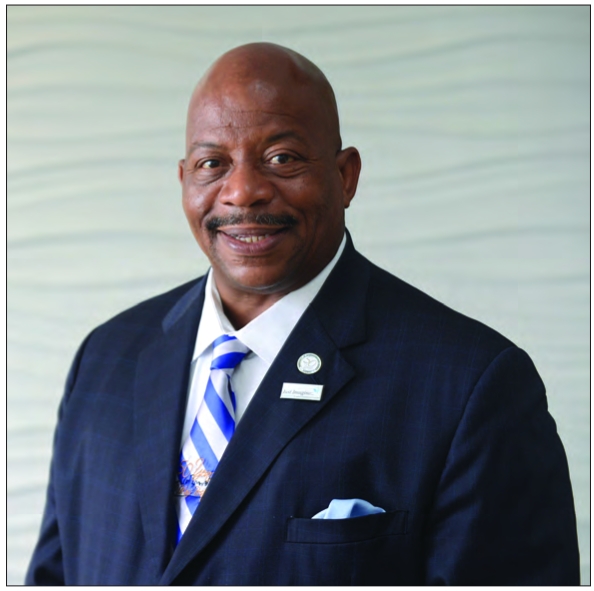
Dr. J. Keith Motley is the former chancellor of the University of Massachusetts Boston.Boston academic leaders kicked off the newest season of ROXTalks, a conversation series hosted by the Children’s Services of Roxbury, with an October 21 episode exploring how communities of color can empower young people and create success for future generations.
Hosted by President and CEO Sandra McCroom, the episode featured two guest speakers: Dr. J. Keith Motley, the former chancellor of the University of Massachusetts Boston, and Dr. Jaykyri Simpson, the executive director of Young Man with a Plan, a mentorship nonprofit serving Black and Latino boys in Boston.
As first-generation college students, Motley and Simpson both highlighted the importance of encouragement and guidance from an early age. Motley, who earned his bachelor’s degree from Northeastern University, attributed much of his personal success to having supportive elders and teachers.
“That early kind of encouragement carried through elementary school and high school and everything else,” he said. “Because they had told me so early that I was this brilliant person, no one could sort of knock me off that pedestal.”
Simpson also emphasized the importance of instilling values and responsibility in children, something he learned from growing up in a large family.
“The rules were … you work hard, don’t bring trouble in this house,” Simpson said.
“You’re the big brother, you have responsibilities.”
Despite encouraging him to excel academically, Simpson said his mother lacked the experience to guide him through the college application process. He never received ACT or SAT preparation, nor did he seriously consider higher education.
“I just didn’t know what I didn’t know,” Simpson said. “I never met a Black doctor; all I knew was Black preachers.”
After graduating high school, Simpson’s basketball coach encouraged him to enroll in Hill Junior College, a local community college. Once on campus, Simpson said he felt more peace than he ever had and realized he loved learning.
“I’m a nerd,” Simpson confessed. “I’ve been a nerd since I was a baby. I never really got to display that because I didn’t have the outlets for that.”
Now, through Young Man with a Plan, Simpson seeks to provide young men with the very exposure he lacked growing up. The organization offers tutoring, career exploration, and mentorship to Boston Public Schools students, encouraging them to envision futures beyond their immediate surroundings.
“I’m asking you what type of life you want to live, what type of car you want to have,” Simpson said. “And then if you haven’t traveled, we’re going to open up a computer, and I’m going to show you … what it looks like in different places of the world.”
Early educational experiences also provided Motley “the rich opportunity to dream big.” In high school, he took college-level classes at local universities. He participated in the University of Pittsburgh’s Upward Bound program (now renamed TRiO), an initiative that helps low-income students attend college.
Motley was later recruited to play basketball at
Northeastern University, where he also conducted research for
then-University president John Curry. He recalled many school leaders
telling him he was “one day going to be them,” but he struggled to see
himself in them.
That changed when he met Benjamin Mays, Morehouse College’s sixth president.
“When
he walked in the room, it blew my mind to see a Black man like that as a
president,” Motley recalled. “He told me that I could be a president,
and I believed it.”
While
both leaders credited their mentors with shaping their paths to
success, they agreed that traditional approaches to guiding young people
must evolve to meet the needs of a new generation.
For
instance, Simpson recalled growing up with the expectation that
children should remain quiet and listen when adults spoke. But that
“leadership tradition” doesn’t work with today’s youth, Simpson said,
who need to feel heard and respected.
“If
you bring a seventh grader in there and you show him that you value his
word, and you’re asking him questions … you’re building that authentic
relationship,” Simpson said. “We have to be in community with them. You
can’t just show up at the door and be like, ‘Oh, I’m the boss just
because I’m older, and you have to do this thing.’”
Beyond
changing how they communicate with young people, Motley called for
moving away from the “baton-handoff ” style of transition and exposing
young people to leadership opportunities earlier.
“It
needs to move from succession to co-leadership,” Motley said. “We have
to sort of figure out co-leadership, where emerging and established
leaders sit together at a governing table.”
Educational
institutions must also adapt to prepare students for a rapidly changing
workforce, Motley wrote in an email to the Bay State Banner.
“Progress
is too slow when systems are designed for a world as it was five years
ago,” Motley wrote. “That’s the structural lag … students need the
agility, technical fluency, and critical thinking required for the next
twenty years.”
Schools
must equip students with technical skills, Motley wrote, including the
ability to navigate artificial intelligence, while preparing them for
career pathways beyond entry-level jobs vulnerable to automation.
“Change
will deepen inequality if we treat technology as something some
communities ‘get’ and others watch,” Motley wrote. “Young people of
color must not be limited to using tools as consumers.”
As
technology reshapes education and employment, both leaders agree that
mentorship alone is no longer sufficient; young people must also have
access to professional networks, internships, and real upward mobility.
“We
can open doors — through mentorship, councils, and invitations to
listen — but lasting transformation requires more than access,” Motley
wrote. “Inclusion must mean decision-making power.”