Economic stability, affordable housing, education, and health care continue to shape Black voters’ political priorities. The Nov. 3 midterm elections are weeks away, and campaigns have centered the Black electorate in their campaign strategies. Early findings from the 2026 Black Census Project suggest that the impact the demographic holds can be understood once the ballots are counted.
Black Future Labs, which surveyed more than 6,000 people from all 50 states and the District of Columbia, found that 95% said they intended to vote, including voters under 30.
“The data does not support disengagement,” said Kristin Powell, executive director of Black Futures Lab. “Black people have lost trust in the systems that govern us, and we have a clear vision for what we want. We require relationships to be delivered by the people who are asking for our vote. But don’t confuse participation with confidence. We are not confident in the systems that govern us.”
Among the reasons respondents want to vote are threats to voting rights and the need for structural change.
“Black people are not interested in restoring an old democracy,” Powell said. “They want a government where they have a seat at the decision-making table beyond the ballot box.”
But their confidence in the voting process did not match the enthusiasm for the turnout.
Trust waning in governance
Only 3% reported trusting the federal government this year, and 22% reported trusting Black elected officials.
Meanwhile, trust in the U.S. Immigration and Customs Enforcement (ICE) and elected officials was low across respondents.
When it comes to values, Black people chose equality and justice as two of their most important values (87%).
A
section of the survey-takers said they would abolish the Electoral
College, which comprises 538 electors, and a majority of 270 electoral
votes is needed to elect the President. It is an indication that they
are looking beyond electoral participation and seeking structural
changes to achieve a responsive democracy.
The
skepticism extends to health insurers, tech companies, U.S. Immigration
and Customs Enforcement (ICE), and the police, garnering less than 10%
of the respondents’ favor.
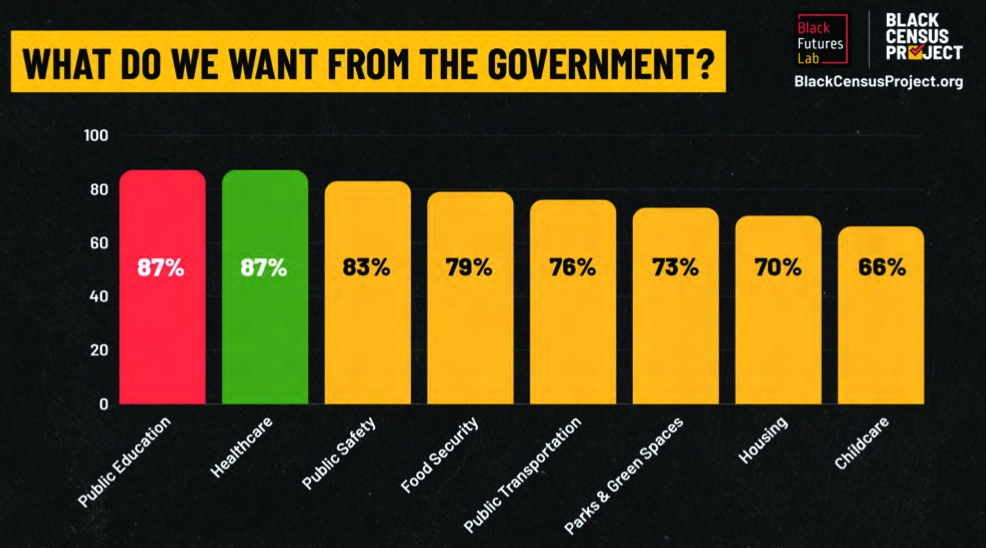
What do Black people seek from the government?
Public
education, health care, public safety, and food security top the list
for Black voters’ expectations from elected officials, followed by
public transportation, parks and green spaces, housing, and child care.
Voters also weighed in on the issues governments
should focus on, including data centers to pay more for electricity, AI
privacy, making college education more affordable, reparations, taxing
millionaires, and increasing the minimum wage to $20.
“All of these are issues that are universal, and these are the things that people are telling us that they
want the most,” said David White, data strategist at Black Futures Lab.
“All these things are tending to be very practical.”
Advocacy for Black children
Rev.
Dr. Starsky Wilson, president and CEO of Children’s Defense Fund, said
early findings from the Black Census Project show that Black children
are more likely to live in poverty and experience hunger from SNAP
(Supplemental Nutrition Assistance Program) cuts.
“Having
heard their voices, this fall we must vote for our children and with
our children,” Wilson said. “But beyond that, we must continue to craft
public policies and an agenda that facilitates their flourishing and
pursues it with all that we have.”
The new American dream
Black
voters dream of becoming debt-free, improving their physical health,
earning more money, and finding safe and affordable housing, according
to the survey.
“You
might describe all of these as kitchen table issues, and they are not
specific, but rather they are universal,” White explained. “We’ve
documented for our data, the dreams specifically of Black people, and
we’re hearing very practical things that they’re dreaming about.”
White added trust in institutions has trended downward across all three censuses (2018, 2022, and 2026).
The
share of respondents identifying as independent rose. It reveals an
engagement gap that Powell raised, which led the lab to build a base
among Millennials and Gen Xers in the South
“We
have seen over time the spike in Black voters that were voting during
the Obama years and haven’t voted much since,” Powell said. “There’s a
lot of engagement and strategy around how do we reach young Black
voters, but not as much as how we reach middle-aged Black voters who
have started to just slowly sit out.”
This story first appeared in The Defender.