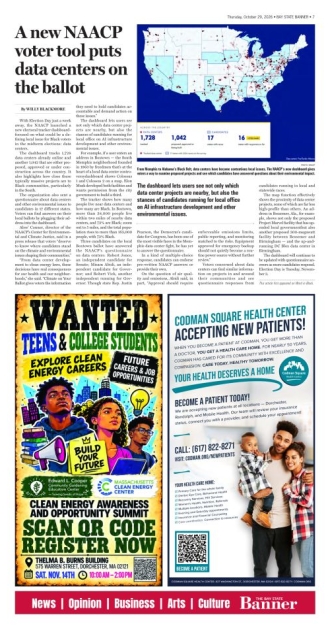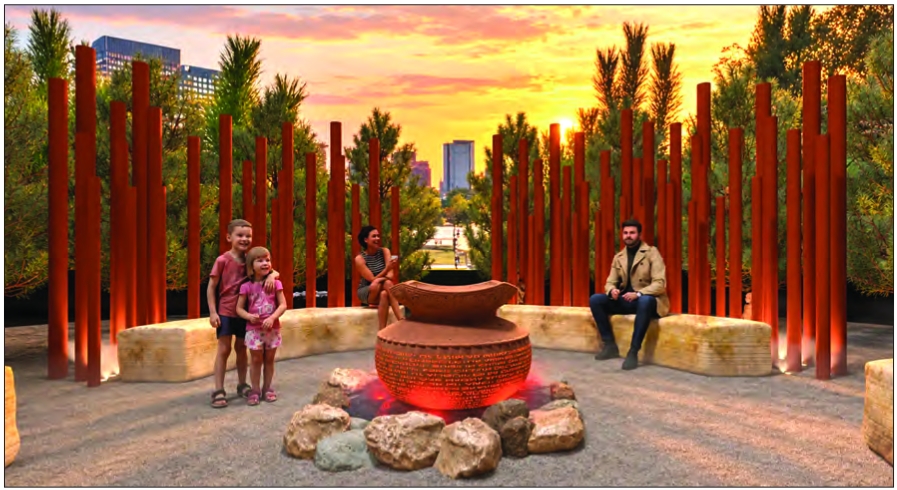
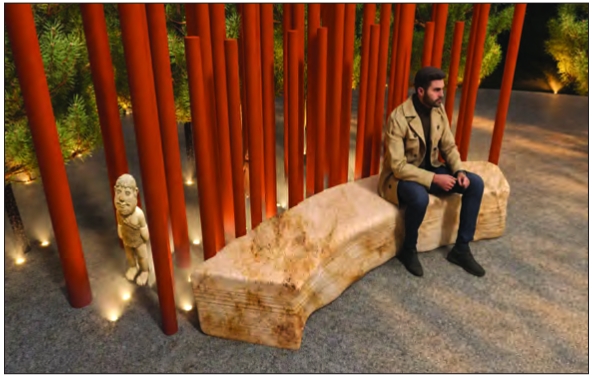
Renderings of the White Pine Gathering Place.
Franklin Park is expected to become home, in the coming years, to a new monument that honors the Wampanoag people.
The monument, known as White Pine Gathering Place, will become the first permanent tribute in Boston that honors an Indigenous community.
“I think this monument really is a step toward healing,” said Steven Peters, a citizen of the Mashpee Wampanoag Tribe. “It’s a step towards finally feeling as though we have a platform as Native Americans to be able to develop a space and share a story that we feel as though truly reflects who we are.”
The monument is part of the city’s “Un-monument | Re-monument | De-monument: Transforming Boston” initiative, a program that works with local artists to reimagine who is memorialized and why.
At the center of the monument will be the story of Moshup, a prominent figure in Wampanoag mythology, which will be inscribed on a pot. Moshup, a giant, created the separation between Cape Cod and Martha’s Vineyard by dragging his foot along the coastline, according to the legend.
The pot will be surrounded by benches and Corten steel poles, symbolizing red cedar and circled by white pine trees, which represent life for the Wampanoag tribe.
The monument was designed by the organization SmokeSygnals, which works to tell the untold stories of Indigenous history through exhibits and art installations.
Peters, who is also the creative director of SmokeSygnals, said he worked with three Wampanoag tribes to help him design the monument. He added that the Wampanoag people view the monument as a “functional space that was connected to the land.”
“That’s what this monument is.
It
has four directions … so you’re able to enter from north, east, south
and west. It has trees that are planted along the exterior that are
bringing nutrients back to that soil,” he explained. “Also, it brings a
contemporary art feel to it, which is something that was important for
the tribal communities, showing that our art and our culture are
continuing to evolve in a contemporary world, as well.”
Erin
Genia, Boston’s first Indigenous Public Art and Cultural Spaces
consultant, said she’s been “heavily advocating” for this monument
because there’s a lack of Indigenous representation in the city’s art
landscape.
“...
There’s many monuments and memorials and public art that not only
invisibilize Native American and Indigenous people, but they also
glorify the story
of colonialism, which has been very hurtful for Indigenous
communities,” said Genia, who is also a member of the Sisseton Wahpeton
Oyate tribe in the Dakotas. “It’s really important that we begin to tell
those stories from an Indigenous perspective.”
Peters said the purpose of the monument is to create a place where people can come, sit and reflect.
“How
they do that is up to them, but we’ve created the space for them to be
comfortable and use it the way that they feel is best,” he said. “We’re
working with, not only Wampanoag tribes, but other Indigenous tribes
from around Boston to talk about how this space is also used for
ceremonial purposes — that’s something that the tribes will use it for.”
SmokeSygnals
will present the final design to the public at Franklin Park later this
month. But the group still needs to raise roughly $2 million to build
the monument and get multiple approvals from the city.
“We’re
going to work with the city to see if we can secure the funding and
make this a reality,” Peters said. “Once the funding is in, we’re at
about a 24-month fabrication and installation schedule.”
Genia said she hopes that this monument can open the door to more Indigenous monuments and public art in the city.
“I
think that to have a monument in public space where the public can
begin to learn about Wampanoag people … and that we need to come to
terms with in order to move forward in a good way — I think that this
monument is an awesome step toward that,” she said.
Peters said developing more spaces like this can also bring healing back to Indigenous communities.
“The
idea of having a place where people get to come together, where
intertribal relations can happen, where intercommunity relations can
happen, is a positive thing for everybody,” he said.
This article first appeared on GBH News. Diane Adame is digital reporter with GBH News.