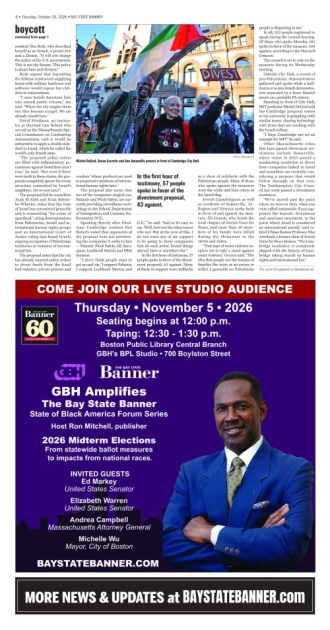
Michel DeGraf, Susan Escovitz and Ann Antonellis protest in front of Cambridge City Hall. Hundreds packed the Cambridge City Council chambers and an overflow room to testify in favor of and against a pair of policy orders that call on the city to divest from and end contracts with businesses that are profiting from Israel’s genocide in Gaza, occupation of Palestinian territories and apartheid policies toward Muslim and Christian citizens of Israel and Palestine.
“These companies are selling weapons to the Israeli government that are bring used to target, maim and kill thousands of children according to the United Nations Human Rights Commission,” said Cambridge resident Steven Cellucci, who wore a keffiyeh while testifying during hearing. “We can do something about it, like we did about South Africa in the 1980s.”
Cellucci and others invoked a series of measures the city took four decades back to withdraw from companies doing business with South Africa as part of a global movement that isolated that country’s government and brought an end to its apartheid policies.
Those testifying against the measure last week argued that singling out Israel is hypocritical and would lead to discrimination against Jewish people of all political persuasions in Cambridge.
“This policy has nothing to do with the Palestinian people,” said Cambridge resident
Noa Roth, who described herself as an Israeli, a proud Jew and a
Zionist. “It will not change the policy of the U.S. government. This is
not the Senate. This policy is about hate and division.”
Roth
argued that boycotting the defense contractors supplying Isreal with
military hardware and software would expose her children to
antisemitism.
“I raise
Israeli American kids who attend public schools,” she said. “When the
city singles them out, they become a target. We are already unsafe
here.”
David Friedman,
an instructor at Harvard Law School who served on the Massachusetts
Special Commission on Combatting Antisemitism, said it would be
antisemitic to apply a double standard to Israel, which he called the
world’s only Jewish state.
“The
proposed policy orders are filled with inflammatory accusations against
Israel that aren’t true,” he said. “But even if there were truth to
these claims, the proposals completely ignore far worse atrocities
committed by Israel’s neighbors. Do we not care?”
The
proposal iled by councilors Ayah Al-Zubi and Jivan Sobrinho-Wheeler,
states that the state of Israel has committed genocide and is committing
“the crime of apartheid,” citing determinations from Palestinian,
Israeli and international human rights groups and an International Court
of Justice ruling that found Israel’s ongoing occupation of Palestinian
territories in violation of international law.
The
proposal notes that the city has already enacted policy orders to
divest funds from the fossil fuel industry, private prisons and vendors
“whose products are used to perpetuate violations of international human
rights laws.”
The
proposal also notes that two of the companies singled out, Palantir and
Flock Safety, are currently providing surveillance technology to the
federal Department of Immigration and Customs Enforcement (ICE).
Speaking
directly after Friedman, Cambridge resident Ben Roberts noted that
opponents of the proposal were not mentioning the companies it seeks to
ban — Palantir, Flock Safety, GE Aerospace, Lockheed Martin and Elbit
Systems.
“I don’t think people want to get up and say, ‘I support Palantir, I support Lockheed Martin and G.E.,’” he said. “And so
it’s easy to say, ‘Well, here are the other issues why not.’ But at the
core of this, I do not want any of my support to be going to these
companies that do such awful, brutal things abroad, here or anywhere
else.”
In the first
hour of testimony, 57 people spoke in favor of the divestment proposal,
43 against. Many of those in support wore keffiyehs as a show of
solidarity
with the Palestinian people. Many of those who spoke against the
measures wore the white and blue colors of the Israeli flag.
Jewish
Cantabrigians as well as residents of Somerville, Arlington and Newton
spoke both in favor of and against the measure. Eli Gerzon, who heads
the local chapter of Jewish Voice for Peace, said more than 40 members
of his family were killed during the Holocaust in the 1930s and 1940s.
“That
type of racist violence inspires me to take a stand against racist
violence,” Gerzon said. “The idea that people use the trauma of families
like mine as an excuse to inflict a genocide on Palestinian people is
disgusting to me.”
In
all, 352 people registered to speak during the council hearing. Of
those who spoke Monday, 165 spoke in favor of the measure, 100 against,
according to the Harvard Crimson.
The council is set to vote on the measure during its Wednesday meeting.
Outside
City Hall, a crowd of pro-Palestinian demonstrators gathered and spoke
while a halfdozen or so pro-Israeli demonstrators separated by a fence
blasted music on a portable PA system.
Standing
in front of City Hall, MIT professor Michel DeGraf said the Cambridge
proposal comes as his university is grappling with similar issues,
sharing technology with firms that are working with the Israeli miliary.
“I hope Cambridge can set an example for MIT,” he said.
Other
Massachusetts cities that have passed divestment resolutions include
Somerville, where voters in 2025 passed a nonbinding resolution to
divest from companies linked to Israel and councilors are currently
considering a measure that would follow through on that vote. The
Easthampton City Council last week passed a divestment resolution.
“We’ve
moved past the point where we were in 2021, when you were called
antisemitic if you supported the boycott, divestment and sanctions
movement, to the point where Israel is considered an international
pariah,” said retired UMass Boston Professor Elsa Auerbach, a former
chair of Jewish Voice for Peace Boston. “The Cambridge resolution is
completely aligned with the history of Cambridge taking stands on human
rights and international law.”
This article first appeared on flipsidenews.net.