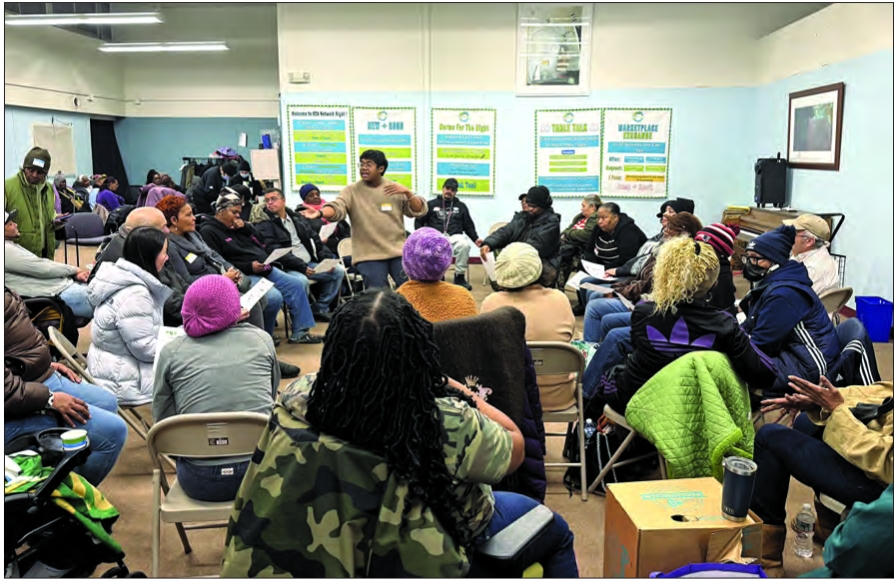
Dr. Dumichel Harley, an MGH neuropsychologist and our lead clinician, giving a talk on “Brain Health and Ways to Bolster It” at a Union Capital Boston network night.Nearly 200 older Black adults in Boston and Cambridge have taken part so far in a Massachusetts General Hospital study of chronic pain and early memory decline, and the research team has received up to 1,100 referrals of people who might join, said Nia Stewart, a project coordinator for the program at the hospital.
Stewart said 195 people have participated across the two communities in the study, called Healthy Aging as Black Adults: In It Together, or HABIT, which she explained is about halfway completed. The study’s website says about 400 older Black adults will take part in it over five years. Stewart pointed out that the Patient-Centered Outcomes Research Institute funds the program.
Many of the participants in HABIT have heard about the study by word of mouth, Stewart said, with a participant experiencing the study and then sharing about it with their communities.
“People are having some pretty profound experiences,” Stewart said.
Stewart, who spoke as both a community member and a researcher, pointed out that participants are “hanging out afterwards. The team is hearing that many people were not leaving their homes as much after COVID-19,” she said, and that an opportunity like this has been “invaluable.”
The study focuses on chronic pain and early cognitive decline commonly occurring together and making each ailment worse, raising the risk of dementia. Their website states that older Black adults have the highest rates of both and are at the highest risk of poor health outcomes. The study compares two programs, the mindfulness-based Cognitive Therapy plus walking and Active Living Every Day, both delivered in person as group sessions in community-based settings.
Participants go through a physical check-in and a few quick assessments when they enter the program, Stewart said, and the team repeats them over time. Participants also fill out surveys throughout the study, and the team pairs those results with interviews to understand what the data show and what participants say about it.
The team cannot change the programs midway through the evaluation even as feedback and survey responses come in, Stewart said, because researchers need consistent, fair points of comparison. What participants say could help shape future versions of the study, she explained.
Stewart said chronic pain is very variable, and so is how much it affects a person’s memory, because many factors come together, including lifestyle and psychosocial factors, which she said are important. She described physical activity as one piece of them, alongside skills that can help with attention, thinking and sleep.
Stewart points out that there is a good, historical reason many in the Black community, including her own, have not been as open to research. That is why it matters that Black people are “in the room and included in intervention development,” she said, because interventions and research are constantly being developed.
The Wellness Collaborative, a Roxbury nonprofit that is a community partner in the inquiry, was founded by three Black women — an internist, a pediatrician and a psychologist. Dr. Karen Craddock, a psychologist, co-founded the organization and serves as executive director of its programs and community initiatives. She is also a co-principal investigator on the study.
Craddock said the collaborative officially launched in 2019 to take a holistic, integrative, interdisciplinary and community-based approach to health.
“It is certainly an important and timely topic for our community,” Craddock said of the research, which she tied to aging, cognitive decline and dementia.
She added that she took part in community-based research about 20 years ago through a Harvard School of Public Health program focused on eliminating health disparities. Returning to that kind of participatory research through The Wellness Collaborative “really felt aligned,” she stated.
Much of the outreach has happened through what she called “community champions” and “community connectors,” residents who attend community events and help identify organizations and groups that might be interested in the study. The partners shaped their approach along the way. Craddock explained that the collaborative molded its approach along the way to reach Black men and Black women and to include faith-based groups and small business owners, including salon owners, who can help amplify the information.
Community members are also being trained as peer facilitators so the work can continue,
Craddock said, and sustainability planning is built in. The training could also be a pathway to careers in health and wellness, she said.
Craddock expressed that she wants residents of Roxbury, Boston and Cambridge to know the topic is timely, important and affects all of us. Saying, “It is important to be well informed, [and] to be discerning.”
She also stressed the importance of Black residents being engaged as researchers, with “having our voices be part of shaping research itself.” Taking part, she said, means more than signing up. It also means reflecting on and understanding what the research involves.
People interested in participating can contact the study team at 617-726-1199 or by email at [email protected]. Further details at can be found at thehabitstudy.com.