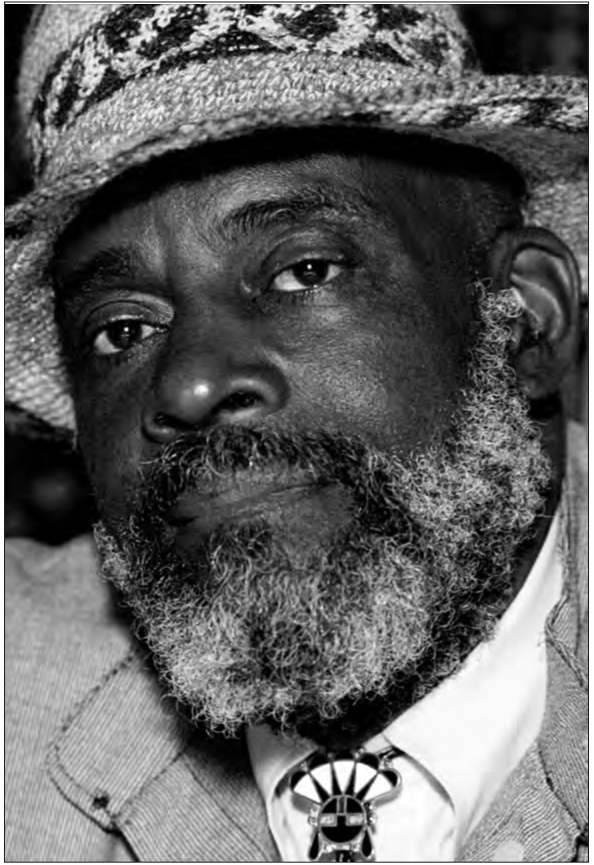
Mel King 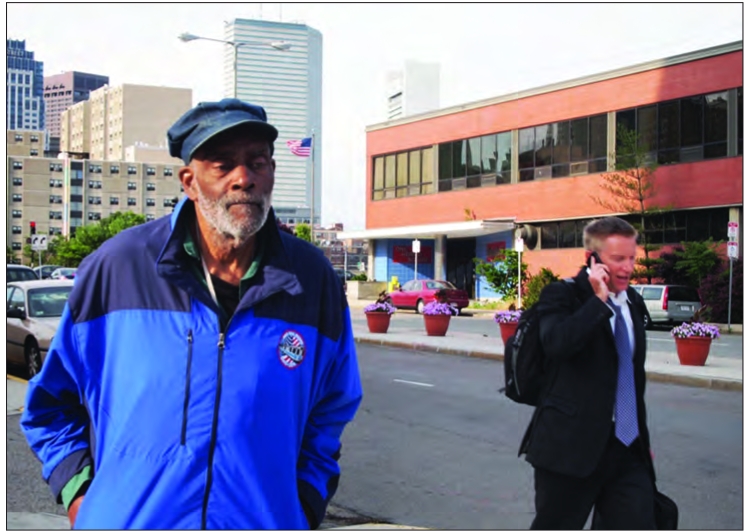
In this 2011 photo, Mel King stands across the street from the former site of his childhood home, then the headquarters of the Boston Herald, now the site of the Ink Block luxury development.
Activist, organizer, legislator and lifelong South End resident Mel King is regarded as the architect who redesigned Boston’s sociopolitical blueprint. A fixture of relentless, human-scaled persistence, King’s primary office was his South End kitchen table, where he opened his home every Sunday for decades to anyone who wanted to challenge local systems that disproportionately affect marginalized communities.
King’s fight for spatial equity and economic justice advanced his concept of “development without displacement,” forging a legacy that gives working-class Black and brown Bostonians a permanent stake in the soil.
That grassroots footprint led the charge in spearheading collective organizing for farmers’ markets in metropolitan settings, the development of William E. Carter Playground in the South End — the city’s first public park to be named after an African-American — and the landmark 1968 Tent City protests triggered by the disregard for displaced residents amid urban renewal projects.
Mercedes Tompkins, a longtime Boston organizer who volunteered during King’s historic 1983 mayoral campaign, remembers a leader whose activism is intertwined with the cobblestones. Tompkins described King as a “big-picture guy,” from his 7:30 a.m. routine presence on the tennis courts at Sportsmen’s Tennis & Enrichment Center to his phone calls that always signaled good trouble.
“I would see Mel’s number pop up and immediately think, ‘Oh, he’s got an idea,’” Tompkins told the Banner. “I would say, ‘Okay, Mel, what is it?’ And he’d say, ‘Well, I’m thinking about pulling such and such together, and I want to meet with you and so-and-so.’ When Mel calls, you go.”
This vision reached national momentum with King’s 1983 mayoral campaign against Raymond Flynn. As the first Black candidate to advance to the general election for mayor, King innovated a multiracial, multigenerational Rainbow Coalition, expanding beyond race to include class, gender orientation, religion, neighborhood and philosophy to advance affordable housing advocacy and ease racial tensions.
“It gave hope to people and taught us that community organizing across race and class can be successful,” Tompkins said. “He saw the city through the Rainbow Coalition, and anybody who ran as a progressive touched base with Mel. They wanted to work with him, get his endorsement and understand his ideas.”
Civil rights leader Rev. Jesse Jackson witnessed and actively supported the campaign before adopting the coalition concept for his own historic U.S. presidential bids.
King lost the mayoral election in a runoff. Still, community members saw him as a representative of hope who fundamentally altered the city’s political DNA and offered an era-defining sense of possibility.
This extended to King’s academic work at MIT, where Tufts University teaching professor Penn Loh was introduced to the activist as an undergraduate in the late 1980s. Loh later worked with Alternatives for Community Environment (ACE) and found King’s legacy to be a steady current beneath local environmental justice.
“Everything we were doing felt like Mel’s fingerprints were on it,” Loh said. “His network of leaders, activists and all those inspired by it was where we looked to develop vision [and strategize].”
King extended the fight for community control into the digital age as a co-founder of the South End Technology Center. He believed technology was never meant to be an inaccessible luxury for the working class.
“Mel taught us that ‘high tech is low-tech,’” Loh said. “We shouldn’t be thinking about high technology as beyond and above people, but who’s deciding what to do with it and how to develop it. Helping young people both learn technology and put it to work for the community [is] the center’s whole ethos.”
The South End Technology Center, located around the corner from King’s home, served as an anchored culmination of his career.
In these later years, he cemented a blazing trail for collective governance, demonstrating how institutions can meet the needs of the neighborhood, workplace, land and academia. This foundation informed Loh’s nearly 20-year trajectory at Tufts.
“I’ve pointed to our program and said, ‘Look at what Mel has been able to do at MIT and why these kinds of programs are so great,’” Loh said. “Maybe we could do something like that here.”
King taught community as a core approach to policy, and in the early 2010s he shared a linguistic diagram during a guest lecture at Tufts that Loh called “completely mind-blowing,” and that still sticks with him in 2026.
“Mel broke down the word ‘hearth’ for a room of over 100 people,” Loh said. “Knowing a hearth is at the center of a home, he pointed out that within the word ‘hearth’ are the words ‘earth,’ ‘art’ and ‘heart.’”
Although King witnessed milestones once considered impossible, like Boston’s first woman and Black mayor, Kim Janey, taking office in 2021, and the city electing its first Asian mayor, Michelle Wu, in the same calendar year, Loh holds onto a truth King gifted his MIT students: “Every generation has its task.”
“We stand on the shoulders of the generations that came before us, and we will be in a place where others come after us,” Loh said. “Mel was always clear that the work towards justice is not something to be achieved in one generation. This is a continual process, and I hold onto hope that the spaces we have, in which to dream, keep going.”
Many believe Boston’s bright mosaic is the harvest of seeds King planted through his innumerable legacies, and it deserves more than passing praise or a handful of infrastructure namesakes and murals. The Mel King Institute for Community Building (MKI), the city’s institutional steward of the “father of community development in Massachusetts’ principal philosophies, established years before he died in 2023, seeks to fill those gaps.
“Mel worked to change repressive systems in Boston and Massachusetts as an elected official as well as a community organizer,” said Emily Haber, president and CEO of the Massachusetts Association of Community Development Corporations, which manages MKI. “We are carrying forward his legacy when we organize through our CDC network to advocate for policies and resources that support the true needs of our communities.”
MKI seeks to remain grounded in King’s mission by keeping programming like a national book club initiative to expose communities to his 1981 book “Chain of Change: Struggles For Black Community Development” and leadership opportunities for public housing tenant board members “highly intentional and thoughtfully designed.”
Yet, as Boston faces surging displacement, rising housing costs, the federal erosion of antidiscrimination protections and a radically shifting South End, locals say official municipal recognition of King’s contributions easily becomes an afterthought.
“We need to think broader and bigger for a coordinated acknowledgment of Mel’s work across the city of Boston,” Tompkins said. “To me, his homegoing services weren’t enough for all he gave to build systems here, especially as a product of the South End himself.”