
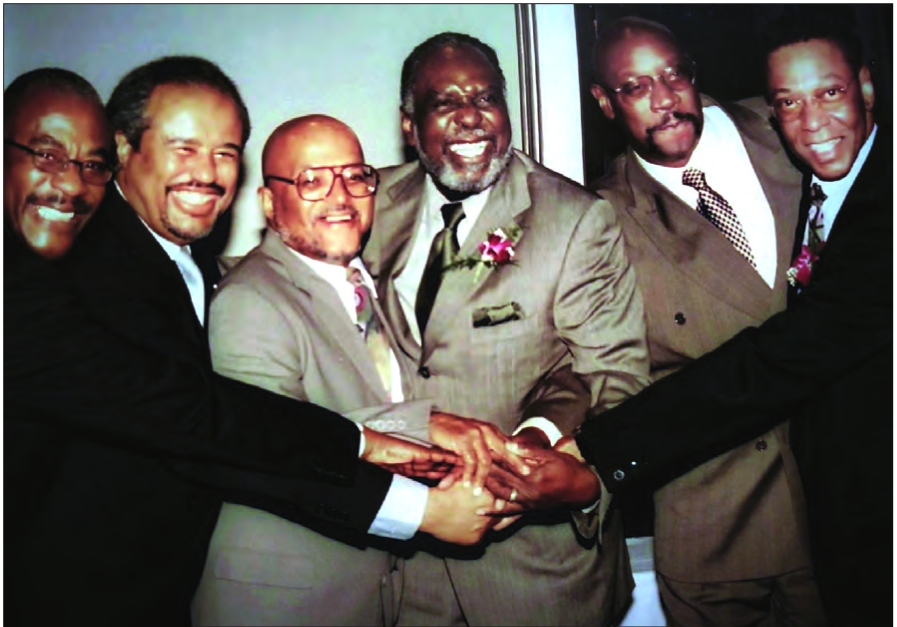
Veterans Benefits Clearinghouse, Inc. Board of Directors Emeritus, (from left) Ernest Washington Jr., Ron Armstead, Alan Dobson, Ralph Cooper, Donalexander Goss and Maurice Lewis.
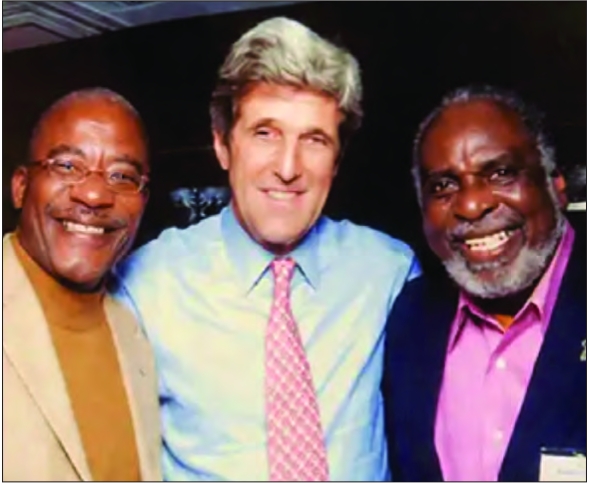
Ernest Washington Jr. and Ralph Cooper with former Secretary of State John Kerry.
Ralph Cooper spent his life making sure that veterans of color, and veterans without homes, got what they had earned. He did it first in Roxbury, as a co-founder and executive director of Veterans Benefits Clearinghouse. He did it nationally, as a co-founder of the National Coalition for Homeless Veterans (NCHV). And he did it in Houston, where he served veterans until the end of his life.
Cooper died Sept. 26 in Houston. He was 85.
An Air Force veteran, he served from 1963 to 1967. He leaves his wife, Deneice Kennebrew Cooper, along with children and grandchildren, and organizations in Boston and across the country that carry his work forward.
“Throughout the history of America, African American men and women have sacrificed, persevered, and survived the challenges and consequences of the military experience,” said Ernest Washington Jr., who co-founded Veterans Benefits Clearinghouse with Cooper. For Cooper, surviving was not enough. Veterans who had served their country also deserved to be served by it.
In 1977, Cooper joined fellow veterans Ron Armstead, Willie Brown, Washington and Donalexander Goss to found Veterans Benefits Clearinghouse, Inc.
(VBC) in Roxbury. They saw a clear problem. Black veterans and other veterans of color were left on their own, competing with veterans across eastern Massachusetts for benefits and information that were hard to find and harder to claim.
VBC set out to close that gap.
It became a place where a veteran of color could walk in, be understood, and get help with a system that too often seemed built to keep them out.
Cooper later led VBC as its executive director. In 1987, VBC created the Veterans Benefits Clearinghouse Development Corporation to move veterans, in its words, “from homeless to homeownership.” VBC’s service work ended in 2009, but the development corporation, which has built 419 units of affordable housing, carries on under Harold Raymond, its president since 2009.
A voice for Black veterans in Boston
Cooper was a recognized leader among Black veterans in Boston. The Bay State Banner and other outlets cited him as one of the veterans who built veterans’ services in Roxbury and quoted him as a voice for veterans of color. In 2011, Vietnam veteran Jaime Rodriguez told the Banner that African American vets such as Cooper, Ernest Washington, Ernest Branch and Ron Armstead helped win services for Vietnam veterans in Boston.
Cooper’s sense of who belonged in that brotherhood was generous. In 2009, at a memorial for the Boston political organizer Juan Tennyson, one of the first Afro-Latinos to serve in the Honduran military, Cooper told the Banner it did not matter that Tennyson had never served in the U.S. armed forces. “He was a soldier, even in campaigning,” Cooper said.
He also pressed the VA directly.
In 2006 at a meeting U.S. Rep. Stephen Lynch called to fight a proposed consolidation of Greater Boston’s VA hospitals, Cooper said he was disappointed that the VA had not responded to local veterans’ concerns. He wanted the agency to commit to making the process “work for all veterans from all neighborhoods.”
A national voice for minority veterans
Cooper’s advocacy reached well beyond Roxbury. In 1990, he was among the founders of the National Coalition for Homeless Veterans, which united community-based veteran service providers around one goal: ending veteran homelessness. In 2002, the VA secretary appointed him to the department’s new Advisory Committee on Homeless Veterans. He also served on the VA’s Advisory Committee on Minority Veterans and the Executive Committee of the Congressional Black Caucus Veterans Braintrust.
NCHV gave him its Thomas Wynn Sr. Memorial Award for Lifetime Achievement in 2009, and in 2021 its Jerald Washington Memorial Founders’ Award, the movement’s highest honor.
Kathryn Monet, NCHV’s chief executive, said Cooper often served as the “conscience for the movement,””pulling colleagues back to their values and keeping veterans first.
Continuing the work
When Cooper moved to Houston, he did not retire from service.
As Community and Residential Veteran Services Coordinator for Cloudbreak Houston, which NCHV called the nation’s largest developer of housing for homeless veterans, he kept supporting veterans who had experienced homelessness for more than 40 years.
He also ran his own company, Brewcoop Business Enterprises.
The setting changed, but the mission did not.
“From VBC in Boston, to his continued dedication in Houston,” said Patricia Bonner-DuVal, “his vision of equity for vets lives on, especially Black and Brown vets struggling to access the services they need most.”
His homegoing celebration was held Oct. 14 at Fallbrook Church in Houston, followed by burial at Houston National Cemetery.
Family and legacy
Cooper leaves his wife, Deneice Kennebrew Cooper, and his children and grandchildren.
Jocelyn Cooper of Baltimore and Deon Kennebrew; a son, James Landrum of Houston; five grandchildren, Shavon Huggins and Crystal Huggins of Boston, Julian Landrum, Kasstiel Landrum, Amitiel Landrum of Houston); four great-grandchildren, Keyshawn Huggins, Deontae Gooden, Nahum Huggins and Crystal Wilson; one great-greatgrandchild, Semaj Gooden of Boston; and a host of family and friends who loved him so much.
Colleagues remember him as a mentor. Brad Bridwell, who chairs NCHV’s board, said Cooper guided many people new to the field, Bridwell among them, and helped bring about some of the movement’s most important policy changes.
His legacy is measured in veterans who got the help they were owed. It lives in the hundreds of affordable homes built by the development corporation VBC created. It lives in a national coalition he helped found. And it lives in the many veterans in Roxbury and Houston who were met, at their moment of need, by someone who had stood where they stood.
Ralph Cooper believed that a country’s promise to its veterans should be kept for all of them. He spent his life holding it to that promise.