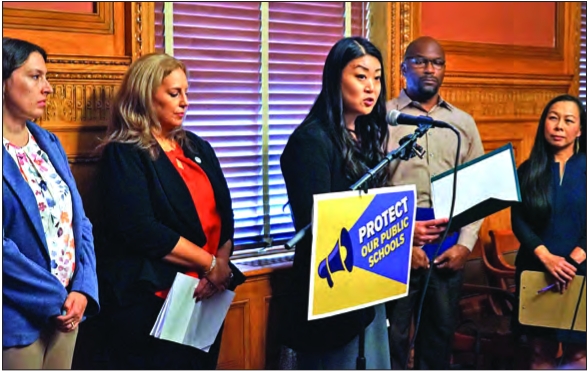
American Federation of Teachers Massachusetts President Jessica Tang addresses reporters during a press conference at the State House on Oct. 5.Under regulations the U.S. Treasury Department released Thursday for the Trump administration’s new federal voucher program, states would have no power over how money is spent and for what purpose.
Under the Federal Scholarship Tax Program, as the voucher system is called, individuals can donate up to $1,700 to nonprofits and receive a full reimbursement from the IRS. Donations are made to so-called scholarship granting organizations (SGOs) which then can donate money for tuition at private and parochial schools and after-school and summer programs. Donations can also be made to schools, including public schools, for the purchase of instructional materials.
Under the law, governors have the sole power to opt states in or out of the program.
While the Republican governors of 30 states have opted into the programs, as has the Democratic governor of Arizona, other Democratic governors have either declined to participate or said they would wait for the federal guidelines to be released.
Gov. Maura Healey has not said whether she will opt Massachusetts into the program. A spokesperson for the Executive Office of Education offered a statement.
“We are aware that the Trump Administration issued temporary and proposed regulations today and will review them,” the spokesperson said in a message sent via email.
Massachusetts Teachers Association President Matt Bach is part of a coalition that is urging the governor to pass on the program.
“Gov. Healey likes to stand up against Trump,” Bach told the Flipside. “This is an instance where she should. We should not re-direct public funds to private institutions.
Members of the Massachusetts Educational Opportunities Coalition, pushing Healey to opt into the tax credit, reject the notion that it is a voucher program and insist it would be advantageous for public school students who are served by nonprofit afterschool and summer programs.
“This was a bipartisan law that was passed over a year ago,” said Katie Everett, executive director of the Lynch Foundation, which funds many of the organization in the coalition. “A vast majority of the kids in public schools will receive funding.”
Vouchers have long been controversial as they’re widely seen as a way to divert public funding from public schools to private schools. The current plan, which was passed last year, marks the second time the Trump administration has proposed federal school vouchers. The administration in 2018 proposed a $1.4 billion voucher program that Congress voted down.
Last year, the Trump administration bypassed legislative opposition by adding the current voucher program to the One Big Beautiful Bill and recasting it as a tax credit. Republicans opposed to vouchers voted for the omnibus bill. It passed without the support of a single Democrat in the Senate or House.
Critics of the Federal Scholarship Tax Program say the Treasury Department guidelines offer states little to no control over how the federal funds would be spent.
“My biggest concern is that it’s very likely it disproportionately ends up sending funds to wealthy communities, communities that already have a lot of resources,” said Jon Valent, director of the Brown Center on Education Policy at the Brookings Institution.
The SGOs would be able to provide voucher money to families earning up to 300% of the area median income. In Suffolk County and parts of Norfolk, Plymouth and Essex counties, families earning up to $493,800 would be eligible. In Worcester County, the eligibility limit for families would be $391,200.
The program works in much the same way voucher programs in Arizona and Florida have worked. Individual tax payers can donate to SGOs and receive a tax rebate. In effect, the program bypasses the Department of Education and draws money for the rebates directly from the Treasury. The limit for families under the program is $3,400.
SGOs must provide funding for no fewer than 10 students and must make grants to at least two organizations. There is no cap on the amount an SGO can provide for an individual scholarship.
Theoretically, under the Treasury guidelines an SGO could direct hundreds of donations to one school or education program and just one to another to qualify, Valent said.
“The law is so permissive, you can have SGOs set up and give really large scholarships to schools for education-related things,” Valant said.
Critics of the program say states would not be able to rein in programs where education providers are given excessive pay or where education programs overpay for instructional materials.
“States are barred from implementing standards to guardrails or determining how public money is allocated,” said Jessica Tang, president of the American Federation of Teachers Massachusetts, speaking during a press conference Monday. “We would be explicitly prohibited from trying to ensure that the funding went to the over 90% of students who are in public schools or the students with the greatest needs.”
Everett, of the Lynch Foundation, said that Massachusetts residents can organize SGOs to take advantage of the tax credits to fund nonprofit programs that help public school students, noting that three-in-ten 8th grade Boston Public School students are reading below grade level.
“If the American Federation of Teachers created an SGO, they could raise $42 million a year for public schools,” Everett said, noting that the union has 25,000 members, many of whom could contribute. “It is an opportunity for us to solve our literacy crisis.”
In areas with high concentrations of poverty, families would not have to apply for scholarships to be eligible for the funds.
Fraud could still be an issue in Massachusetts. In Arizona and Florida, states that have implemented their own tax credit programs, SGOs have come under investigation for financial impropriety.
Those opposed to Massachusetts opting in argue that the federal voucher program is a slippery slope toward the privatization of education and would take as much as $26 billion off the tax rolls.
“Every dollar that we divert away from the public good into the wealthy has a human consequence,” Massachusetts Teachers Association Vice President Deb Gesueldo said Monday. “It can be the difference between a student having a social worker to turn to or facing a crisis alone, between a struggling reader getting one-on-one help or falling further behind.”
Opposing vouchers are unions including the Massachusetts Teachers Association and the Massachusetts chapter of the American Federation of Teachers.