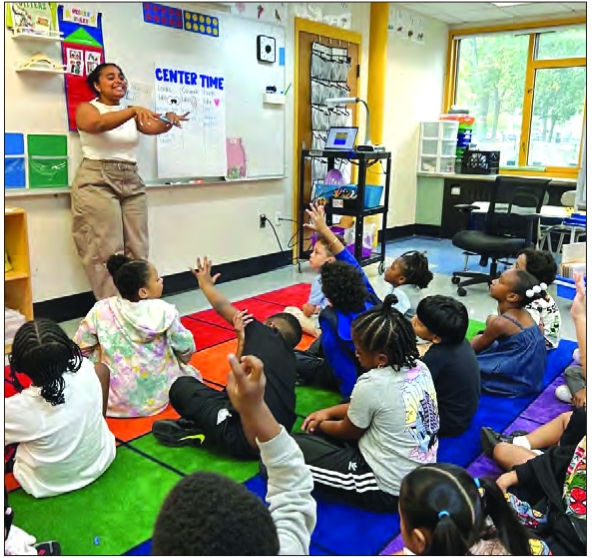
First day of school in Ms. Lanzo’s first grade classroom at John P. Holland Elementary School on Sept. 8.On Sept. 8, for the first time in over a decade, the John P. Holland Elementary School in Dorchester opened its doors for a new academic year under full Boston Public Schools (BPS) governance.
Formerly operated as UP Academy Holland during a 12-year state receivership, the K-6 school has officially cleared its chronically underperforming status, shedding its Level 5 identity and returning to district oversight. This is the first successful exit of a school from receivership in the state.
“Holland is finally back where it belongs: with Boston Public Schools and its community,” state Sen. Liz Miranda said in a statement.
The breakthrough transition follows a December 2025 vote by the Massachusetts Department of Elementary and Secondary Education (DESE) to allow Holland to exit state control, culminating years of performance assessments. On July 1, the school officially reverted to its original name, John P. Holland Elementary School.
BPS and student success nonprofit UP Education established a collaborative transition agreement for the 2026–2027 school year, wherein leaders provide weekly coaching for school administrators, monthly professional development, instructional resources and operational support focused on managing absenteeism.
“BPS has been a genuine partner in this transition, and Holland returns to the district as one of its strongest schools, not as a problem to manage,” Hillary Casson, CEO of UP, told the Banner. “Our shared job now is to protect the momentum.”
Casson, who served as assistant principal when the school entered receivership in 2014 and became principal in 2016, says the milestone was earned over more than a decade of sustained work.
“This school was once labeled one of the lowest-performing in Massachusetts, and now it is one of the strongest schools in Dorchester and a top-tier school in Boston,” Casson said. “Walking into the building on the first day of school this year, with the same leaders, teachers and joyful kids as a BPS school in full standing was a full circle moment.”
When UP took over management in 2014, Holland ranked in the bottom 1% statewide for academic performance. Today, the school serves a student body where over 90% are designated as high-needs, including 35% multilingual learners and nearly 20% special education students. These measurements of growth have outpaced peer institutions across the city.
For focus areas like achievement, growth, completion, and progress toward English language proficiency, Holland met 83% of its improvement targets. Compared to local schools serving similar student demographics across Boston in 2026, Holland ranked first in overall achievement on state exams and third in student growth ratings. It was also one of fewer than 10 schools district-wide rated as meeting or exceeding all state performance targets in 2026.
Casson described the days leading up to the first day of school on Sept. 8 as “deliberate and collaborative.” A working group of Holland staff, parents, community members and UP leaders engaged with DESE and BPS teams to safeguard essential design features, including specialized multilingual and special education programming, and build in teacher coaching systems.
As the exit decision approached, family advocacy proved crucial to its success. Holland parents banded together and organized, writing letters to state officials urging that the school’s core systems and partnerships be protected in the oversight transition.
“We have never believed this work can be done to a community,” Casson said. “It has to be done with one. That advocacy was not something we could have manufactured, and it reflects real trust built over 12 years. Holland proved that a chronically underperforming school can transform without closing, without displacing its students and without replacing its community.”
BPS Superintendent Mary Skipper and Mayor Michelle Wu joined Holland staff on the first day of school, welcoming students back to campus with water bottle stickers. Wu said it was an “exciting time.”
Holland’s success stands out in a district where state intervention has historically yielded mixed results. While the school achieved an exit propelled sustained growth, Paul A. Dever Elementary School — which entered state receivership around the same time — faced severe hardships and was ultimately closed by BPS.
What made the receivership successful for Holland, Casson said, is a prototype complete stable leadership, educator coaching and development, coherent instructional systems, strong operations and deep family partnership.
UP is now adapting this model with Lynn Public Schools at Pickering Middle School and was recently selected by DESE as an Accelerating Achievement Partner to support schools and districts across the commonwealth.
“Exiting receivership was always the goal,” Casson said. “We [built] a school culture around what students need. Struggling schools do not need to be given up on, but [rather] need sustained investment, real expertise and genuine partnership with their communities.”
There is broader skepticism surrounding state takeovers among labor leaders and community advocates. The Boston Teachers Union (BTU) maintains a stance that state receivership remains a fundamentally broken process.
“Schools that have been identified for receivership or takeover by the state are underperforming,” BTU president Erik Berg said. “Measuring school performance solely on the absolute basis of test scores is a flawed measure of what makes a school successful or not, particularly when you don’t consider growth.”
The BTU continues to support legislative education reform efforts like the Thrive Act, which seeks to end state takeovers of local public schools entirely in favor of educator-led support systems.
“We believe that school communities are stronger and serve students better when educators are supported by leaders who honor their expertise,” Berg said. “We hope that continues at Holland.”
As the academic year moves forward, Holland’s landmark ascension arrives against a sobering district climate.
More than 40 Boston schools continue to perform in the bottom 10% of public schools statewide, according to Commonwealth Beacon, leaving extensive doubts about district leadership’s ability to replicate Holland’s success elsewhere and into the future against this backdrop.