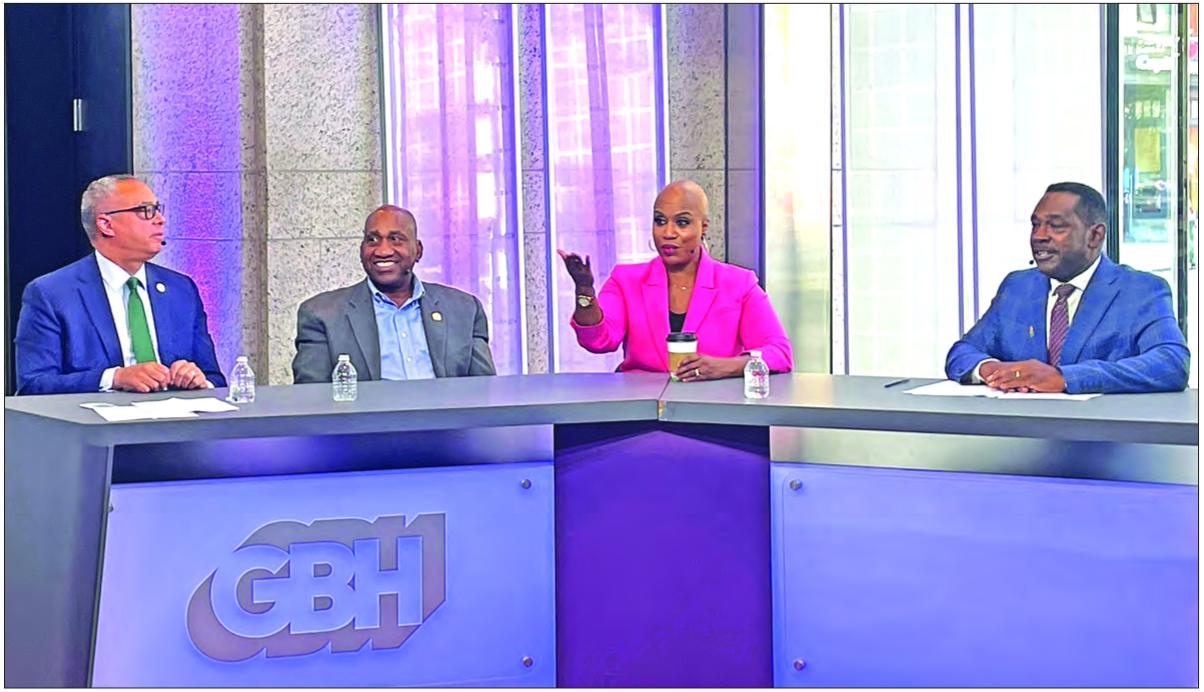
Suffolk County District Attorney Kevin Hayden, State Rep. Russell Holmes and U.S. Rep. Ayanna Pressley sit with Ron Mitchell, Bay State Banner publisher at the GBH Amplified and Bay State Banner panel.
Pressley, Hayden, Holmes encourage informed voting during forum series
With nine state ballot questions and contested congressional races in other states, the upcoming midterm election asks voters to make big choices. Elected officials who spoke on the Banner and GBH News’ latest “State of Black America Amplify” panel on Oct. 8, sought to make those choices easier by sharing their thoughts on some local ballot questions and critical races happening across the country.
“It is so important that everyone turns out in droves because they will challenge these election outcomes and results,” Pressley said.
Pressley, who represents Massachusetts’ 7th Congressional District, joined State Representative Russell Holmes, who represents the 6th Suffolk District, and Suffolk County District Attorney Kevin Hayden on the panel.
Ron Mitchell, publisher of the Banner, moderated the panel.
The panelists shared similar sentiments on every issue discussed, though none seemed more important than showing up to the polls.
Hayden said people in the past made sacrifices so that people today could vote, and that not voting would be a missed opportunity.
“There [are] more of us than there are of them,” Hayden said, referring to Republicans. “We just need to make sure that we are doing the work, that we are advancing, that we are letting our voices be heard.”
Holmes told voters to fill out the checklist pages in the “Massachusetts Information for Voters” booklets they received in the mail and bring them to their voting places on Nov. 3 to use as “cheat sheets.”
“This time, your ballot can look intimidating,” Holmes said. “It’s literally three pages. There’s a lot to pan out.”
All the panelists agreed that barriers to the ballot box should be eliminated. They supported voting “yes” on Question 4 to allow state residents to register to vote on Election Day for most elections, starting in 2028.
“A lot of people don’t vote not only because it’s inconvenient, but because they are not motivated to vote because of broken systems, broken policies and broken promises,” Pressley said. “It’s important that we are keeping the public trust, keeping our word and that we’re making it more convenient to vote.”
Hayden dismissed a belief many opponents of the proposal hold: that same-day registration will increase voter fraud.
“If people come and bring their records and information to prove that they have a right to vote … then they should have an opportunity to do that, no matter who they are,” Hayden said.
Holmes said he believes smaller municipalities are exaggerating their inability to handle new registrants on Election Day.
“Let’s not go and stop something just because we think it may happen,” Holmes said. “Let’s actually see if it becomes a challenge.”
The panelists opposed voting “yes” on Question 3, which would replace party primaries with single, all-party primaries. Pressley, a long-standing rejector of corporate funding, said the proposal is a form of voter suppression funded by private equity groups and is “out of step” with what the local electorate wants.
“I believe the people closest to the pain should be closest to the power. And this would make it harder for the people closest to the pain — working-class candidates, candidates of color, more progressive candidates — to run and to win,” Pressley said.
Most of the state electorate is independent: 66% are unenrolled while 26% are registered Democrats and 8% are registered Republicans, according to 2025 data from Massachusetts Secretary of State William Galvin’s office. Despite that, Holmes said, Massachusetts Democrats are still able to make it onto the ballot and win, suggesting that voters already have the freedom to choose a candidate of any party and that voting “yes” on question three is a solution to a nonexistent problem.
“It’s not that, all of a sudden, this jumbo primary is going to bring up all this choice, this independence and this opportunity,” Holmes said. “Most of us [are] already making this choice today.”
The panelists urged voters to maintain the state’s gun law. Question 9 gives voters the option to keep or repeal the 2024 law that placed tighter restrictions on gun regulations, such as mandated firearm registration with the state and the introduction of regulations on “ghost guns,” firearms made with components lacking serial numbers.
Hayden explained that safety correlates with tougher gun laws. He said repealing the existing law would not just loosen regulations, but slash funds for advocacy and gun violence prevention.
“If this [law] goes away, everything goes away,” he said. “We cannot go backward from where we are with this new bill that has proven to be effective and has not proven to have any of the detrimental harm that people say it’s having.”
Pressley said keeping the gun law in place stands up to the Trump administration and shows the rest of the nation what’s possible.
“We are a model for the nation.
… They’re trying to make an example of us, which is why we need to be in vigorous opposition [to] this bill being repealed,” Pressley said.
When asked about the time she’s spent supporting other Democratic candidates in Tennessee and Florida, Pressley said the party has not invested in competitive Black congressional candidates in the South, and she is showing up for them.
“It is a mistake the party has made historically for decades,” Pressley said. “My party often operates with scared power, and scared power isn’t power at all.”
The congresswoman pointed out that the Democratic Party must move more aggressively if it gets power, suggesting an approach similar to the second Trump administration, which saw the president sign 142 executive orders in his first 100 days in office.
“I don’t like what those executive actions are, but do I wish that we moved more like that? Absolutely,” Pressley said. “When you have the power, you have to use it.”