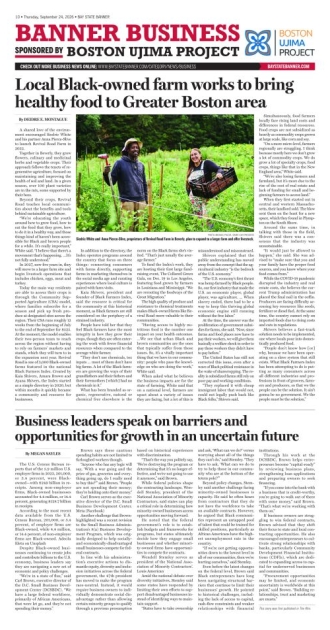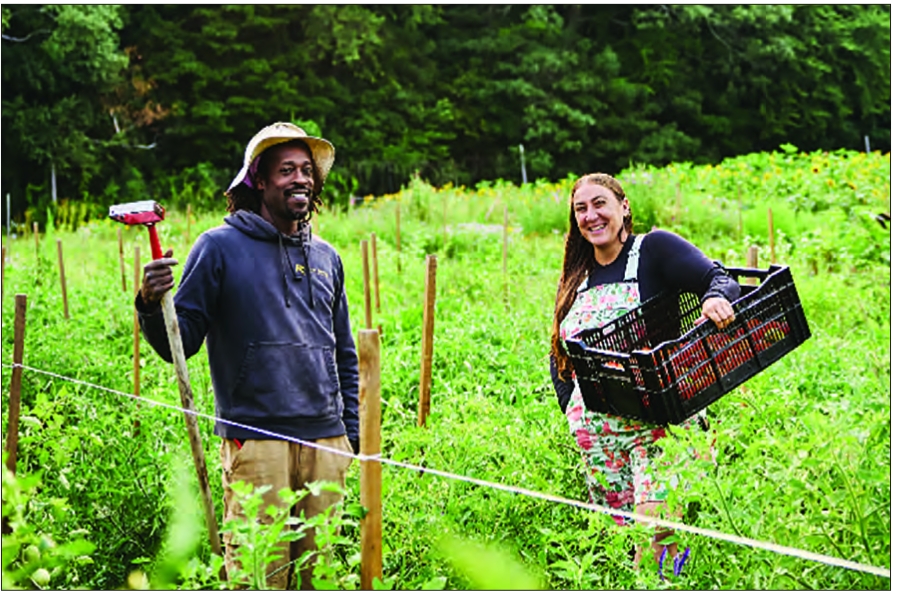
Siedric
White and Anna Pierce-Slive, proprietors of Revival Road Farm in
Beverly, plan to expand to a larger farm and offer livestock.A shared love of the environment encouraged Siedric White and his partner Anna Pierce-Slive to launch Revival Road Farm in 2022.
Together in Beverly, they grow flowers, culinary and medicinal herbs and vegetable crops. Their approach follows the tenets of regenerative agriculture, focused on maintaining and improving the health of soil and land. In a given season, over 100 plant varieties are in the mix, some supported by their bees.
Beyond their crops, Revival Road teaches local communities about the benefits and tools behind sustainable agriculture.
“We’re educating the youth around how to grow food, how to eat the food that they grow, how to do it in a healthy way, and those things kind of haven’t been accessible for Black and brown people for a while. It’s really important,” White said. “I believe that there’s a movement that’s happening. …It’s not fully understood.”
In 2027, now five years in, they will move to a larger farm site and begin livestock operations that includes chicken, eggs, meat and turkey.
Today the main way residents are able to access their crops is through the Community Supported Agriculture (CSA) model, where families subscribe for a season and pick up fresh produce at designated sites across the region. Their CSA runs roughly 12 weeks from the beginning of July to the end of September for $525. At the moment, the model enables their two-person team to reach across the region without having to rely on farmers’ markets and stands, which they will turn to in the expansion next year. Revival Road is one of 3,000 Black-owned farms featured in the national Black Farmers Index. Created by Kaia Shivers, Amara Brown and Ayana Shivers, the Index started as a simple directory in 2020, but within months it quickly became a community and resource for businesses.
In addition to the
directory, the Index operates programs around the country that focus on
three things: connecting consumers with farms directly, supporting farms
in marketing themselves in the social media age and curating
experiences where local culture is paired with farm visits.
Kaia
Shivers, president and founder of Black Farmers Index, said the
resource is critical for the community at this historical moment, as
Black farmers are still considered on the periphery of a strained
industry.
People have
told her that they feel Black farmers have the most integrity in how
they grow their crops, though they are often entering the work with
fewer financial resources when compared to the average white farmer.
“They
don’t use chemicals, tox inputs … most of them don’t have big farms. A
lot of the Black farmers are growing the ways of their grandfathers and
their fathers and their foremothers [which] had no chemicals in it.”
What
has been branded as organic, regenerative, natural or chemical free
elsewhere is the norm on the Black farms she’s visited. “That’s just
usually the average farmer.”
To
fund the Index’s work, they are hosting their first large fundraising
event, The Collared Green Gala, on Dec. 19 in Los Angeles, featuring
food grown by farmers in Louisiana and Mississippi. “We are rerouting
the foodways of the Great Migration.”
The
high quality of produce and resistance to chemical treatments makes
Black-owned farms like Revival Road more valuable to their communities.
“Having
access to highly nutritious food is the number one impact on your
health outcomes. …We see that urban Black and brown communities are the
ones that typically suffer from those issues. So, it’s a vitally
important thing that we have in our community: people who pass the
knowledge on who are doing the work,” White said.
When
asked what he believes the business impacts are for the state of
farming, White said that on a national level, farmers are upset about a
variety of issues they are facing, but a lot of this is misunderstood
and misconstrued.
Shivers
explained that the public understanding has moved away from the concept
that the agricultural industry “is the bedrock of the U.S. economy.”
“The
U.S. economy’s first thrust was hemp farmed by Black people. So, our
first industry that made the U.S. an economic player, global player, was
agriculture. … When slavery ended, there had to be a way to keep this
thriving global economic engine still running without the free labor.”
At
the time, the answer was the proliferation of government subsidies for
farms, she said. “Now, since farms and food places now have to pay their
workers, we will give them basically a welfare check in order to pay
these workers they didn’t have to pay before.”
The
United States has still not corrected this issue, even after a wave of
Black political resistance in the wake of sharecropping. The reality is
subsidized farms still rely on poor pay and working conditions.
“They replaced it with cheap immigrant labor that would not, could not legally push back like Black folks,” Shivers said.
Simultaneously, food
farmers locally face rising land costs and differences in federal
resources. Food crops are not subsidized as heavily as commodity crops
grown at large scale, like corn and soy.
“On
a more micro level, farmers regionally are struggling. I think because
mostly here we don’t grow a lot of commodity crops. We do grow a lot of
specialty crops, food crops, things like that in the New England area,”
White said.
“We’re
also losing farmers and farmland, but it’s more due to the rise of the
cost of real estate and lack of funding for small and beginning farmers
to access land.”
When
they first started out in central and western Massachusetts, their
landlord sold. The blow sent them on the hunt for a new space, which
they found in Plympton on the South Shore.
Around
the same time, in talking with those in the field, Shivers said there
was a consensus that the industry was unsustainable.
“It
would just be allowed to happen,” she said. She was advised to “make
sure that you and your family have the proper food sources, and you know
where your food comes from.”
While
the COVID-19 pandemic disrupted the industry and real estate costs, she
believes the current Trump administration has placed the final nail in
the coffin. Producers are facing difficulty accessing key resources like
seeds, fertilizer or diesel fuel. At the same time, the country cannot
rely on imported foods due to rising costs and cuts in regulations.
Shivers believes a fast-track solution needs to be implemented, one where locals pour into domestically produced food.
“People
don’t know how [or] why, because we have been operating on a slave
system that still exists. What Black Farmers Index has been attempting
to do is putting as many consumers across all different industries and
professions in front of growers, farmers and producers, so that we the
people can be the solution. It ain’t gonna be no government. We the
people must be the solution.”