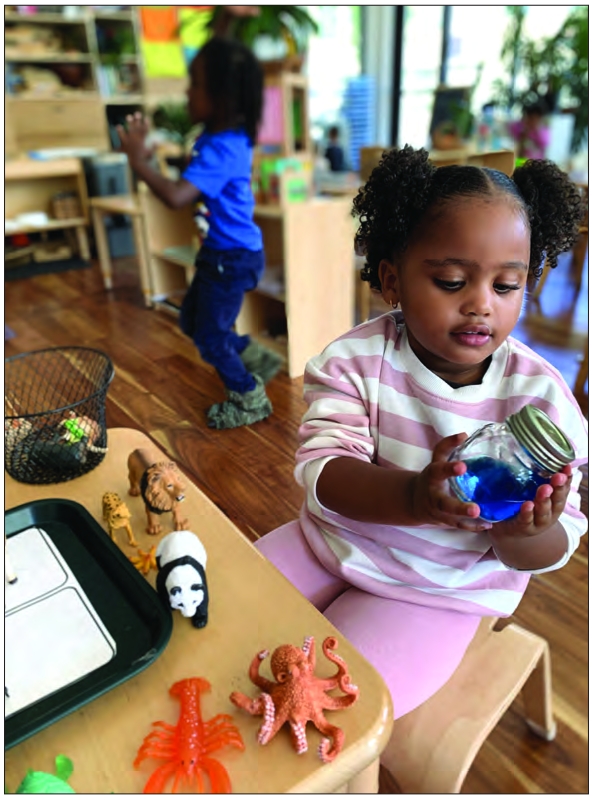
Students learn, play, and explore at Roxbury Roots Montessori. 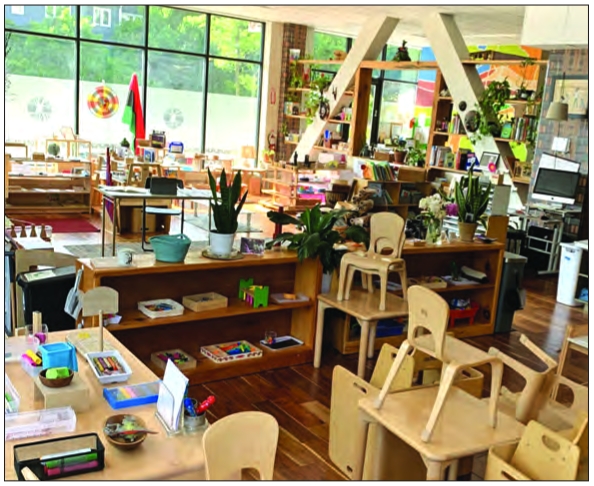
The Roxbury Roots Montessori will be celebrating its 5th anniversary.
Over a decade ago, Renee Jolley wrote her mother a letter promising that she would open a Montessori school in Roxbury by the time she turned 50.
The promise held. Roxbury Roots Montessori opened in November 2021, after the COVID-19 pandemic delayed construction and drove up costs. This fall, as families settle into another school year, the nonprofit school is approaching its fifth anniversary; a milestone for a small program built to bring a form of education often associated with affluent communities into the neighborhood where Jolley grew up.
“I’ve worked outside of Roxbury and I’ve seen what high quality looks like,” said Jolley, the school’s founder and head of school. “I’m bringing resources. I’m bringing high quality.”
Roxbury Roots serves children ages 2.9 to 6 in a mixed-age classroom. Jolley said the school currently enrolls 20 students, with additional families in the enrollment pipeline. The size is deliberate: Montessori education depends on teachers observing children closely and offering lessons when each child is ready.
Developed by Italian physician and educator Maria Montessori more than a century ago, the approach gives children sustained time to choose work within a carefully prepared classroom. Teachers act as guides rather than directing every child through the same lesson at the same moment.
Materials are hands-on and arranged so children can reach, use and return them independently. The American Montessori Society identifies trained teachers, mixedage groups, specially designed materials, student-directed work and uninterrupted work periods as core elements of a high-quality program.
That
freedom is not the absence of structure, Jolley said. Children may
repeat an activity because repetition builds concentration and mastery.
Over the traditional three-year cycle, classroom work expands from
practical tasks and sensory materials into literacy and mathematics.
Younger children watch older classmates; older children practice
leadership and responsibility.
The
model has attracted research interest, though the evidence should not
be overstated. A 2017 peer-reviewed study followed 141 children who
entered lotteries for two public Montessori magnet schools in a
high-poverty city. Over three years, the Montessori students showed
stronger growth in academic achievement, social understanding and
mastery orientation, and the income-based achievement gap narrowed. The
authors cautioned that the schools used a rigorous version of Montessori
and that larger studies were needed before broad conclusions could be
drawn.
For
Black and other children of color, Jolley sees an additional benefit in
attending a high-quality school where cultural belonging is central
rather than incidental. Families have told her they do not want their
child to be the only brown child in a classroom.
Roxbury Roots keeps Montessori’s academic framework and surrounds it with an African-centered curriculum. Children
encounter books, songs and images that reflect their lives. The school
observes Ancestor Day (in lieu of Columbus or Indigenous Peoples Day),
participates in Black Birders Week and offers enrichment that has
included drumming, capoeira and chess taught by neighborhood elders.
Friday visits to Thornton Street Farm extend the classroom into the
community.
“The kids
are getting all of it,” Jolley said. “They get the whole package, the
whole experience: a trained teacher, beautiful environment, well taken
care of materials — everything.”
The
school’s roots are practical as well as philosophical. Jolley and her
original co-head, Kendall Allen, spent months working from Dudley Cafe
while searching for a Roxbury location. Local contractors and
Black-owned businesses helped build the space, website and signs. The
Wildflower network,
which supports teacher-led micro-schools, provided much of the startup
funding and helped Jolley navigate pandemic-era relief and banking
requirements. Jolley now mentors other educators who hope to open
schools of their own.
That
communal support has not erased the strain of running a small
independent school. Jolley described finances as the school’s greatest
vulnerability. Roxbury Roots uses a flexible tuition model, accepts
child-care vouchers and participates in Boston Universal Pre-K. She said
annual tuition ranges from $5,000 to $19,500, with many families paying
about $14,000 to $16,000 after conversations about what they can
afford.
The school
currently receives no philanthropic support for operations, Jolley said,
leaving it dependent on tuition, vouchers and public pre-K funding.
With a small enrollment, a delayed or missing payment can quickly cause
trouble. The effort to remain affordable also limits what the school can
offer prospective administrators and teachers.
Administrative
capacity is the next challenge. Jolley is trying to strengthen the
board, hire a cohead and build a fundraising and marketing operation.
This work, she explained, cannot fall to the same person leading the
school. Jolley once hoped word of mouth alone would attract families
committed to the mission, but visibility matters when a small school
must fill nearly every seat.
Those
pressures make the anniversary more than a ceremonial marker. Roxbury
Roots has survived a pandemic opening, construction inflation and
leadership transitions while preserving a neighborhood-based alternative
for families in Roxbury and nearby Dorchester and Mattapan.
Jolley
encourages parents considering Montessori to attend an open house, see
the classroom, learn how the curriculum works and ask whether its pace
fits their child and their own expectations. The method may not suit
every family, she said, but access to a thoughtful choice should not
depend on leaving the neighborhood.
“They deserve it,” Jolley said.