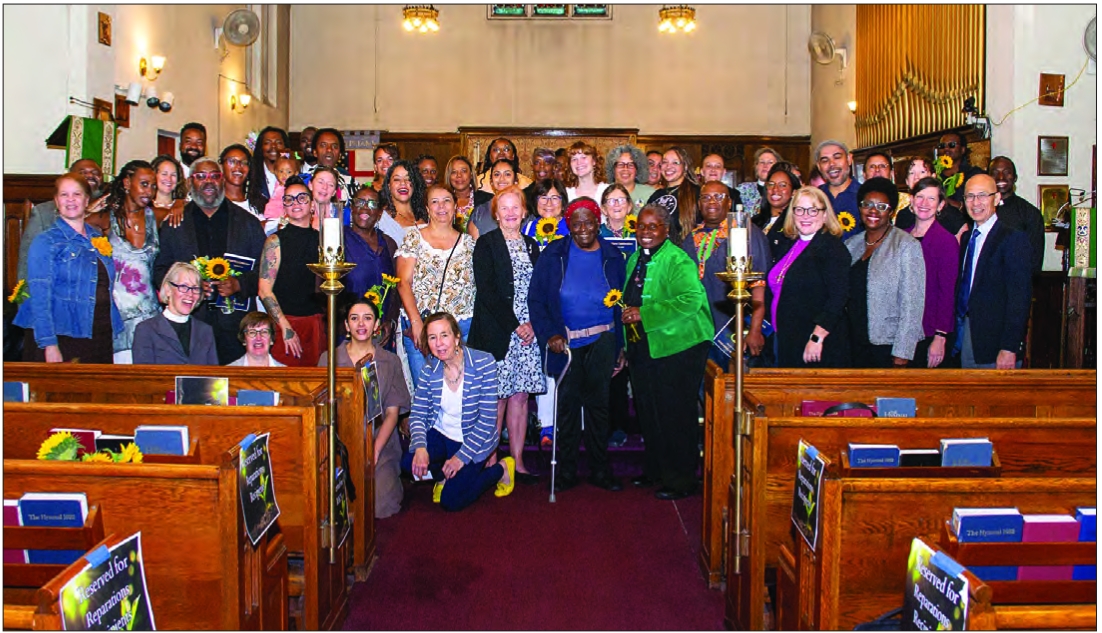
Reparations
Advisory Committee and Stewards members gather with organization
recipients, the Episcopal Diocese Bishop and the Episcopal City Mission
team at St. Cyprian’s Episcopal Church on Sept. 15. 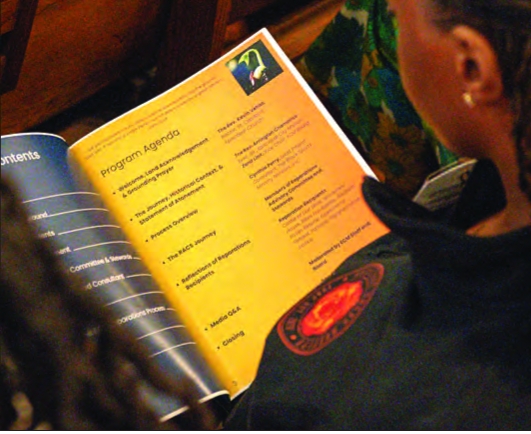
Program from Sept. 15 featuring Episcopal City Mission, Reparations Advisory Committee and Stewards, and granted organizations.
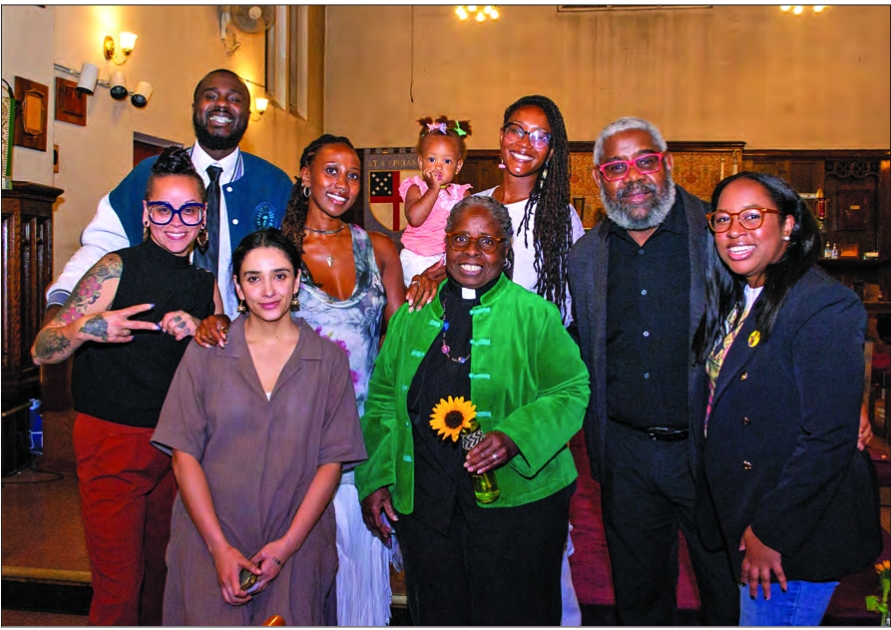
Reparations
Advisory Committee and Stewards members with co-director of Episcopal
City Mission Neha Rayamajhi at St. Cyprian’s Episcopal Church on Sept.
15.
On Sept. 15, Episcopal City Mission (ECM) announced the distribution of $2.75 million in reparations to 25 statewide organizations committed to promoting racial and economic justice and equity, truth-telling, reconciliation and strengthening communities.
The landmark distribution marked a tangible effort by a local faith-backed institution to address the deep racial wealth gap rooted in centuries of stolen labor and land dispossession.
ECM unveiled the news at St. Cyprian’s Episcopal Church in Roxbury, which was built over a century ago by Boston’s Black and West Indian residents who initially had to meet in living rooms before gaining formal diocesan recognition. The location is the city’s oldest Black Episcopal church and provided a resonant backdrop for the act of historical reclamation.
Reparations
Advisory Committee and Stewards (RACS) mapped 11 distinct “social
justice buckets” spanning housing, land theft, health equity and
criminal justice reform. Formed in summer 2025, the primary objective of
RACS was to bypass major institutional players and get meaningful
capital directly to frontline leaders in the Black community.
“We wanted to touch
organizations that often are not touched,” Rev. Dr. Althea Smith, an
ordained minister and RACS member, told the Banner. “We wanted to reach
folks who would not necessarily be on other people’s agenda … those who
are close to the ground doing meaningful work for the community and have
significantly felt the cuts from the federal government.”
Recipients
reflect that grassroots focus across a wide array of vital community
initiatives, from like local farmers distributing free food, family
stability programs like Brookview in Dorchester, and youth leadership
initiatives like Bikes Not Bombs in Jamaica Plain and Pa’lante
Restorative Justice in Holyoke. The committee also intentionally
prioritized organizations dismantling the carceral system, such as
Families for Justice and Healing and the Massachusetts Bail Fund.
“Through
our work at Brookview House, we’ve seen that many families are carrying
challenges that didn’t start with them,” said Deborah Collins,
president and CEO of Brookview. “The hurdles they face today are often
shaped by generations of unequal access to opportunities, resources and
support.
This
reparations payment is an acknowledgment that the disparities we see
today did not happen by accident, and that addressing them requires
intentional action.”
For
Black arts and education organization Castle of our Skins, receiving
reparations represents a rare shift in how institutions interact with
Black creators and organizers.
“We
never thought we would see the day when an institution would look
honestly at the harm embedded in its history and make a meaningful
commitment to repair,” Dr. Ciyadh Wells, executive director of Castle of
our Skins, said in a statement.
“This
investment will allow us to continue creating opportunities for
cultural curiosity, bringing Black artistry and edu-tainment into
classrooms, concert halls and community spaces. This is reparations, not
simply philanthropy.”
While
ECM — a Boston nonprofit affiliated with the Diocese of Massachusetts —
has funded antipoverty initiatives since its founding in 1844, the
$2.75 million is explicitly framed as an act of repair for harms tied
directly to the institution’s financial inception.
Prompted
by urgent calls during racial justice uprisings in 2020, ECM launched a
multiyear historical audit of its endowment. Research traced a
foundational grant back to William Appleton, a prominent 19th-century
white Episcopalian merchant who worked in the textile industry and was
connected to slave economies, including cotton in New Orleans, sugar in
Cuba and maritime insurance.
“We
know these insurance companies insured cargo, which were often enslaved
Africans,” said Cynthia Perry, cofounder of The Black Sports Ministry
Network, Inc. and lead consultant to RACS. “Thus, if money given to
start ECM was connected to the exploitation of Black labor it is only
right to give reparations as unrestricted funds as a form of atonement,
apology and attempt of repair.”
Although
the organization pivoted in the 1950s and 1960s toward being justice
oriented, recognizing modern racism and examining the root causes of
poverty, ECM’s historical research served as another major wake-up call
to deepen its practice.
“We
were intentional in using the term reparations,” Rev. Arrington
Chambliss, executive director of Episcopal City Mission said. “We
understand that reparations require us to give up power and not just
give away money.”
The
initiative led to them penning a “case statement of atonement” — a
traditional term within the church for coming back into the right
relationship — and handing decision-making power over to the
intergenerational cohort of seven Black and Indigenous organizers,
ministers and community leaders who make up the RACS team to fully
design the entire funding framework. Chambliss said this would ensure
the process would remain “grounded in relationship, trust and moral
responsibility.”
“What
was really great was that ECM immediately empowered us to do the work,”
Smith added. “They did not hover to make sure we were reaching the
people who they thought we should reach. They trusted us.”
For
Smith, a lifelong Bostonian and product of Boston Public Schools’ prior
to the city’s tumultuous busing era, called the ceremony at St.
Cyprian’s a “full circle moment.” Her family also used the church’s
after-school programs decades earlier.
Beyond
local history, Smith viewed the committee’s work through the visionary
lens of Octavia Butler’s 1993 literary pillar “Parable of the Sower” — a
story centered on overcoming fear, listening deeply to others and
cultivating community survival via radical change. “Being in community
can be transformative,” Smith said.
ECM
aims for this $2.75 million disbursement to set a blueprint for other
legacy faith organizations across Massachusetts to audit their own
assets. Pointing to Spike Lee’s 1989 film “Do the Right Thing,” Perry
challenged white institutions sitting on capital to move beyond
surface-level charity.
“White
business practices are often associated with perfectionism, and in
trying to find a perfect model, repair and justice are delayed,” Perry
said. “It is hypocritical to say you are an example of God’s love, teach
about God’s love on Sunday and then sit on resources that can have
transformative systemic and institutional change. Larger faith
institutions that know their wealth was built on the exploitation of
Black labor and Indigenous land need to do the right thing and do it
now.”
Though the $2.75
million payout is historically significant, organizers say the
allocation is just an initial step toward broader healing — restitution
too expensive for a price tag.
“There’s
really no reconciliation without repair, so this is a step in that
direction,” Chambliss said. “It doesn’t mean that everything’s
reconciled in any way. It’s more of a spiritual practice than a goal.
For us, this is a milestone as opposed to a finish line.”