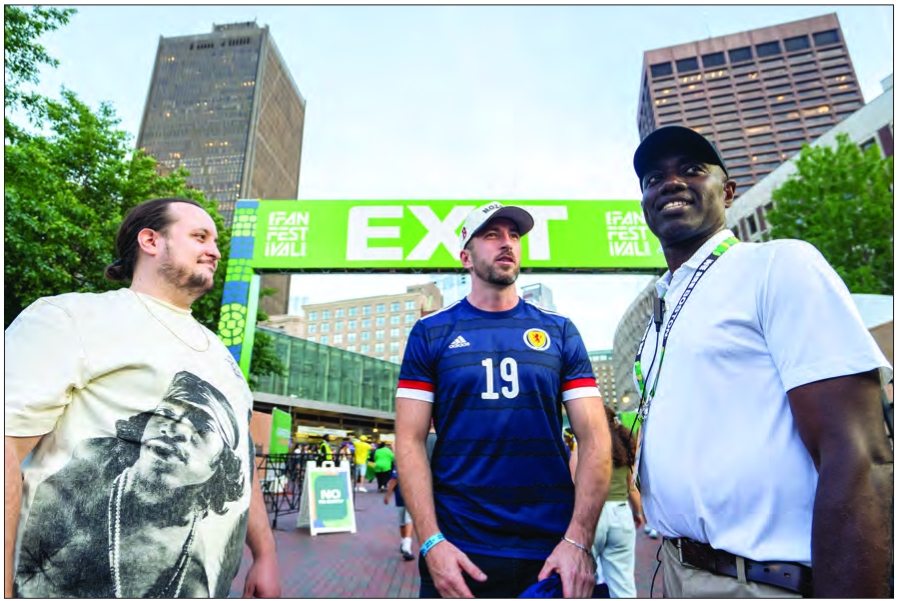
Herby Duvernés‘ company, the Windwalker Group, gained a FIFA World Cup contract handling security during the tournament.When the FIFA World Cup confirmed Boston as a host city, many local businesses saw a tourist boom. Several were contracted for services with FIFA, while others hosted watch parties.
Now, roughly two months after the final match, the Banner connected with two Black business owners about how their businesses were affected by the global sporting event. Ricardo Louis is the CEO of Privé Parking, which provided shuttle bus operations to the stadium in Foxborough. The company also provides valet, parking lot and garage management, livery, traffic control and consulting services.
Louis said that while his business was a lot busier during the World Cup and he’s not yet had new, large-scale contracts, he believes the major event put a spotlight on local businesses, especially those that are Black and brown owned.
“The way I look at it is [this]: if you were good enough to provide services and products for the largest sporting event in the world, then there should be no question on if you have the capacity, understanding, and if you can actually pull it through to provide services for the city of Boston, state of Massachusetts, or any other major organization that’s here in the state,” he said.
The opportunity also opened his eyes to how successful, largescale events are operated, from public-private partnerships to the relationships that make service opportunities possible on a quick turnaround.
“That’s
what I thought was really interesting, because when you think of FIFA
World Cup, there is major planning that goes into it years out, from the
organization, and from city and state planning, but when you look at
the details, the services, and the subcontracting, a lot of those
decisions were made last minute,” Louis said.
Herby
Duverné, owner of the security, IT and professional training company
Windwalker, was also contracted for services with FIFA.
“It
was more like we had the opportunity, and that opportunity would not
have happened without people like Meet Boston and certainly BECMA [The
Black Economic Council of Massachusetts], who’s behind the scenes makes
businesses like mine [have] the opportunity to thrive and get those
deals, and also the actual FIFA Group,” Duverné said.
To
support the security effort, Windwalker hired about 150 people in a
span of five weeks, 70% of whom were people of color and 67% of whom
were from Boston.
Since
the World Cup has passed, Duverné shared that his business is
flourishing, having gained new, regular clientele including major event
organizations and corporate brands based in Boston.
“It’s
doing awesome. What’s great about the World Cup is the fact that it’s
such a major international event…people understand that you have the
capability,” he said. Duverné later added that “now, we understand what
it takes to get this thing done, how we can scale at the level we want
to scale.”
The Black
Economic Council of Massachusetts played a major role in helping many
Black-owned businesses to take advantage of the contract opportunities
available during the major sporting event, investing over $150,000 in
grants, training and staff time.
BECMA President and CEO
Nicole Obi confirmed her organization was able to help advocate for and
support 87 businesses throughout the summer, from the FIFA World Cup,
Sail.
Boston 250 and
the MA250 Commemoration. Those businesses in turn generated just under
$11 million in revenue, and over 350 part- and full-time working
opportunities.
“For
example, the governor said that restaurants and bars can stay open until
3 a.m. — and that’s great, but if you don’t have the means to hire
additional staff to take full benefit of those extended hours, it
doesn’t do anything for you. We wanted to make sure that businesses were
able to participate in that,” she said. “We wanted to make sure that
vendors didn’t have to put things on credit cards in order to take
advantage of the opportunities.”
BECMA also provided legal representation to help business owners know what they were signing.
“We did what we could do to have some impact, and we’re really proud of the work that we did,” she added.
When
asked if there was anything she felt has been ignored by prior media
coverage regarding this topic, Obi referred to the concept of equitable
procurement.
“People
have talked about it, but very few people did anything about it. So
that’s why we at BECMA took the action to make sure that there would be
at least some benefit from this major boom to the economy for our
members and other diverse businesses,” Obi said.