Tomas
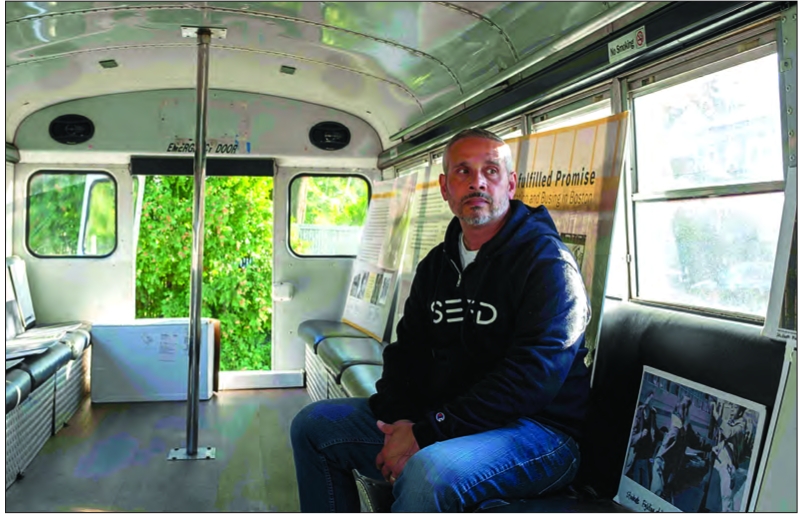
Gonzalez sits on a bench in the mobile bus museum. Gonzalez has helped
transform a retired school bus into a mobile museum outlining the story
of Boston’s school desegregation crisis.
The
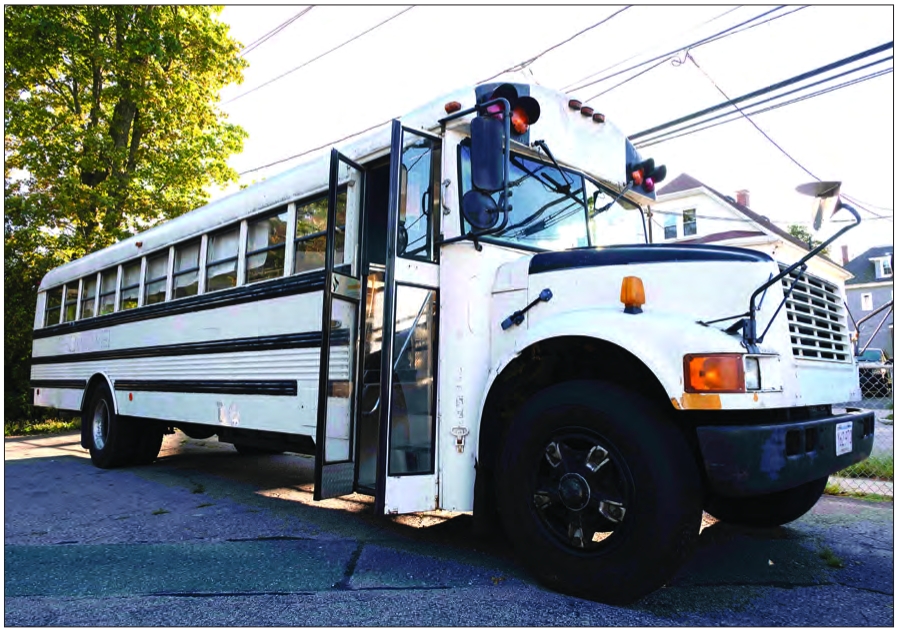
mobile museum sits in the back lot of a gas station in Readville. The
bus is driven by two Boston Public School bus drivers and one
Massachusetts Bay Transportation Authority driver.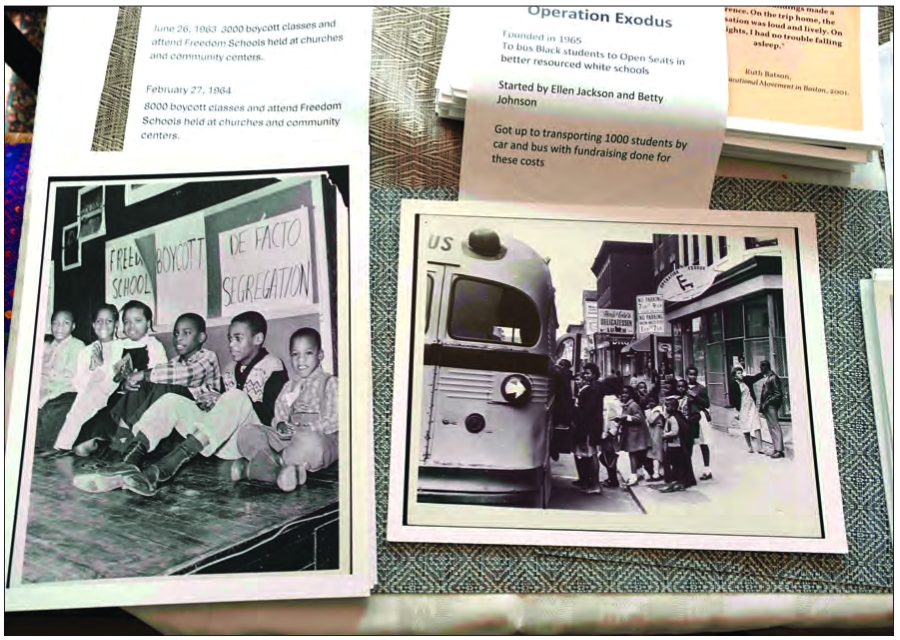
Archived
pictures of Boston School Stay Outs (left) and Operation Exodus (right)
sit on Lewis Finfer’s dining room table. Boston School Stay Outs drew
thousands of students to boycott classes in 1963 and ‘64. Operation
Exodus used rented buses, taxis and borrowed cars to bus Black students
to better schools before court-ordered busing.
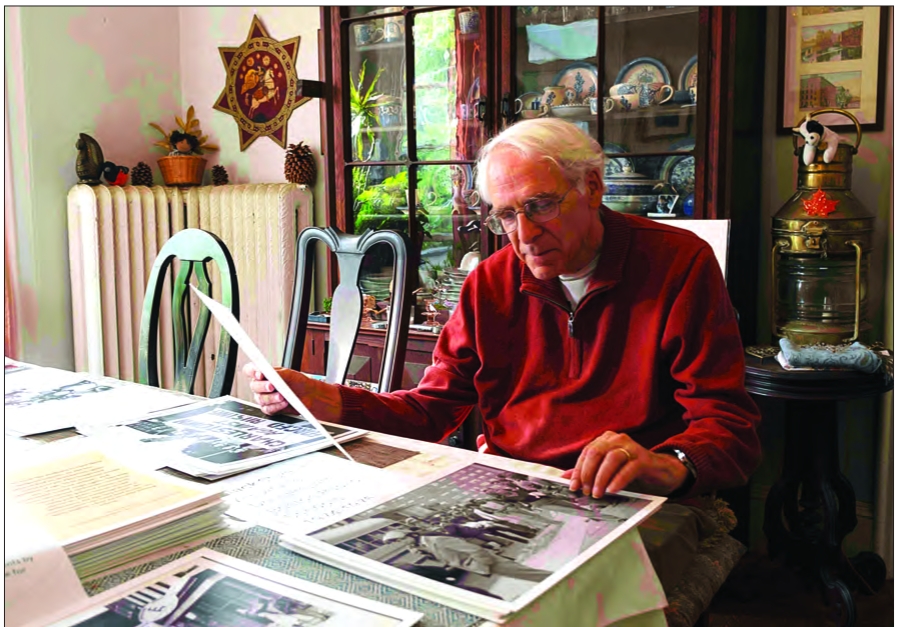
Lewis Finfer, of Dorchester, flips through archives in his living room.
Tomas Gonzalez was 2 years old the night the firebombs hit. In the winter of 1973, he was among hundreds of Puerto Rican families in South Boston, according to Gonzalez. His mother said riots and violence were common against Puerto Ricans in the neighborhood.
That night, his mother said her three young kids were ready for bed, near the back of the house, when she heard a noise. Gonzalez’ father ran out to the front deck and kicked a burning gas can away from the house, but all three porches of the triple-decker had firebombs thrown on them, according to his mother. She said six Puerto Rican families lived in the house at the time.
Boston firefighters put out the blaze, Gonzalez said, and the family evacuated to a local shelter. Two of his uncles would never return to South Boston after this night.
Gonzalez said by spring, many of the Puerto Rican families in South Boston relocated because of fear. He’s spent decades trying to reconcile this story and understand how someone could be motivated to do this.
“You wouldn’t think that people would be so angry,” he said.
Over
the years, Gonzalez had to come to terms with the weight of his
family’s displacement, which happened before he was old enough to
remember.
“It became so entwined in who I am,” he said.
Now,
Gonzalez is working with a team of local leaders with deep roots in
Boston, in an effort to ensure the reality of desegregation and racial
violence in the city isn’t forgotten.
In
a tight collaboration among a group of community leaders and academics,
Gonzalez has helped transform a retired school bus into a mobile museum
outlining the story of Boston’s school desegregation crisis in order to
bring these lessons into the 21st century, and provide a space to heal
through learning.
“There
was a desire and a hope that through this project, there can be some
reconciliation and healing,” Gonzalez said, “hopefully working together
towards a more just and inclusive community here in the city of Boston.”
Education and desegregation’s legal roots in Boston
Jose
Lopez, a legal director of compliance and civil rights at Boston Public
School and volunteer with the project, has long been fascinated by one
word in Massachusetts’ Constitution — the first in the nation to
guarantee the public’s right to an education: “It shall be the duty of
legislatures and magistrates, in all future periods of this
commonwealth, to cherish the interests of literature and the sciences.”
Cherish.
Written by John Adams, this clause may have influenced the city of
Boston to continue to be an educational hub for not just the state or
nation, but the world, said Lopez, a resident of Roxbury for more than
20 years.
“Boston
is extremely rich in resources. Financial, social, philanthropic,
institutional, educational and historical,” Lopez said.
“There’s a very strong gravitational pull to Boston because of what it has to offer.”
Boston’s
role in the legal battle over school segregation started over a century
before the busing crisis of the 1960s and ‘70s. The city was the site
of the first legal challenge to segregated schooling in 1848 and
Massachusetts became the first state to ban segregated schools in 1855.
In 1848, Benjamin Roberts’ 5-year-old daughter had to pass five schools
close to their North End home on her walk to an assigned school for
Black children on Beacon Hill due to the color of her skin. He sued, and
in a 1850 Massachusetts Supreme Judicial Court ruling, the court upheld
segregation in Roberts v. City of Boston.
Lopez
said that not many people know this Boston-based case was later cited
in the U.S. Supreme Court’s 1896 Plessy v. Ferguson ruling, which
established the “separate but equal” doctrine, which determined racial
segregation to be constitutional.
More
than a century later, that doctrine had been struck down, but Boston’s
schools were far from integrated. In 1974, Judge W. Arthur Garrity
ordered busing in Boston in Morgan v. Hennigan, rejecting a more modest
desegregation plan in favor of one that split the city along racial
lines.
“The judge made
a very severe implementation of desegregation, where everything had to
be 50-50… so that led to more opposition,” said Lewis Finfer, the
co-chair of Boston’s Desegregation and Busing Initiative, lifelong
community organizer, historian and Boston resident for more than 55
years. Karilyn Crockett, another co-chair for Boston’s Desegregation and
Busing Initiative and a professor at MIT, is also the granddaughter of
one of the 14 adult plaintiffs from Morgan.
This inheritance shapes how Lopez sees students walking through the bus today.
“They are an extension of history,” he said.
A vehicle for storytelling
The
bus itself, a retired white and black school bus from Connecticut with
over 170,000 miles, has been up and running in the Boston area since
June. The bus is close to the exact model used during the 1960s and 70s,
and serves as a powerful icon for the project.
Lopez
got the idea for the museum-on-wheels after Hurricane Katrina, when he
worked on a project that converted two eBay FEMA trailers into mobile
exhibits. The desegregation bus draws on the same accessible model, but
with the symbol of desegregation. Molly Brown, an archivist at
Northeastern University, curated the exhibit inside the bus with
material sourced from local universities and city and school department
records. Gonzalez said Finfer was “absolutely essential” in gathering
these archives.
Funded
through a quilt of local organizations, the bus has already appeared at
four events in its first four months, and even drew a visit from Mayor
Michelle Wu and Governor Maura Healey at a Juneteenth celebration at
Franklin Park.
Lopez said the individual impacts on visitors are the most rewarding.
One woman who had been bused as a child during the 1970s quietly asked Lopez to photograph her in front of the bus.
“She looked so powerful,” Lopez said. “She looked like the victor, and not the vanquished.
“The wheels could have fallen off right then and it would have been a success.”
Pieces of history ‘not necessarily told’
Dr.
Ilyitch Nahiely Tabora, who was born and raised in Boston and graduated
from the city’s public schools, said she didn’t learn about the history
of desegregation in the area until college.
“It’s
a missed opportunity,” said Tabora, who was previously the assistant
superintendent at Boston Public Schools and now serves as president and
executive director of the Talented And Gifted Association, or TAG, a
nonprofit supporting young Latino and English language learners, and the
main partner of the museum.
“It
is shameful that our students are graduating from Boston Public Schools
not knowing the rich history of the liberation movement that happened
here,” Tabora said.
Lopez said desegregation is in the curriculum, but the focus is on other cities, and a lot of the instruction is up to teachers.
“Being in the curriculum and being taught are two different things,” Finfer said.
Scars
from Boston’s desegregation era still feel fresh for some locals.
Garrity’s ruling set off years of violence, including the stabbing of a
white student at South Boston High School, the beating of Ted Landsmark
near Boston City Hall and the shooting of Black high school football
player Darryl Williams in Charlestown.
“This is an opportunity for us to lift up their voices without lifting up their own trauma,” said Tabora.
The organizers took extra care to seek public input during 20 events and forums before the project’s launch.
Today,
Boston Public Schools enrolls more than 44,000 students across 104
schools, roughly 44% Latino, 29% African American, 15% white and 8%
Asian, according to Massachusetts Department of Elementary and Secondary
Education figures for the 2025-26 school year. This is a dramatic shift
from the roughly 85% white enrollment the district had in 1963, just
before the first organized school boycotts began, according to a
timeline of desegregation compiled by Jim Vrabel, a Boston historian and
author of A People’s History of the New Boston and When in Boston: A
TimeLine and Almanac.
One
of the local desegregation era’s most enduring responses is the
Metropolitan Council for Educational Opportunity, or METCO, which Ruth
Batson and Betty Johnson launched in 1966 along with other Black parents
in Boston. METCO is a voluntary busing program giving Boston students
an opportunity to attend suburban schools with better resources. About
220 students enrolled in the first year of the program, and today it
includes more than 3,000 students and more than 30 schools, according to
Vrabel.
“It’s still worth it,” Finfer said, “But it’s challenging because they’re not completely in their neighborhood anymore.”
Organizers
say the point of the museum is to give today’s students a way to claim
this history as their own and spark conversations within their families,
as many visitors are descendants of the communities that were once
excluded.
“The best
thing that can happen is that it sparks a conversation at home, where
they end up speaking to someone who has first-hand knowledge and
experience,” Lopez said.
He
said he thinks the bus could be a way to bridge the generational and
cultural gap, bringing these stories closer to home. Organizers said
they also are working to include more of the Latino and Asian
perspective in the museum.
“It’s
Black, Latino, white, American, constitutional and educational
history,” Lopez said. “It’s the history of a city evolving.”
The bus will stay on the road until the cold months hit. Lopez said what happens next is up to the city it was built to serve:
“This history belongs to the city.”