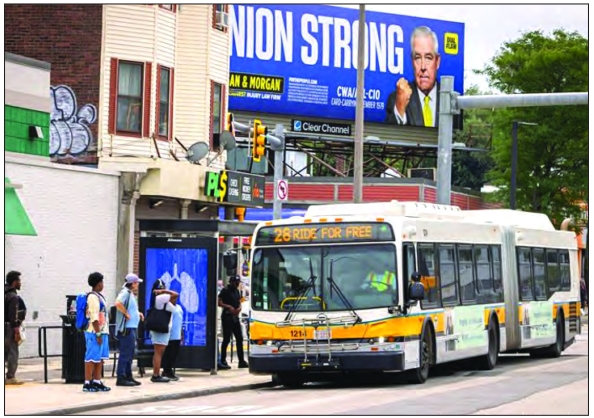
Passengers
board a bus along Blue Hill Avenue. A plan to create designated bus
lanes in the center of Blue Hill Avenue, is being met with some
opposition from business owners who would be severely impacted by the
loss of parking spaces.
MASSLIVE.COM
Strong emotions continued to swirl around the proposed plan to redesign a traffic-snarled thoroughfare through the heart of Boston’s Black communities as authorities presented a fresh vision for the street on Thursday night.
The overhaul of Blue Hill Avenue has faced years of public feedback and criticism, including concerns that new bus and bike lanes could slow traffic flow and that parking changes could hurt businesses. After absorbing that input and more, Mayor Michelle Wu and interim State Transportation Secretary and MBTA General Manager Phillip Eng arrived Thursday at Morning Star Baptist Church to outline an updated plan they believed struck consensus.
The project is “a true once-in-a-generation opportunity” to improve quality of life and deliver an economic boost to the surrounding neighborhoods, Wu said ahead of the town-hallstyle event. It’s also an opportunity, she added Thursday, to correct historical disinvestment from the area, including the removal of a trolley that ran down Blue Hill Avenue decades ago.
“Ultimately I believe my job is to fight for residents to have the best quality of life and infrastructure, regardless of neighborhood,” Wu said Thursday.
An engaged crowd greeted the mayor. Down the street from the church, a pair of city councilors led a protest opposing the project and backing a far more ambitious goal — extending subway service through the area — that city and transit officials have said is not realistic in the near term.
Inside the sanctuary, several hundred residents from surrounding neighborhoods filled the pews, bringing questions and feedback. More residents lined the back of the room.
Rickie Thompson, of Hyde Park, came interested in traffic flow. He was concerned that if the redesign reduced travel lanes, it would take drivers like him longer to get to their destinations.
“In the evening and at rush hour it can be very slow,” he said. “Going from two or three lanes to one will slow everybody down.”
Theresa Rochelle, of Roxbury, said she wanted to learn more about how the redesign would affect traffic, though she also had concerns about whether neighborhood businesses would still have enough parking for customers.
“It’s not just about my block,” she said. “It’s about the community as a whole and the businesses. You need to give people somewhere to park.”
For
years, city and state officials have eyed a major redesign of Blue Hill
Avenue, which runs from Mattapan through Dorchester and into Roxbury,
to improve traffic flow, public transit and roadway safety in the area.
The
three-mile stretch carries the highest bus ridership in the MBTA system
— around 40,000 passengers each day, according to the transit agency.
The T said more people ride the bus through the area than drive cars.
But as drivers double- and triple-park along the side of Blue Hill
Avenue, traffic can back up into a twisted mess.
The
boulevard lacks a dedicated bus lane that would allow a freer flow of
public transit, potentially saving 15 minutes of travel time for bus
riders at rush hour, according to MBTA estimates.
Installing
a bus lane — a centerpiece of the project with hefty federal funding
tied to it — has been met with some pushback amid fears it could limit
travel for others on the road.
The
new plan, released last week by Wu’s office, includes the bus lane
running down the center of Blue Hill Avenue, with adjacent bus stop
islands.
It also
maintains at least two travel lanes for cars along 75% of the street,
addressing a central criticism of earlier plans that called for more
single-lane travel for cars.
But
as officials fielded question after question from the crowd of more
than 450, the bus lane remained a central point of tension.
“I
grew up in Mattapan all my life,” one woman said. “Putting the bus in
the middle lane is not a good idea. It should be flush to the sidewalk
because they’re not thinking about the elderly people and the kids.
Every child runs for their bus.”
Putting
the bus lane in the middle frees up space on the side for buses, cars,
emergency vehicles and other road users, officials have said. It also
reduces what they have described as “conflict at the curb” and the
potential for double- or triple-parked cars to block traffic.
The
new plan would increase street parking, install nearly 200 new
wheelchair-accessible curb ramps and add parking in high-traffic areas,
such as near a grocery store or the church where Wu and Eng held
Thursday’s town hall meeting. The redesign also includes beautification
and quality-of-life improvements, including replacing street lights,
repaving the sidewalks along Blue Hill Avenue and adding nearly 200 new
trees, Wu’s office said.
The
proposal calls for increasing the number of parking spaces on Blue Hill
Avenue from 675 to 717, according to The Boston Globe. The street would
lose 10 all-day parking spots, but gain another 52 outside of peak
travel hours. Outside the church, for example, the street’s center
median would provide additional parking on Sundays.
The
project would also install a two-way bike path along the side of Blue
Hill Avenue, separated from traffic, connecting to Franklin Park,
Boston’s largest green space.
Officials
said the redesigned road would handle the area’s high volume of vehicle
traffic and provide safer transit for drivers and pedestrians alike. It
includes signalized left turns and U-turn lanes in some spots. Planners
also focused on reducing pedestrian crossing distances.
“Both
of my children almost got hit crossing the street,” another woman from
the crowd told the mayor and Eng. “Sometimes I pick them up just to
drive around the corner. So I am for this.”
The
project has secured $124 million in local, state and federal funding.
Construction is expected to begin in 2028 and take place in phases over
three years.
State
Rep. Russell Holmes, whose 6th Suffolk District includes part of Blue
Hill Avenue, supported the redesign in a statement provided by the
mayor’s office.
“Our communities deserve this investment into our neighborhoods,” he said.
Holmes
told The Boston Globe in June that he wanted to preserve the street’s
two traffic lanes in each direction, retain as much parking as possible
and avoid adding bike lanes to the plan.
“We’re not going to have any bike lanes,” he said. “Forget that.”
The
paper reported last week that the newest designs reduced the number of
bike lanes in favor of motor vehicle travel lanes and more parking.
Officials have repeatedly emphasized that their new designs were based largely on public comments.
“No
amount of planning or design can succeed without doing the groundwork
and listening to the community,” Chris Osgood, the city’s interim chief
of streets, said in a statement last week.
Yet
the changes made in this latest edition of the Blue Hill Avenue
proposal did little to allay the concerns and disappointment of many
residents at Thursday’s town hall event.
“Somebody
needs to get out there and stop this double parking,” a woman named
Barbara, who described herself as a Mattapan resident of 52 years, said.
“Let code enforcement show us what they can do before you have all these buses in the middle lane.”
One
of the largest cheers from the crowd came when one resident expressed
concern that investment in a new roadway, bike lanes and other refreshed
infrastructure would price current residents out of the neighborhood.
That
question “is the root of everything,” Wu said. However, she added, “it
can’t be that the only two choices for our community are either
disinvestment or displacement.”
The
mayor pointed to efforts by her administration to head off
gentrification, including the creation of the city’s first
Anti-Displacement Action Plan.
Ahead
of the meeting, Boston City Councilors Miniard Culpepper and Brian
Worrell, whose districts include Dorchester, Roxbury and Mattapan,
marched with community members down Blue Hill Avenue in protest of the
plan.
The councilors
argued earlier this summer that their neighborhoods have been left with
empty promises of improved access to the MBTA’s subway network, even as
it had expanded into whiter communities. Rather than paving a bus lane
through Blue Hill Avenue, they want the MBTA to construct a new branch
of the Orange Line under the corridor.
They said Thursday that they wanted the T to study the feasibility of an Orange Line extension.
They
also want officials to acquire more community input on the project and
protect residents and businesses from potential impacts of the
construction and changes.
Both councilors then sat in the church pews Thursday, listening to the presentation.
Wu
and Eng have tempered expectations for a subway expansion. Wu said in
June that the city’s priority should be on making “real improvements
now” and that an extension of the Orange Line is “many billions of
dollars, likely decades away.”
Eng also said Thursday that the project did not preclude future expansion of subway service to the area.
Thursday’s
town hall was the first of four community meetings on the project this
month where residents can review the designs and share questions and
feedback with city and MBTA officials. Over the next three weeks,
officials will host another meeting in Mattapan and two in Dorchester.
This story first appeared on MassLive.com