GBH
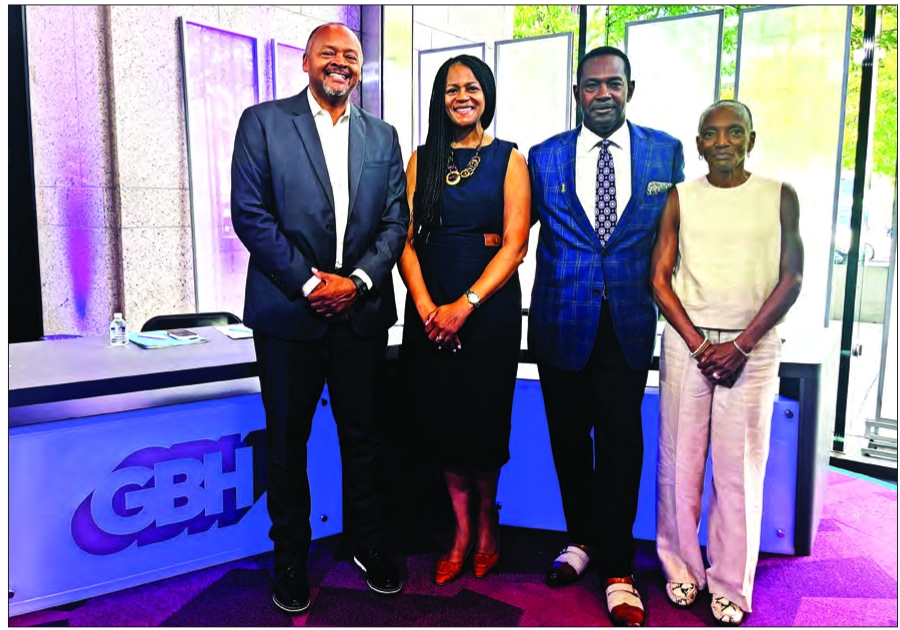
Amplifies guests Michael Curry, President and CEO of the MassLeague of
Community Health Centers, Dr. Bisola Ojikutu, Boston Commissioner of
Public Health; and Dr. Thea James, VP of Mission at Boston Medical
Center flank Bay State Banner CEO, Ron Mitchell.
In the three miles between Back Bay and Roxbury, there is a 23- year difference in life expectancy — due in large part to economic, racial and health disparities.
During a September 10 forum, a continuation of GBH Amplifies the Bay State Banner, local health care providers and professionals said these phenomenons and social determinations of health are intrinsically intertwined.
The panel featured Dr. Bisola Ojikutu, executive director of the Boston Public Health Commission; Dr. Thea James, chief medical officer at Boston Medical Center; and Michael Curry, president of the Massachusetts League of Community Health Centers, a non-profit. Banner publisher Ron Mitchell moderated the forum as the leaders discussed what can be done to address the disparities.
Health care providers are not always equipped to address patients whose issues stem from broader inequities. James, who oversees BMC’s Health Equity Accelerator — an initiative aimed at eliminating differences in health outcomes — said she frequently saw patients return with the same conditions she had treated just weeks earlier. Often, she found, their health problems could not be resolved with medication alone because the underlying causes were economic.
“We’re telling [patients]: pay for your medications, pay for your prescriptions, get on three buses and go to another neighborhood where there is healthier food,” James said. “Instead of using your limited resources to pay for your rent, to put food on your family’s table, pay your utilities.”
For a patient already struggling to afford basic necessities, that advice is “irrational,” James said.
Hospitals like the BMC are trying to address these issues by categorizing employment and housing as health needs, too. After the hospital invested approximately $6.5 million into housing and supportive services, mental health readmissions among their most frequent patients fell by about 78%, while the cost of their care dropped about 46%, James said.
James
described those interventions as offering patients a “value
proposition” — something that materially improves their lives rather
than asking them to spend their resources on short-term solutions.
“Their
outcomes get better,” she added. “It breaks these perpetual cycles, and
you can put them on a course to sustain stability.”
The
health disparities across Boston aren’t due to intrinsic gaps in
wellness, the panelists explained; rather, they’re driven by a myriad of
environmental and economic factors.
“Only
20% of our health status can be attributed to the care we get; 80% is
upstream,” Curry said in an interview with the Banner. “It is [the]
environment, social conditions, poverty and racism.”
For
example, properties in historically Black and brown neighborhoods have
been undervalued, limiting homeowners’ ability to build wealth and
contributing to disparities in school funding, job opportunities and
economic mobility. Decades of redlining and disinvestment have also
created food deserts — areas with
limited access to grocery stores and other sources of fresh food — which
directly impact residents’ long-term health.
The panel also examined disparities within maternal health.
Black
women nationwide are up to three times more likely to die in childbirth
than white women, Ojikutu pointed out during the panel, and in cases of
severe maternal complications such as bleeding and hypertension, Black
women’s reports of pain are often dismissed by health care providers.
BMC
identified one such disparity in its own maternal care: physicians were
taking longer to deliver babies for Black and Latina patients
experiencing complications. The hospital responded by requiring
clinicians to make critical decisions within a specified time period,
James said, which quickly helped ameliorate the trend.
In
a statement to the Banner, Ojikutu wrote that “health is shaped far
beyond the walls of a hospital or doctor’s office” — rather, it starts
with the city.
“Health
equity is not a standalone goal or the responsibility of the health
department alone,” Ojikutu wrote. “It must be built into every policy
and every decision a city makes. That is how cities create the
conditions in which everyone has a fair opportunity to be healthy.”
Despite
the persistence of the disparities, James said she believes
Massachusetts has the infrastructure and ability to narrow them.
“I think for sure we will close that life expectancy gap,” James said. “We just have to be intentional and go for it.”