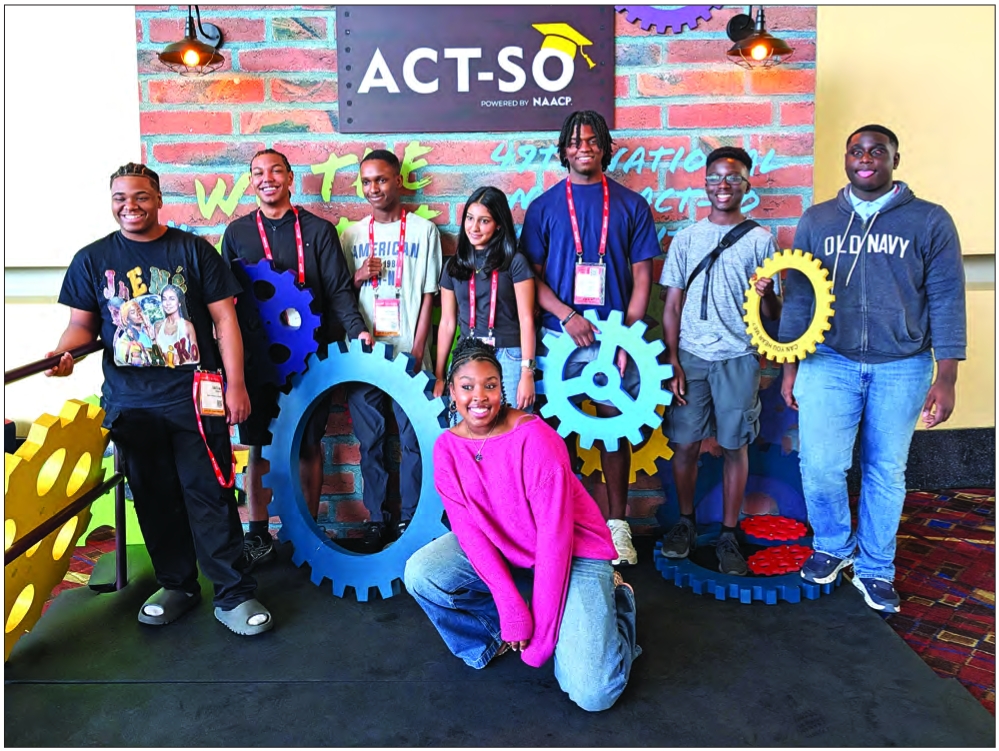
ACT-SO Boston-Students: (front kneeling) Katherine Shaw; (standing from left) Jacob Roach, Stephen Yancey, Ifeanyi Onwunaka, Myda Gilani, Kenneth Foster, Micah McCleary and Nathan Pierre. 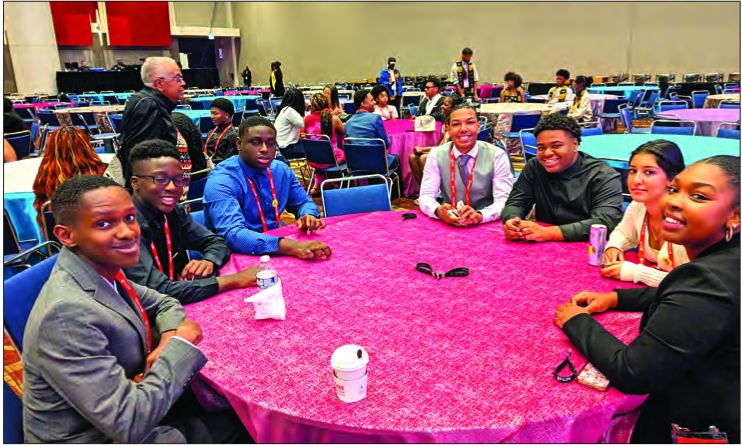
Boston-Branch Act-So awardees: (From left) Ifeanyi Onwunaka (AI Computer Science), Micah McCleary (Instrumental Classical), Nathan Pierre (Physics), Stephen Yancey (Entrepreneurship), Jacob Roach (Vocal Contemporary), Myda Gilani (Sculpture), Katherine Shaw (Short Story).
For nearly 50 years, the NAACP has opened doors for high school students across the country through the Afro-Academic, Cultural, Technological and Scientific Olympics (ACT-SO) showcase. This year, several local students were honored locally and nationally for their innovations in the year-long program and culminating competition.
The story begins at local NAACP chapters, where students originally present projects to their community. Of the many Boston-based students who participated, eight won gold locally and two won gold nationally, Nathan Pierre and Stephen Yancey for Physics and Entrepreneurship, respectively.
About a year ago, Yancey grew concerned with the wealth gap between Black and white families after a period of research.
According to the Federal Reserve Bank of Boston, the current average net wealth for African American families in the Greater Boston area is $7,800, yet it is $549,200 for white families. To address this disparity, the Rivers School senior built Augera, a program that aims to equip youth of color with financial literacy in an engaging format. He developed three apps with the help of AI that serve as an online “ecosystem,” blending games, quizzes, and scrolling features with the goal of informing users.
“The attention span right now has really depleted versus 10 years ago. We wanted to create something that would keep students engaged while also teaching valuable lessons,” he said.
Among Yancey’s friends, he’s noticed that few save and many remain uninformed of useful financial terminology. Soon, he will begin advertising Augera to the public via social media, in order to reduce the wealth gap.
“My parents grew up in Boston in an unwealthy area … Some of [my friends] have under $10 in their accounts, since they’ve never been taught what to do with their money. It’s important to teach youth early so that they don’t go into their 30s or 40s not knowing what to do,” Yancey said. “We want everybody to have access to the program, but it’s more aimed at youth of color because we want to close the wealth gap.”
Ifeanyi Onwunaka’s project also came about through observation. The senior at North Quincy High School started playing chess through his middle school chess club. As he grew to love the game, he became increasingly fascinated with AI’s superiority to human chess players. In the realm of chess, AI is essentially infallible due to its ability to predict many moves in advance.
AI’s remarkable capabilities when it comes to chess contrast its shortcomings in other, more serviceable domains, such as medicine, due to its tendency to hallucinate, or dispense incorrect information.
“‘What if we can make AIs as reliable and strong [in other domains]?’ We want to make sure that AIs are as reliable as possible if we’re going to see them in high-stakes fields in the future,” said Owunaka. “Hallucinations are probably one of the biggest limitations that AI has to this day.”
For his project, which won the local honor for Artificial Intelligence and Computer Science, Onwunaka asked three commonly used AI tools — ChatGPT, Google Gemini and Deep-Seek — the same 60 questions across numerous categories, totaling the number of hallucinations.
Owunaka recalls asking each AI when Shakespeare’s Romeo and Juliet was published. ChatGPT, the most error-prone of all three, responded with an entirely incorrect time frame. Gemini was the most consistently accurate.
Onwunaka articulated findings to a panel of judges to heighten public awareness of the frequency of AI hallucinations, as “many people I ask don’t actually know what a hallucination is.”
Onwunaka attended one presentation and evaluation session in Boston, where he was the sole contestant in his division. He won gold and then advanced to Chicago. Though he didn’t take home the gold for the field on the national stage, Onwunaka walked away from ACT-SO with a sense of purpose.
“Your passion might just get you a medal,” he said. “I didn’t know my love for Chess AIs would come all this way, but here we are. Just follow your passion and stay motivated.”
Myda Gilani, the local Sculpture division winner and a sophomore at the Rivers School, created five plates through a foundational ceramics course at school. The plates had broader messaging around poverty and the global hunger crisis, which she felt connected to as someone who has experienced not having access to food while fasting for Ramadan.
“Growing up as a Pakistani Muslim, I’d feel lonely sometimes because during our holy month of Ramadan, I was always the only one fasting at school. I was always the one sitting at the lunch table, not eating. When I’d get home, my mom would make this huge buffet of food. Fasting was my biggest tie to creating this piece, because it showed me two different worlds: a privileged world at home when I’d break my fast, and then one deprived of food throughout the whole day. Some people are unwillingly in that situation,” Gilani said.
“It created this sense of urgency in me to create something personal and something connected to my culture.”
During her presentation, Gilani explained the significance of her ceramic plates to a panel of judges. She sculpted a small well in the center of each plate, which she painted white, to convey an “emptiness” — a lack of food and resources. She painted the rim of each plate a different color, denoting the variety of circumstances through which someone may have lost access to resources.
Gilani left Chicago inspired, having competed against about 45 sculptors who had also won gold in their local divisions for woven work and facial pieces.
“It was super intimidating, but such a great experience because it was so cool to see how people all across the United States have the same interests as me.”