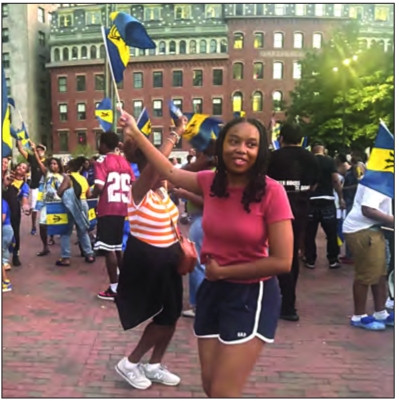
A young woman celebrates Barbados at the Oistins party on City Hall Plaza. 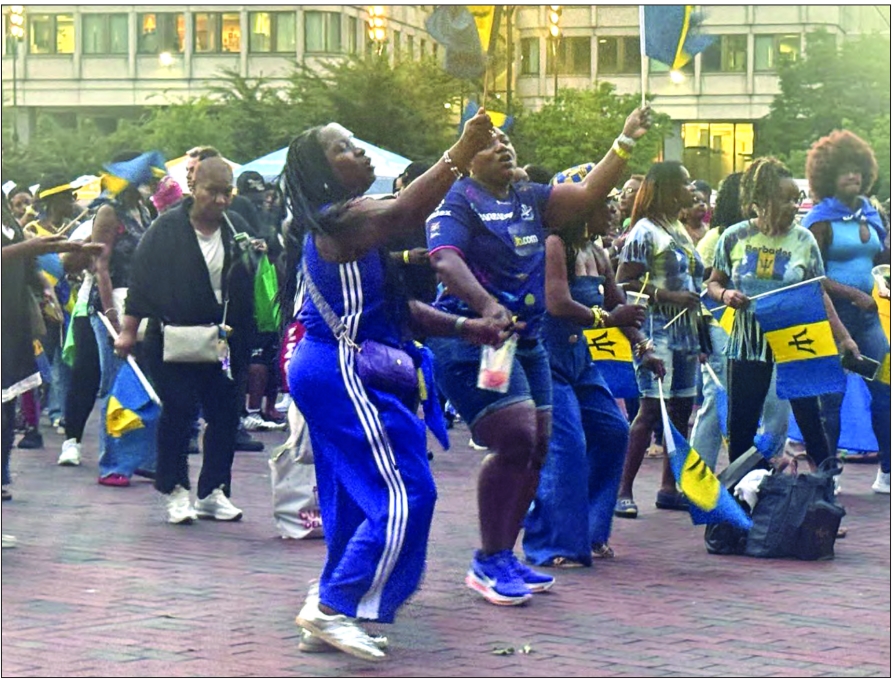
The Boston Oistins party grew out of a Friday celebration on the island of Barbados where everyone can dance, drink, and socialize.
By 8 p.m. on September 4, the lines for fish stretched across Boston City Hall Plaza, but few people seemed eager to leave. For five hours, a stretch of downtown had taken on some of the spirit of a Friday night more than 2,000 miles south.
Families settled into lawn chairs. Vendors sold their wares. Children ran between play areas and face-painting stations. Barbados flags rose above the crowd while a DJ sent soca and Caribbean rhythms across the plaza.
People danced near the stage, gathered over dominoes and waited for plates piled with fish, macaroni pie and plantains. A stilt walker moved above the crowd, and nearby, adults sampled Barbadian rum and cocktails inside a 21-and-older section.
An estimated 4,000 people attended Boston’s first Oistins Fish Fry according to Tenisha Holder, senior business development officer for Barbados Tourism Marketing Inc., or BTMI. Bianca Rose, the city’s Caribbean cultural advisor, confirmed the estimate and said more than 30 vendors participated.
The free event sought to reproduce one of Barbados’ signature cultural experiences while connecting the island with its diaspora in New England.
“It definitely exceeded expectations,” Holder said of the partnership among the city of Boston, BTMI and the Consulate General of Barbados in New York.
Organizers knew Boston had a substantial Caribbean community, she said, but the event fell around Labor Day weekend, when competing travel and family plans made turnout difficult to predict. Nearly 4,700 people RSVP’d in advance.
Boston has one of the more established Barbadian communities in the United States. In 2023, the city reported 2,595 Barbados-born residents in Boston and 4,704 statewide, meaning more than half of the state’s foreign-born Barbadian population lived in the city.
For generations of Black Barbadians and their descendants, the community is larger than the foreign-born count alone because census birthplace figures do not include U.S.-born children and grandchildren of Bajan immigrants.
Rose said the event differed from a traditional downtown concert because people arrived expecting the atmosphere of Oistins itself: food, music and room to linger.
“They’re just vibing,” she said while looking across the plaza shortly before 8 p.m. “Nobody’s even trying to leave.”
Some Barbadians traveled into the city from elsewhere in Massachusetts. One man she met had come from Hanover after seeing the Barbados flag.
“What? I can’t miss this. Are you kidding me?” Rose recalled him telling her.
That sense of recognition mattered to Cynthia Grant Carter of Dorchester, who was attending for the first time.
“It’s my first time here and I love seeing people having fun, laughing, and embracing their cultural identity,” Grant Carter said.
On Barbados, Oistins is not simply the name of a party. It is a historic fishing town in Christ Church parish on the island’s south coast, where fishing boats still bring their catches ashore.
The Barbados Fisheries Division states Barbados’ government opened a purpose-built fish market in Oistins in 1950 and a modern fisheries complex in 1983, part of the town’s long development as one of the island’s major fishing centers.
Today, the fish market sits beside Oistins Bay Gardens, where food vendors operate throughout the week. Friday is the celebrated night: locals and visitors crowd the open-air area to eat, drink, dance, listen to music and spend hours socializing. Barbados’ tourism agency describes the evening as a mix of karaoke, dancing and food, with vendors grilling mahi-mahi, tuna, snapper and barracuda, sometimes alongside lobster.
The Fish Fry grew alongside the fishing community and became an increasingly important tourism draw after the Oistins Fish Market was redeveloped in the 1980s. Barbados planning documents later identified the Fish Fry as a significant community tourism attraction.
It is distinct from the annual Oistins Fish Festival, an Easter tradition dating to 1977 that celebrates the island’s fishing industry and fisherfolk.
Holder said that when visitors ask Barbadians where they should go before leaving the island, Oistins is nearly always among the answers.
“It’s become a place where visitors, locals, that’s where they come and they come together on Friday,” she said. “It’s just a true expression of all things Barbados.”
The Boston version offered that expression in abundance.
Menus included snapper, kingfish, flying fish and mahi-mahi, also known in Barbados as dolphin fish, as well as fish cakes, chicken stew, curry goat and oxtail. Sides and sweets included cou-cou, rice and peas, plantains, macaroni pie, cassava pone, sweetbread and Bajan cake loaf.
Barbadian food reflects centuries of African, British, Indian and other influences. The country’s national dish is cou-cou and flying fish. Cou-cou is traditionally made with cornmeal and okra, while flying fish is commonly seasoned and stewed with ingredients including onion, garlic, thyme, tomato and pepper. Fish cakes made with salted cod are another everyday Bajan staple.
At the weekly Oistins Fish Fry, fish is commonly grilled or fried and served with sides such as macaroni pie, sweet potato, rice, coleslaw and plantain.
Food was also part of the evening’s larger tourism pitch. Jet-Blue, which operates service between Boston and Barbados, contributed four travel certificates for a raffle, Holder said, and promoted a special $149 one-way fare through Sept. 6 as part of the event campaign.
BTMI also used the evening to promote the Barbados Food and Rum Festival, scheduled for November 5-8. The four-day culinary celebration will feature island chefs, rum, cocktails and events ranging from Oistins-style food to more formal dining experiences.
“The real deal is always going to be so much better,” Holder said, encouraging attendees to visit Barbados itself.
The diaspora has built institutions of its own. United Barbadians in Massachusetts, or UBIM, was formed with support from the Barbados Consulate in New York ahead of Barbados’ 50th anniversary of independence in 2016. The organization now hosts cultural programs, an annual independence gala, flag-raising ceremonies and events including its own Oistins Night and Barbados Festival Day.
The City Hall event also offered Caribbean entrepreneurs a prominent downtown platform.
Althea Blackford, founder of Boston Caribbean Fashion Week, used her vendor space to promote the organization’s 13th annual event, scheduled for October 14-17. Blackford, whose mother is Barbadian and father is Jamaican, said gatherings such as the Fish Fry create opportunities both to promote individual organizations and to connect across island communities.
“It’s a great opportunity to participate in these events and get the word out of our event and also be amongst the Caribbeans of all of the islands,” she said.
Boston followed earlier Oistins-inspired events in New York.
Holder said BTMI began planning the Boston edition around April after the success of the New York model, working with the Consulate General, city officials and local associations to recruit vendors. This year’s Brooklyn Fish Fry was held June 5 during Caribbean Week and also drew roughly 4,000 people, she said. A Toronto edition in Sankofa Square took place simultaneously with Boston’s event.
Consul General Lorenzo Harewood did not respond to emailed questions before publication. But his previous comments about Boston offer a window into the consulate’s broader strategy.
After a 2025 Barbadian diaspora gathering in the city, Harewood praised an event that brought together Bajan food, music and businesses, describing it as a showcase of the island’s culture and entrepreneurial community.
Friday’s Fish Fry brought those elements together on a much larger stage.
Holder said what impressed her most was not simply the size of the crowd, but what people did once they arrived.
“There were very few people that just came to pass through to see,” she said. “People came and they stayed.”