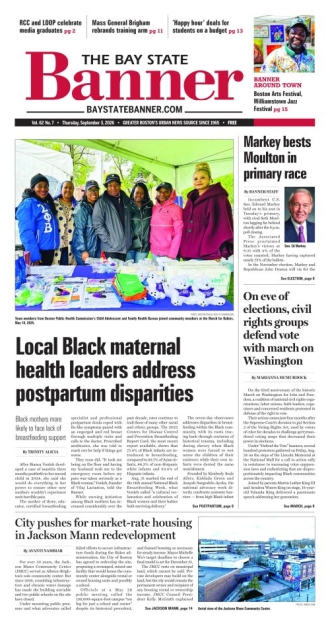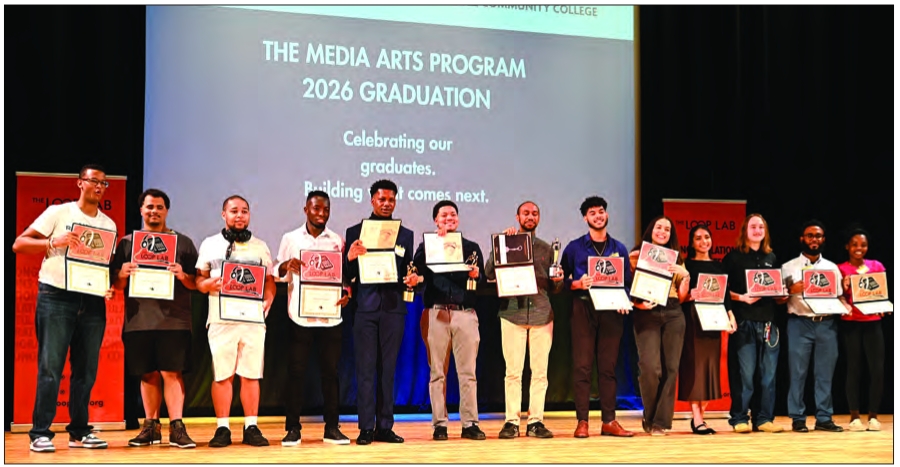
Loop Lab students display their diplomas at the Media Arts Program graduation ceremony.As media graduates were honored on the evening of Aug. 27, Roxbury Community College (RCC) and The Loop Lab, a local tech and media workforce development nonprofit, unveiled a partnership that will begin in spring 2027.
The AI Civic Corps apprenticeship program was formed with the intention of creating a pathway for students in the RCC consortium to qualify for jobs in artificial intelligence, as demand is high for workers with experience in the field.
As the job market radically changes in the wake of emerging technology, community institutions like RCC and The Loop Lab are beginning to evolve with the market, ensuring that their courses and career-preparation remain relevant.
“AI is going to change the way we create, work and solve problems. Our responsibility as an institution is not simply to react to these changes, but to make sure that our students and communities can shape them too,” said Dr. Jonathan Jefferson, RCC president.
“It’s about creating pathways for people who have historically been left out of the future. [We want to make sure] the next generation of leaders in technology includes people from Roxbury, Boston and communities across Massachusetts.”
The 15-week program will provide participants with relevant knowledge in the classroom, where students will increase fluency, study ethics, hone AI literacy and work experience at various job sites, where students will apply their new skills to real-world issues. Participants will receive college credit and a formal certificate upon completion.
An August 2026 study from Lightcast, a global labor market data provider, revealed that out of 1.3 billion job listings analyzed, postings that sought AI-proficient workers offered 28% higher salaries than postings that didn’t.
Rev. Christopher Hope, founder and executive director of The Loop Lab, says the future of AI is not predetermined.
“Every human being, every person that is contributing towards the future is shaping it in real time,” he said. “We’re opening opportunities to contribute to the future to folks that would otherwise be left behind.”
The distinct assets each institution will bring to the AI Civic Corps “will create something greater than either organization can do alone,” Jefferson said. RCC’s roots in the Greater Roxbury community and its capacity to dispense formal degrees, and The Loop Lab’s experience connecting youth to employment opportunities will be combined to initially serve seven to 10 students. Down the road, The Loop Lab hopes to expand similar local partnerships with more community colleges, such as Lawrence, Dalton and Springfield.
Outside of the AI Civic Corps, RCC does not offer specific courses dedicated to instruction in AI. Instead, students build foundational knowledge of AI through general STEM classes. The college additionally hosts annual “Hack-athons,” which are opportunities for students to get hands-on experience using and creating AI models through lighthearted intercollegiate competition.
The planning process for the AI Civic Corps, which has been in the works for a year, was developed after a thorough evaluation of student demand and help building the curriculum from various certification companies.
A notable project that will be completed through the program for public benefit is research using an AI tool that can aggregate typically inaccessible data.
“There’s so many resources online, and you can use them [with AI help] to determine how the government’s policies, AI and the job market are affecting people,” said Marlon Orosco, The Loop Lab’s senior instructor.
The AI program was announced at a graduation ceremony for Loop Lab students in the media arts program. By the program’s end, the 14 graduates had launched podcasts, taken photos and created short films — a few of which had received national accolades.
When one graduate took the stage to receive her certificate, she danced between handshakes with her mentors as the audience cheered her on vivaciously.
Hope has observed that “talent is everywhere, but opportunity is not.”
The Loop Lab was created with leveling the playing field in mind. Participants are paid by the hour to take part in its courses so they don’t need to choose between financial stability and education.
Graduate Gerson Lantigua initially connected with The Loop Lab in January due to his interest in media. His favorite project was directing the short film — his was about the recovery process after addiction.
“I bit off way more than I could chew for my video, so I had to crunch overtime. I lost a lot of sleep, which was bad, but the whole program was fun. We got to explore our creativity a lot, and I’ve never done anything like it before,” Lantigua said.
When students graduate from Loop Lab, they are offered a scholarship at Lesley University, where they may further their education in their interest of choice. Many students take advantage of this opportunity, while others enter the workforce directly.
“We believe that education should open doors, but opening doors is not enough,” Jefferson said.
“We have to help students walk through that door, and then we have to ensure that they have the knowledge, experience, credentials, relationships and support they need to succeed once they get there.”