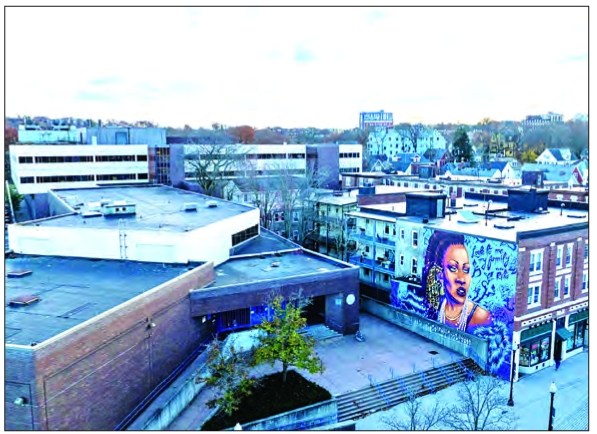
Aerial view of the Jackson Mann Community Center. 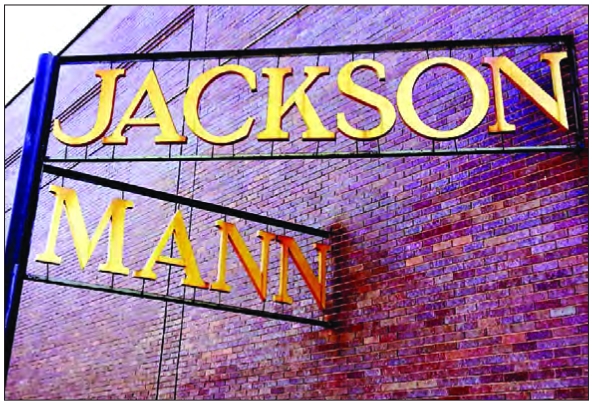
Crumbling infrastructure and chronic water damage has made the Jackson Mann building unviable.
For over 50 years, the Jackson Mann Community Center (JMCC) served as Allston-Brighton’s sole community center. But since 2019, crumbling infrastructure and chronic water damage has made the building unviable and two public schools on the site have closed.
Under mounting public pressure and what advocates called failed efforts to secure infrastructure funds during the Biden administration, the City of Boston has agreed to redevelop the site, proposing a revamped, mixed-use facility that would house the community center alongside rental or owned housing units and possibly a school.
Officials at a May 29 public meeting called the 130,000-square-foot campus “too big for just a school and center” despite its historical precedent, and framed housing as necessary for steady income. Mayor Michelle Wu’s target deadline to choose a final model is set for December 31.
The JMCC rests on municipal land, which cannot be sold. Private developers may build on the land, but the city would remain the permanent owner and recipient of any housing rental or ownership income. JMCC Council President Kelly McGrath explained that profits would be directed into maintaining low-income units and the community center.
Critics have noted that the wealthier North End, with only 10,635 residents, secured a new $110 million community center, its second, without a housing mandate. Allston-Brighton, home to about 87,679 residents, was promised just $10 million for the JMCC, which will require demolition and full reconstruction.
“The places where people have more money get more money. We get the crumbs,” said resident Tara Tillery. She added that if the JMCC were to host both market-rate housing and a school, children — particularly Black, brown and disabled kids — may be unwelcome near private units, forced to “tiptoe” for fear of noise complaints.
Housing organizer Nikhil Dasgupta says construction best practices, such as separate entrances and soundproofing, can maintain privacy and reduce friction.
The City of Boston allocated capital repair funds to the JMCC in 2001 and 2011. The money sat unspent by City Hall, allowing the building to decay. Housing expert and Allston resident Lizzie Torres branded the situation “a self-induced emergency from hitting snooze for way too many years.”
City representatives originally presented plans for the proposed renewal during a May 29 public meeting. Dasgupta called the presentation “dense” and “jargony.”
Despite advocates’ requests for simpler materials, an Aug. 12 slideshow maintained confusing “testfits,” typically used by specialized developers, and added statistical data on declining school enrollment to argue against adding a new school.
Responses from an ensuing public opinion survey indicate many residents misinterpreted the slideshow contents, or lacked the context to form an opinion.
Deputy Chief of Operations for the City of Boston Trish Cafferky said the first survey met its target of 0.5% of the neighborhood — only about 400 responses representing 80,000 residents. Visits by the Banner to affordable housing developments revealed that many locals remain unaware of the project.
Dasgupta suggested falling enrollment numbers are based on a self-fulfilling prophecy: when a city systematically removes neighborhood schools, parents with children are motivated to leave the area. This flight reduces enrollment, which then excuses further school closures.
Advocates also say the city underinvests in Allston-Brighton because it’s seen as a “transient” student area. However, this lack of investment in long-term infrastructure discourages graduates and young parents from staying in the area.
Dasgupta argues that the city should build a variety of housing so that residents aren’t “pigeonholed” into living situations that contradict their lifestyles. He said many families would love to live next to a lively community hub and believes Boston should “build the imperfect” rather than reject affordable housing entirely.
Survey results showed 171 residents favored the old model of a center and school, with no housing. The survey also showed that 190 wanted housing with no school and another cohort wanted a mix of all the above.
Despite a sizable majority of respondents requesting a school, Cafferky stated that they were “leaning more towards” a housing-centered model.
Among housing supporters, most preferred affordable rentals or homeownership. The city’s presentation, however, emphasized market-rate units to generate income.
When asked why the city would keep inviting community feedback only to steer respondents toward its preexisting preferred model, Torres suggested, “They are afraid to make a decision.”
Dasgupta also expressed uncertainty over whether the feedback requests are intended for the city to “validate decisions that it’s already kind of made internally.” The city’s third survey closes Sept. 10 and another public meeting is planned for the fall.