

Conan Harris, CoJo Partners.
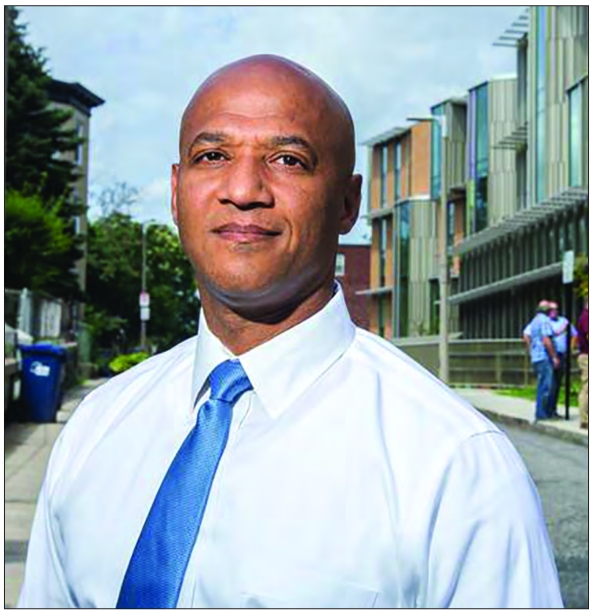
John Barros is the Executive Director of the Massachusetts Convention Center.
In July, the developers, USPB JV LLC and Springfield Tower Square, submitted a lawsuit against the Division of Capital Asset Management & Maintenance (DCAMM) to stop their chosen winning bidder, minority-owned Liberty Junction, from moving forward on the redevelopment project, The Journal reports.
The Journal also reports that in their lawsuit, USPB JV LLC and Springfield Tower Square said that there could be a conflict of interest, as they had a relationship with John Barros, who is the executive director of the Massachusetts Convention Center, who was chosen to be a member of the courthouse redevelopment in his other role of being the head developer for CoJo Partners.
After this lawsuit was filed, Barros took himself out of Liberty Junction, The Journal adds. This decision was Court records show that the developers tried to prove “the burden of showing a likelihood of success on the merits; that it will suffer irreparable harm from the denial of the injunction; and that, in light of the moving party’s likelihood of success on the merits, the risk of irreparable harm to the moving party outweighs the potential harm to the nonmoving party in granting the injunction.”
The Business Journal also reports that a recent ruling from Justice of the Superior Court David Hodge decided that the developers did not present adequate reasons for halting the Liberty Junction project.
In court records, Hodge also said that when it came to any potential conflict of interest when it came to Burros, that “there is no evidence in the voluminous provision…to the contrary, Barros went above and beyond in ascertaining and then fulfilling his obligations…”
“Even before he became a state employee, Barros sought the advice of SEC’s general counsel and of MCCA’s general counsel with regard to any potential conflict of interest arising out of his interest in Liberty Junction and its proposal for the courthouse project,” he added.
One of the development members of Liberty Junction, Conan Harris spoke about their recent legal victory.
“I think it’s justice. The word that comes to mind is justice. That’s the word that comes to mind immediately. What we’ve always known is it’s been a fair process, a long process, but a fair one and we just put our best foot forward by putting together the best project possible to be able to mitigate harm that existed in the courthouse,” he said.
He also said that he wanted to make sure that individuals can now focus their attention on the physical condition of the courthouse.
“The story that’s not always told is the courthouse is a sick building, and people would get sick to the point where…a person had passed away through the sickness of that building, all the way to the point where the state was ringing [the] alarm button to get this building redone,” he said.
According to The Business West website, the Liberty Junction Team was chosen to build the new Roderick L. Ireland Regional Justice Center (RJC) in Springfield, after “a competitive process led by the Trial Court, in consultation with DCAMM on July 2.”
Harris also spoke about what prompted his development group to put in their bid for the Springfield Courthouse.
“The goal in development is to find projects that match - not just from a skill perspective, but from a responsible perspective. One of the things that we realized very quickly in that part of the Commonwealth…and throughout the state [is that] we don’t see many minority construction companies, minority developments, being part owners of some of the larger projects. So it was focused on mission [and] because we realized that it was a sick building,” he said.
The Junction team plans to reconstruct 125 Liberty St. in downtown Springfield into the future home of the Springfield RJC. While the new building will keep the Roderick L. Ireland name, it will be a replacement for an outdated building “with modern, safe, accessible and sustainable court facilities for employees, court users and visitors throughout the region, The Business West website reports.
The location has “convenient access to public transportation, including Union Station and 21 bus lines, as well as regional highways and nearby parking, making it highly accessible for those needing to visit the court (DCAMM noted) ,” according to The Business West.
The Business West also reports that it was decided by the DCAMM and Trial Court to use “a long-term lease for this project,” as they want to deliver this new building as soon as they can.
An initial lease term of 40 years was approved with two optional 10 year extensions, which would allow tenancy for up to 60 years. Since the team has been chosen, DCAMM will work with them to implement the lease, The Business West reports.
The Business West reports that the building should be ready for use in 2030, as it would be a longer time for the project if it went “through traditional state construction due to capital plan funding constraints. Since the project is not publicly owned, it will create new notable property taxes for the city of Springfield.
Despite the recent ruling, USPB JV LLC and Springfield Tower Square said in a statement to The Boston Business Journal that they will appeal the court’s decision.
“We remain fully committed to that goal. Our confidence is complete, and our commitment to this community is unwavering, which is why we will continue to pursue every available legal avenue, completely and without hesitation,” the developers, Jeb Balise and Dinesh Patel, said.
In response, Harris said that everybody has the right to appeal a court decision.
“I think that’s the natural right of anybody. The plan is always to be consistent, to be responsive to the court’s demand, and show the fairness, the seriousness, and the importance of the project,” he said.
“The goal is to be able to build something in Western Massachusetts that stops people from being sick and harmed by being in the building. Our goal is to be able to fulfill the obligation, making sure people are less sick and less harm is being done to the residents of Massachusetts.”