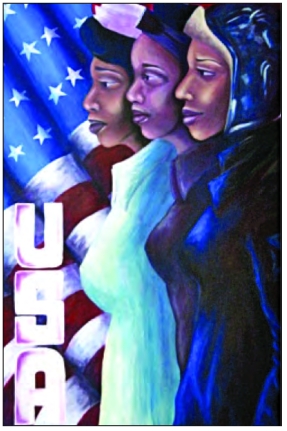
Potential veterans’ stamp design 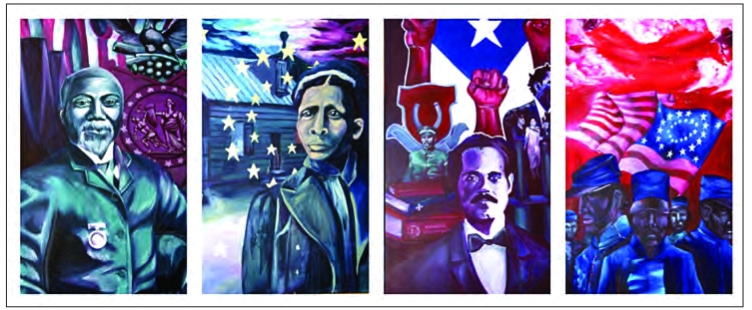
A sampling of stamp designs created by members of a youth art program for the 2011 art exhibition “Triumph, Unsung Heroes.”
African American veterans have faced documented systemic discrimination, from the unequal distribution of housing loans and access to higher education and the denial of treatment for post-traumatic stress disorder, a 2017 report from the Department of Veterans Affairs revealed.
One local Black veteran is working to acknowledge that reality. Haywood Fennell, who founded the Tri-Ad Veterans League and served in the Vietnam War in a noncombat role and now lives in the South End, has led an effort to launch a commemorative postage stamp series recognizing African American veterans’ contributions for the past decade.
“It’s a very significant project because the stamps will go all over the United States,” Fennell said.
“This will empower our veterans by showing them that they belong and that they’re appreciated.”
The 13 proposed stamps include individual portraits of notable veterans and nurses from different wars and conflicts. Many of the paintings feature the American flag or stars as a backdrop while maintaining dark color palettes.
The Black Heritage postage stamp series is a precedent for Fennell’s project. It took three years to conceptualize, with the series of 49 stamps launching in 1978. One Black pioneer is selected annually to be featured on the stamps, the most recent being 18th-century poet Phillis Wheatley.
Fennell’s designs were painted by teenage members of a youth art program for the 2011 art exhibition “Triumph, Unsung Heroes,” which was displayed at the Worcester Public Library. The artists were mentored by visual artist and Harvard University doctoral candidate Stephen Hamilton.
“While making the paintings, we heavily considered how Black people have contributed to the building of our nation, and we tried to highlight how complex those stories and experiences were,” Hamilton said.
“Image making and creative work can be a tool for education, since humans are moved by images. Sharing ideas through images is very useful for teaching nuanced, complicated understandings of history.”
The project was born out of the pain endured by Fennell. He endured demeaning treatment by colleagues and superiors during his six years in the army. Often addressed by derogatory names, he also witnessed underqualified white peers get promoted over him, which eroded his understanding of democracy.
To cope with the pain, he turned to substance use, which resulted in multiple incarcerations “My military career was a contributing factor to the way I behaved when I got out. It was oppressive, deceptive and insensitive to who I was as a person,” he said. “Democracy for me meant that being born an American, I would have access to equal opportunities in the military. That wasn’t true.”
Struggling with addiction and “desperate,” Fennell was “unable to do anything but pray to God to help me get and stay clean. And God delivered.” After a period of sobriety, he turned to activism.
In addition to his stamp series, Fennell’s crusade against discrimination toward Black veterans has included speaking in government spaces and prisons and authoring 12 plays and four books to educate the public.
To launch a stamp series, protocol requires Fennell to receive legislative approval to present his stamps to the United States Postal Service (USPS), as it is a quasi-federal agency.
He is now working more directly with legislators, seeking their support and an introduction to the USPS. Fennell aims to introduce the project by Nov. 5, in time for a press conference with “Beyond the Uniform,” an advocacy group that aims to educate the public about Black veterans’ service and valor.
Boston City Councilor Ed Flynn sponsored a resolution in February that passed unanimously in the City Council in support of Fennell’s stamps.
“I’ve seen Black veterans unsupported when they’ve returned from service. Historically, Black veterans haven’t been respected for their service as other veterans have,” Flynn said.
“Having a postage stamp to celebrate the contributions of Black veterans is a small way to honor their contributions and sacrifices for our nation.”
When U.S. Rep. James McGovern saw the exhibition, he recommended turning it into a stamp series and offered his support, which gave Fennell momentum.
“We hope the impact is to change the world’s thinking. People used to say that Black veterans had tails — that we were cowards and things like that,” Fennell said. “We proved all that wrong when we fought for this nation with our valor and gallantry. We want the entire United States to know that, to know who we are and what we did. The stamp is just a symbol of our greatness as a people.”
Klare Shaw, a friend of Fennell’s and an interested community member, has attended many rallies and events hosted by the Tri-Ad Veterans League. She corroborates Fennell’s and Flynn’s perspectives, adding that the Pentagon has promulgated a harmful narrative of what veterans look like: “a strapping, white, Midwestern son.” This excludes many groups, including women, transgender folk and people of color.
“If you know your Black history, you’re aware that Black people have made contributions to the American armed forces going back to the Revolutionary War,” Shaw said. “The people this country has often treated the worst and made the least accommodations for have been very patriotic and have fought for freedom for centuries.”